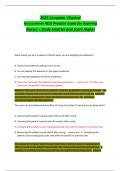
2025 Complete Physical
Assessment HESI Practice Exam for Aspiring
Nurses – Study Smarter and Score Higher
What should you do if a patient is ticklish when you are palpating the abdomen?
A. Distract the patient by talking to him or her.
B. Do not palpate the abdomen in the upper quadrants.
C. Do only deep palpation of all four quadrants.
D. Place your hand over the patient's hand during palpation. - - correct ans- -D. Place your
hand over the patient's hand during palpation.
Rationale: Place your hand over the patient's hand during palpation, leaving your fingers free
to palpate. Palpate with a firm hand or place your hand over the patient's during palpation.
All quadrants are palpated for a thorough abdominal assessment. The abdominal
assessment begins with light palpation.
The nurse can best determine the effect of crying on a patient's apical pulse by doing what?
A. Measuring the patient's apical pulse before and after crying
B. Assessing the patient's apical pulse 30 minutes after crying
C. Comparing the patient's post-crying apical pulse rate with her baseline or previous rate
D. Measuring the patient's pulse deficit after crying - - correct ans- -C. Comparing the
patient's post-crying apical pulse rate with her baseline or previous rate
The comparison of apical pulse rates at these times is the best means of evaluating the
effect of crying on the patient's apical pulse rate. These values would be available data to
compare. It is unlikely that the nurse will have the opportunity to measure the patient's
,apical pulse before and after crying. The time interval of 30 minutes is too long to effectively
assess the effect of the crying on the apical pulse. Pulse deficit indicates alterations in
cardiac output, not the effect of the emotional reaction.
How often should normal bowel sounds be heard in each quadrant of the abdomen?
A. 5-35 times per minute
B. Less than 5 times per minute
C. 15-20 times per minute
D. 20-40 times per minute - - correct ans- -A. 5-35 times per minute
Normal bowel sounds should be heard 5-35 times per minute. Bowel sounds reflect
peristalsis and should be heard irregularly
During a well-baby check for several 4-month-old infants, a nurse recognizes that which
infant needs further assessment of an abnormal finding? a. The infant who is unable to sit
independently
b. The infant whose head circumference and chest circumference are equal
c. The infant whose weight has doubled since birth
d. The infant whose length falls in the 90th percentile on growth charts - - correct ans- ANS:
B
Feedback
A This is not an expected motor skill for a 4-month-old; it is expected at 6 months of age.
B At four months of age, the head circumference should be larger than the chest
circumference.
C This is a normal finding; infants generally double their birth weight by age 4 to 5 months.
D This is not an abnormal finding, especially if weight is normal; the height of the parents
should also be considered.
,What is the correct order for abdominal assessment?
A. Inspection, palpation, auscultation, percussion
B. Inspection, auscultation, percussion, palpation
C. Auscultation, inspection, palpation, percussion
D. Palpation, inspection, auscultation, percussion - - correct ans- -B. Inspection, auscultation,
percussion, palpation
The correct order for abdominal assessment is inspection, auscultation, percussion,
palpation. Palpation is the last step in abdominal assessment. Auscultation follows
assessment because percussion and palpation can alter the frequency and intensity of bowel
sounds.
Which technique does a nurse use to assess hip location of a newborn?
a. With newborn's knees flexed, the nurse adducts the legs, then abducts them, moving
the knees apart and down to touch the table.
b. With the newborn supine, the nurse flexes and extends the hips, and then passively
moves each leg through internal and external rotation.
c. The nurse holds the newborn in a vertical position with the feet flat on the table and
palpates each hip for location.
d. With the newborn supine, the nurse measures the length of each leg from the
trochanter to the lateral malleolus (ankle). - - correct ans- -ANS: A
Feedback
A This describes the Barlow-Ortolani maneuver to assess hip location and determine
dislocation.
B This describes an incorrect technique.
C This describes an incorrect technique.
D This describes an incorrect technique.
, Which of the following is an important part of performing an abdominal assessment?
A. Completing the assessment as quickly as possible
B. Stopping the assessment if the patient has any tenderness
C. Explaining each step of the assessment to the patient
D. Having the patient breathe normally at all times - - correct ans- -C. Explaining each step of
the assessment to the patient
Explaining each step of the assessment demonstrates respect for the patient and allows the
patient to be informed of the assessment process. Abdominal assessment should be
performed in a thorough manner, not as quickly as possible. Complaints of tenderness from
the patient should be noted, and the complete abdominal assessment should be continued.
For most parts of the assessment, the patient will breathe normally. There are instances
when the patient will need to take a deep breath, such as when assessing the spleen and
gastric air bubble
Based on Mr. Kapur's report of increasingly frequent periods of dyspnea, dizziness, and
minor chest discomfort, what assessment should the nurse perform next?
Ask the client to stand and then recheck the blood pressure.
Assessment of the client for orthostatic hypotension is important, but another assessment
takes priority.
Place the client in a supine position and observe for orthopnea.
Assessment for orthopnea is important, but another assessment takes priority.
Measure the apical and radial pulse rates at the same time.
Assessment of the client for an apical-radial deficit is important, but another assessment
should be completed first.
Assessment HESI Practice Exam for Aspiring
Nurses – Study Smarter and Score Higher
What should you do if a patient is ticklish when you are palpating the abdomen?
A. Distract the patient by talking to him or her.
B. Do not palpate the abdomen in the upper quadrants.
C. Do only deep palpation of all four quadrants.
D. Place your hand over the patient's hand during palpation. - - correct ans- -D. Place your
hand over the patient's hand during palpation.
Rationale: Place your hand over the patient's hand during palpation, leaving your fingers free
to palpate. Palpate with a firm hand or place your hand over the patient's during palpation.
All quadrants are palpated for a thorough abdominal assessment. The abdominal
assessment begins with light palpation.
The nurse can best determine the effect of crying on a patient's apical pulse by doing what?
A. Measuring the patient's apical pulse before and after crying
B. Assessing the patient's apical pulse 30 minutes after crying
C. Comparing the patient's post-crying apical pulse rate with her baseline or previous rate
D. Measuring the patient's pulse deficit after crying - - correct ans- -C. Comparing the
patient's post-crying apical pulse rate with her baseline or previous rate
The comparison of apical pulse rates at these times is the best means of evaluating the
effect of crying on the patient's apical pulse rate. These values would be available data to
compare. It is unlikely that the nurse will have the opportunity to measure the patient's
,apical pulse before and after crying. The time interval of 30 minutes is too long to effectively
assess the effect of the crying on the apical pulse. Pulse deficit indicates alterations in
cardiac output, not the effect of the emotional reaction.
How often should normal bowel sounds be heard in each quadrant of the abdomen?
A. 5-35 times per minute
B. Less than 5 times per minute
C. 15-20 times per minute
D. 20-40 times per minute - - correct ans- -A. 5-35 times per minute
Normal bowel sounds should be heard 5-35 times per minute. Bowel sounds reflect
peristalsis and should be heard irregularly
During a well-baby check for several 4-month-old infants, a nurse recognizes that which
infant needs further assessment of an abnormal finding? a. The infant who is unable to sit
independently
b. The infant whose head circumference and chest circumference are equal
c. The infant whose weight has doubled since birth
d. The infant whose length falls in the 90th percentile on growth charts - - correct ans- ANS:
B
Feedback
A This is not an expected motor skill for a 4-month-old; it is expected at 6 months of age.
B At four months of age, the head circumference should be larger than the chest
circumference.
C This is a normal finding; infants generally double their birth weight by age 4 to 5 months.
D This is not an abnormal finding, especially if weight is normal; the height of the parents
should also be considered.
,What is the correct order for abdominal assessment?
A. Inspection, palpation, auscultation, percussion
B. Inspection, auscultation, percussion, palpation
C. Auscultation, inspection, palpation, percussion
D. Palpation, inspection, auscultation, percussion - - correct ans- -B. Inspection, auscultation,
percussion, palpation
The correct order for abdominal assessment is inspection, auscultation, percussion,
palpation. Palpation is the last step in abdominal assessment. Auscultation follows
assessment because percussion and palpation can alter the frequency and intensity of bowel
sounds.
Which technique does a nurse use to assess hip location of a newborn?
a. With newborn's knees flexed, the nurse adducts the legs, then abducts them, moving
the knees apart and down to touch the table.
b. With the newborn supine, the nurse flexes and extends the hips, and then passively
moves each leg through internal and external rotation.
c. The nurse holds the newborn in a vertical position with the feet flat on the table and
palpates each hip for location.
d. With the newborn supine, the nurse measures the length of each leg from the
trochanter to the lateral malleolus (ankle). - - correct ans- -ANS: A
Feedback
A This describes the Barlow-Ortolani maneuver to assess hip location and determine
dislocation.
B This describes an incorrect technique.
C This describes an incorrect technique.
D This describes an incorrect technique.
, Which of the following is an important part of performing an abdominal assessment?
A. Completing the assessment as quickly as possible
B. Stopping the assessment if the patient has any tenderness
C. Explaining each step of the assessment to the patient
D. Having the patient breathe normally at all times - - correct ans- -C. Explaining each step of
the assessment to the patient
Explaining each step of the assessment demonstrates respect for the patient and allows the
patient to be informed of the assessment process. Abdominal assessment should be
performed in a thorough manner, not as quickly as possible. Complaints of tenderness from
the patient should be noted, and the complete abdominal assessment should be continued.
For most parts of the assessment, the patient will breathe normally. There are instances
when the patient will need to take a deep breath, such as when assessing the spleen and
gastric air bubble
Based on Mr. Kapur's report of increasingly frequent periods of dyspnea, dizziness, and
minor chest discomfort, what assessment should the nurse perform next?
Ask the client to stand and then recheck the blood pressure.
Assessment of the client for orthostatic hypotension is important, but another assessment
takes priority.
Place the client in a supine position and observe for orthopnea.
Assessment for orthopnea is important, but another assessment takes priority.
Measure the apical and radial pulse rates at the same time.
Assessment of the client for an apical-radial deficit is important, but another assessment
should be completed first.