HUMAN ENDOCRINE SYSTEM vascular = richly supplied with
blood vessels
- the nervous and endocrine How do exocrine and
systems enable animals to endocrine glands differ?
respond to external changes - secretions of an exocrine
and to control conditions gland are carried in ducts to
inside their bodies where they are needed, e.g.
salivary glands, liver,
Chemical co-ordination pancreas
- may be described as a slow - endocrine glands don’t have
prolonged process of ducts and their secretions are
communicating info carried in the blood stream to
throughout the body by way of target organs
chemicals called hormones
- a variety of hormones are
secreted by special
glands/tissue called endocrine
glands
- endocrine system works with
the nervous system
What is a hormone?
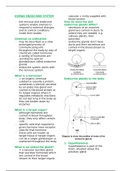
- = an organic chemical Endocrine glands in the body
substance (usually a protein,
6.
sometimes a steroid) secreted
by an endocrine gland and 5.
carried in the blood stream to
its target organ/s where it
regulates metabolic reactions 4.
- do not last long in the body as
they are broken down by
enzymes
What is a target organ?
- although hormones are
carried in blood throughout
3.
body, they only affect certain
cells
1.
- specific cells that respond to
given hormone have receptor 2.
sites for that hormone
- these cells are known as
target tissue or target organs
- can be a single gland/organ or
scattered throughout the body
1. Hypothalamus
What is an endocrine gland? - hypothalamus is part of the
- = a vascular ductless gland brain, situated above the
that secretes hormones which pituitary gland
are carried in the blood
stream to their target organs
, - secretes, amongst others, the - luteinising hormone (LH)
hormone ADH (anti-diuretic which stimulates ovulation
hormone) (release of an egg) from the
What is the role of ADH? ovary and the formation of the
- osmoreceptors in the blood corpus luteum
vessels of the hypothalamus - prolactin which stimulates
detect an increase in the the production of milk in the
osmolarity (low water levels) female mammary glands after
of the blood, the birth of baby – this will
hypothalamus responds and continue for as long as baby
releases ADH suckles – also responsible for
- ADH helps to conserve water if maternal instinct
the body is dehydrated – it - adrenocorticotropic
does this by causing more hormone (ACTH) which
water to be reabsorbed back stimulates the adrenal cortex
into the blood from the to secrete the hormones,
collecting ducts of the kidney cortisone and aldosterone
so less water is lost in urine - interstitial cell stimulating
hormone (ICSH) which
2. Pituitary gland stimulates the testes to
- acts as the chemical co- secrete testosterone
ordinator of most other - growth hormone (GH) or
endocrine glands – is therefore somatotophic hormone
often called the ‘master gland’ (STH) which promotes skeletal
- attached to the hypothalamus and muscular growth – does
at the base of the brain by a this by stimulating the
short stalk synthesis of proteins
What growth disorders can
occur?
- too much/too little growth
hormone causes growth
disorders
- hypersecretion = over
secretion of hormone
- hyposecretion = under
What hormones are secreted secretion of hormone
by the pituitary? - in prepubertal (before growth
- thyroid stimulating stops) children:
hormone (TSH) which hypersecretion of growth
stimulates the thyroid gland to hormone results in
secrete its hormone, thyroxin overdevelopment of the
- follicle-stimulating skeleton (tall stature) which
hormone (FSH) is a condition known as
in females, FSH stimulates gigantism – usually caused
oogenesis in the ovary, i.e. by a tumour in the pituitary
the formation of eggs (ova) gland and is very rare
in males, FSH stimulates hyposecretion of growth
spermatogenesis in testes, hormone results in
i.e. sperm formation underdevelopment of
skeleton (short stature)
blood vessels
- the nervous and endocrine How do exocrine and
systems enable animals to endocrine glands differ?
respond to external changes - secretions of an exocrine
and to control conditions gland are carried in ducts to
inside their bodies where they are needed, e.g.
salivary glands, liver,
Chemical co-ordination pancreas
- may be described as a slow - endocrine glands don’t have
prolonged process of ducts and their secretions are
communicating info carried in the blood stream to
throughout the body by way of target organs
chemicals called hormones
- a variety of hormones are
secreted by special
glands/tissue called endocrine
glands
- endocrine system works with
the nervous system
What is a hormone?
- = an organic chemical Endocrine glands in the body
substance (usually a protein,
6.
sometimes a steroid) secreted
by an endocrine gland and 5.
carried in the blood stream to
its target organ/s where it
regulates metabolic reactions 4.
- do not last long in the body as
they are broken down by
enzymes
What is a target organ?
- although hormones are
carried in blood throughout
3.
body, they only affect certain
cells
1.
- specific cells that respond to
given hormone have receptor 2.
sites for that hormone
- these cells are known as
target tissue or target organs
- can be a single gland/organ or
scattered throughout the body
1. Hypothalamus
What is an endocrine gland? - hypothalamus is part of the
- = a vascular ductless gland brain, situated above the
that secretes hormones which pituitary gland
are carried in the blood
stream to their target organs
, - secretes, amongst others, the - luteinising hormone (LH)
hormone ADH (anti-diuretic which stimulates ovulation
hormone) (release of an egg) from the
What is the role of ADH? ovary and the formation of the
- osmoreceptors in the blood corpus luteum
vessels of the hypothalamus - prolactin which stimulates
detect an increase in the the production of milk in the
osmolarity (low water levels) female mammary glands after
of the blood, the birth of baby – this will
hypothalamus responds and continue for as long as baby
releases ADH suckles – also responsible for
- ADH helps to conserve water if maternal instinct
the body is dehydrated – it - adrenocorticotropic
does this by causing more hormone (ACTH) which
water to be reabsorbed back stimulates the adrenal cortex
into the blood from the to secrete the hormones,
collecting ducts of the kidney cortisone and aldosterone
so less water is lost in urine - interstitial cell stimulating
hormone (ICSH) which
2. Pituitary gland stimulates the testes to
- acts as the chemical co- secrete testosterone
ordinator of most other - growth hormone (GH) or
endocrine glands – is therefore somatotophic hormone
often called the ‘master gland’ (STH) which promotes skeletal
- attached to the hypothalamus and muscular growth – does
at the base of the brain by a this by stimulating the
short stalk synthesis of proteins
What growth disorders can
occur?
- too much/too little growth
hormone causes growth
disorders
- hypersecretion = over
secretion of hormone
- hyposecretion = under
What hormones are secreted secretion of hormone
by the pituitary? - in prepubertal (before growth
- thyroid stimulating stops) children:
hormone (TSH) which hypersecretion of growth
stimulates the thyroid gland to hormone results in
secrete its hormone, thyroxin overdevelopment of the
- follicle-stimulating skeleton (tall stature) which
hormone (FSH) is a condition known as
in females, FSH stimulates gigantism – usually caused
oogenesis in the ovary, i.e. by a tumour in the pituitary
the formation of eggs (ova) gland and is very rare
in males, FSH stimulates hyposecretion of growth
spermatogenesis in testes, hormone results in
i.e. sperm formation underdevelopment of
skeleton (short stature)