

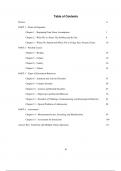
Table of Contents
Preface iv
PART 1 – Points of Departure
Chapter 1 – Beginning Point: Basic Assumptions 1
Chapter 2 – What We’re About: The Problem and Its Size 8
Chapter 3 – Where We Started and Where We’re Going: Past, Present, Future 16
PART 2 – Possible Causes
M
Chapter 4 – Biology 24
Chapter 5 – Culture 30
EL
Chapter 6 – Family 36
Chapter 7 – School 44
AN
PART 3 – Types of Disordered Behaviors
Chapter 8 – Attention and Activity Disorders 51
Chapter 9 – Conduct Disorder 58
IE
Chapter 10 – Anxiety and Related Disorders 67
Chapter 11 – Depression and Suicidal Behavior 76
??
Chapter 12 – Disorders of Thinking, Communicating, and Stereotypical Behavior 83
Chapter 13 – Special Problems of Adolescents 88
??
PART 4 – Assessment
Chapter 14 – Measurement Issues, Screening, and Identification 95
Chapter 15 – Assessment for Instruction 104
Answer Key: True/False and Multiple Choice Questions 111
iii
, Preface
This Instructor’s Manual (IM) is designed to facilitate the use of Characteristics of Emotional and
Behavioral Disorders of Children and Youth (11th edition) by James M. Kauffman and Timothy J.
Landrum. Each chapter of the text opens with a set of results-oriented learning outcomes that serve as
specific objectives to guide readers in their study. The resources included in this IM are meant to serve as
teaching aids to help students meet these learning outcomes. For each chapter, I have suggested questions
intended to help frame class discussions or serve as guiding questions students might consider as they
read, questions that might be used for quizzes or exams, and activities that may be used in and out of class
by individuals and groups. I hope instructors find these useful and can tailor the use of these materials and
ideas to their specific class needs.
M
Further, the 11th edition of this text is the first edition to be offered as an interactive eText with helpful
features that include an online glossary, two to three videos per chapter that illustrate key concepts and
stories related to students with EBD, and an online, self-assessment for each chapter that readers can use
EL
to judge their mastery of chapter learning outcomes. I have provided questions and activities that
correspond with the videos throughout the Instructor’s Manual (IM). Additionally, instructors can check
students’ basic understanding of topics by reviewing their responses to the online eText quizzes and also
use the different test bank questions in the IM to create midterm or final assessments.
AN
The IM mirrors the chapter organization of the text, with each chapter containing: (a) a chapter outline,
(b) chapter learning outcomes, (c) a list of new terminology introduced or discussed in the chapter, (d) a
set of true-false questions, (e) a set of multiple choice questions, (f) a set of discussion questions, (g) a set
IE
of essay questions, (h) suggestions for learning activities, including activities that correspond with eText
videos, and (i) a set of case-based activities that can be used in conjunction with the case book.
??
The previous edition of this IM was authored by Jim Kauffman, and the edition before that by Tim
Landrum. Previous authors and contributors to the IM for earlier editions of the text have included
Devery Mock, Tim Landrum, Theresa M. Zutter, Jeanmarie Bantz, Michele M. Brigham, Jennifer
??
Jakubecy, Kristen Sayeski, Kathleen A. McGee-Benton, Donna M. Murphy, E. Jane Nowacek, Melody
Tankersley, and Jeanne Bauwens. It would be impossible to tease out the specific contributions of each
author and contributor, but it is important to note that this most recent edition draws heavily on previous
editions. I hope that any changes I have made add to, and do not diminish, the fine work of these previous
contributors. The current edition of this manual truly rests upon the work of all of those listed above. I
hope that our collective effort will be useful to instructors using this text, and that ultimately these efforts
further the goal of improving the educational experiences of both students with emotional and behavioral
disorders and the educators who teach them.
-CAS
iv
Copyright © 2018 Pearson Education Inc. All Rights Reserved.
, Chapter 1
BEGINNING POINT: BASIC ASSUMPTIONS
Various Ways of Thinking About the Problem and Our Ideas About Good Teaching
OUTLINE
Learning Outcomes
Thinking About the Problem
Brief Descriptions of Four Conceptual Models
Biological Model
Psychoeducational Model
Ecological Model
Behavioral Model
Choosing Models
M
An Integrated, Social-Cognitive Model
Good Teaching
Expectations
Causes of Behavior
EL
Definition, Measurement, and Assessment of Behavior
Work, Play, Love, and Fun
Direct, Honest Communication
Self-Control
AN
Cultural Differences
Instruction: The Business of Special Education
Thoughts about Actual People
Interrelationships among Causes, Types of Behavior, Assessment, and Intervention
Summary
End-of-Chapter Quiz (eText)
IE
Cases for Discussion
LEARNING OUTCOMES
??
1.1 Explain how thinking about behavior problems is linked to intervention strategies.
1.2 Briefly describe the most obvious strengths and weaknesses of four conceptual models:
biological, psychoeducational, behavioral, and ecological.
??
1.3 Describe how you would choose a conceptual model.
1.4 Describe the major features of an integrated, social-cognitive model.
1.5 Understand the role of an effective teacher of students with EBD with regard to each of these:
expectations; causes of behavior; definition, measurement, and assessment; work, play, love, and
fun; direct, honest communication; self-control; cultural differences; instruction; and thoughts
about actual people.
1.6 Explain how causal factors, types of behavior, assessment, and intervention are interrelated in
discussions of EBD.
TERMINOLOGY
Behavioral model
Biological model
Conceptual model
Eco-behavioral analysis
1
Copyright © 2018 Pearson Education Inc. All Rights Reserved.
, Ecological model
Medical model
Personal agency
Psychoeducational model
Social-cognitive model
Social-cognitive theory
M
EL
AN
IE
??
??
2
Copyright © 2018 Pearson Education Inc. All Rights Reserved.
Preface iv
PART 1 – Points of Departure
Chapter 1 – Beginning Point: Basic Assumptions 1
Chapter 2 – What We’re About: The Problem and Its Size 8
Chapter 3 – Where We Started and Where We’re Going: Past, Present, Future 16
PART 2 – Possible Causes
M
Chapter 4 – Biology 24
Chapter 5 – Culture 30
EL
Chapter 6 – Family 36
Chapter 7 – School 44
AN
PART 3 – Types of Disordered Behaviors
Chapter 8 – Attention and Activity Disorders 51
Chapter 9 – Conduct Disorder 58
IE
Chapter 10 – Anxiety and Related Disorders 67
Chapter 11 – Depression and Suicidal Behavior 76
??
Chapter 12 – Disorders of Thinking, Communicating, and Stereotypical Behavior 83
Chapter 13 – Special Problems of Adolescents 88
??
PART 4 – Assessment
Chapter 14 – Measurement Issues, Screening, and Identification 95
Chapter 15 – Assessment for Instruction 104
Answer Key: True/False and Multiple Choice Questions 111
iii
, Preface
This Instructor’s Manual (IM) is designed to facilitate the use of Characteristics of Emotional and
Behavioral Disorders of Children and Youth (11th edition) by James M. Kauffman and Timothy J.
Landrum. Each chapter of the text opens with a set of results-oriented learning outcomes that serve as
specific objectives to guide readers in their study. The resources included in this IM are meant to serve as
teaching aids to help students meet these learning outcomes. For each chapter, I have suggested questions
intended to help frame class discussions or serve as guiding questions students might consider as they
read, questions that might be used for quizzes or exams, and activities that may be used in and out of class
by individuals and groups. I hope instructors find these useful and can tailor the use of these materials and
ideas to their specific class needs.
M
Further, the 11th edition of this text is the first edition to be offered as an interactive eText with helpful
features that include an online glossary, two to three videos per chapter that illustrate key concepts and
stories related to students with EBD, and an online, self-assessment for each chapter that readers can use
EL
to judge their mastery of chapter learning outcomes. I have provided questions and activities that
correspond with the videos throughout the Instructor’s Manual (IM). Additionally, instructors can check
students’ basic understanding of topics by reviewing their responses to the online eText quizzes and also
use the different test bank questions in the IM to create midterm or final assessments.
AN
The IM mirrors the chapter organization of the text, with each chapter containing: (a) a chapter outline,
(b) chapter learning outcomes, (c) a list of new terminology introduced or discussed in the chapter, (d) a
set of true-false questions, (e) a set of multiple choice questions, (f) a set of discussion questions, (g) a set
IE
of essay questions, (h) suggestions for learning activities, including activities that correspond with eText
videos, and (i) a set of case-based activities that can be used in conjunction with the case book.
??
The previous edition of this IM was authored by Jim Kauffman, and the edition before that by Tim
Landrum. Previous authors and contributors to the IM for earlier editions of the text have included
Devery Mock, Tim Landrum, Theresa M. Zutter, Jeanmarie Bantz, Michele M. Brigham, Jennifer
??
Jakubecy, Kristen Sayeski, Kathleen A. McGee-Benton, Donna M. Murphy, E. Jane Nowacek, Melody
Tankersley, and Jeanne Bauwens. It would be impossible to tease out the specific contributions of each
author and contributor, but it is important to note that this most recent edition draws heavily on previous
editions. I hope that any changes I have made add to, and do not diminish, the fine work of these previous
contributors. The current edition of this manual truly rests upon the work of all of those listed above. I
hope that our collective effort will be useful to instructors using this text, and that ultimately these efforts
further the goal of improving the educational experiences of both students with emotional and behavioral
disorders and the educators who teach them.
-CAS
iv
Copyright © 2018 Pearson Education Inc. All Rights Reserved.
, Chapter 1
BEGINNING POINT: BASIC ASSUMPTIONS
Various Ways of Thinking About the Problem and Our Ideas About Good Teaching
OUTLINE
Learning Outcomes
Thinking About the Problem
Brief Descriptions of Four Conceptual Models
Biological Model
Psychoeducational Model
Ecological Model
Behavioral Model
Choosing Models
M
An Integrated, Social-Cognitive Model
Good Teaching
Expectations
Causes of Behavior
EL
Definition, Measurement, and Assessment of Behavior
Work, Play, Love, and Fun
Direct, Honest Communication
Self-Control
AN
Cultural Differences
Instruction: The Business of Special Education
Thoughts about Actual People
Interrelationships among Causes, Types of Behavior, Assessment, and Intervention
Summary
End-of-Chapter Quiz (eText)
IE
Cases for Discussion
LEARNING OUTCOMES
??
1.1 Explain how thinking about behavior problems is linked to intervention strategies.
1.2 Briefly describe the most obvious strengths and weaknesses of four conceptual models:
biological, psychoeducational, behavioral, and ecological.
??
1.3 Describe how you would choose a conceptual model.
1.4 Describe the major features of an integrated, social-cognitive model.
1.5 Understand the role of an effective teacher of students with EBD with regard to each of these:
expectations; causes of behavior; definition, measurement, and assessment; work, play, love, and
fun; direct, honest communication; self-control; cultural differences; instruction; and thoughts
about actual people.
1.6 Explain how causal factors, types of behavior, assessment, and intervention are interrelated in
discussions of EBD.
TERMINOLOGY
Behavioral model
Biological model
Conceptual model
Eco-behavioral analysis
1
Copyright © 2018 Pearson Education Inc. All Rights Reserved.
, Ecological model
Medical model
Personal agency
Psychoeducational model
Social-cognitive model
Social-cognitive theory
M
EL
AN
IE
??
??
2
Copyright © 2018 Pearson Education Inc. All Rights Reserved.


