FOR MORE HIGH-QUALITY PAST PAPER MODEL ANSWERS, ONLINE TUTORING AND
ECONOMICS HELP, visit LondonEconomicsTutors.co.uk.
Discounted prices compared to all other websites
ECN222 Financial Markets and Institutions - 2015
Questions and Answers
Question 1
A)
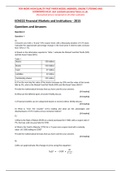
i) We can approximate the change in price using the equation:
∆𝑖
%∆𝑃 ≈ −𝐷𝑈𝑅 ×
1+𝑖
, FOR MORE HIGH-QUALITY PAST PAPER MODEL ANSWERS, ONLINE TUTORING AND
ECONOMICS HELP, visit LondonEconomicsTutors.co.uk.
Discounted prices compared to all other websites
0.01
%∆𝑃 ≈ −6.76 ×
1 + 0.1
%∆𝑃 ≈ 6.15%
b)
Mutual Fund Net Worth = 50 + 30 + 7 – 2 = 85
Net Asset Value = 50 + 30 + 7 – 2 – 25 = 60
c)
Mutual Fund Net Worth = 60 + 28.5 + 7 – 2 = 93.5
Net Asset Value = 60 + 28.5 + 7 – 2 – 25 = 68.5
B) Bonds differ in a number of ways. In terms of coupon payments, there are:
1. Fixed rate bonds (such that the coupon is a fixed proportion of the face value of the bond)
2. Stepped-coupon bonds (where the coupon increases during the life of the bond)
3. Floating rate notes (these are bonds with variable coupon rates which are linked to a
reference rate of interest)
In terms of types of risk:
1. Secured bonds have collateral attached. These could be mortgage bonds, where the
collateral is a building/home, or equipment trust certificates, where the collateral is a
tangible non-real-estate good.
2. Unsecured bonds do not have collateral attached. Debentures are bonds backed only by the
general creditworthiness of the issuer, subordinated debentures have lower priority claim
than debentures, and variable-rate unsecured bonds are unsecured bonds where the
interest rate is tied to another market interest rate.
3. Junk bonds have a high default risk and are rated below BBB.
C) Financial markets can be categorised in a number of ways:
By seasoning of claim: Primary markets versus Secondary markets. Primary markets are
where new issues of securities are sold to initial buyers by the institution borrowing the
money, and secondary markets are securities that have already been issued in the primary
market and now being resold.
By nature of claim: Debt markets versus Equity markets. Debt/bond markets are market
which enable corporation and government to borrow money to finance their activities by
issuing debt instruments, whereas a stock market allows for the trading of company stocks
on a stock exchange.
By organizational structure: Exchanges versus Over The Counter (OTC) markets. Exchange
Traded markets are markets such as the New York Stock Exchange or the Chicago Board of
Options Exchange, which allow traders to trade sticks and derivatives. They perform the
function of organizing the trades that take place and ensure that agreements will be
honoured. Over the Counter markets are large networks of traders and financial institutions
who negotiate contracts bilaterally.
ECONOMICS HELP, visit LondonEconomicsTutors.co.uk.
Discounted prices compared to all other websites
ECN222 Financial Markets and Institutions - 2015
Questions and Answers
Question 1
A)
i) We can approximate the change in price using the equation:
∆𝑖
%∆𝑃 ≈ −𝐷𝑈𝑅 ×
1+𝑖
, FOR MORE HIGH-QUALITY PAST PAPER MODEL ANSWERS, ONLINE TUTORING AND
ECONOMICS HELP, visit LondonEconomicsTutors.co.uk.
Discounted prices compared to all other websites
0.01
%∆𝑃 ≈ −6.76 ×
1 + 0.1
%∆𝑃 ≈ 6.15%
b)
Mutual Fund Net Worth = 50 + 30 + 7 – 2 = 85
Net Asset Value = 50 + 30 + 7 – 2 – 25 = 60
c)
Mutual Fund Net Worth = 60 + 28.5 + 7 – 2 = 93.5
Net Asset Value = 60 + 28.5 + 7 – 2 – 25 = 68.5
B) Bonds differ in a number of ways. In terms of coupon payments, there are:
1. Fixed rate bonds (such that the coupon is a fixed proportion of the face value of the bond)
2. Stepped-coupon bonds (where the coupon increases during the life of the bond)
3. Floating rate notes (these are bonds with variable coupon rates which are linked to a
reference rate of interest)
In terms of types of risk:
1. Secured bonds have collateral attached. These could be mortgage bonds, where the
collateral is a building/home, or equipment trust certificates, where the collateral is a
tangible non-real-estate good.
2. Unsecured bonds do not have collateral attached. Debentures are bonds backed only by the
general creditworthiness of the issuer, subordinated debentures have lower priority claim
than debentures, and variable-rate unsecured bonds are unsecured bonds where the
interest rate is tied to another market interest rate.
3. Junk bonds have a high default risk and are rated below BBB.
C) Financial markets can be categorised in a number of ways:
By seasoning of claim: Primary markets versus Secondary markets. Primary markets are
where new issues of securities are sold to initial buyers by the institution borrowing the
money, and secondary markets are securities that have already been issued in the primary
market and now being resold.
By nature of claim: Debt markets versus Equity markets. Debt/bond markets are market
which enable corporation and government to borrow money to finance their activities by
issuing debt instruments, whereas a stock market allows for the trading of company stocks
on a stock exchange.
By organizational structure: Exchanges versus Over The Counter (OTC) markets. Exchange
Traded markets are markets such as the New York Stock Exchange or the Chicago Board of
Options Exchange, which allow traders to trade sticks and derivatives. They perform the
function of organizing the trades that take place and ensure that agreements will be
honoured. Over the Counter markets are large networks of traders and financial institutions
who negotiate contracts bilaterally.