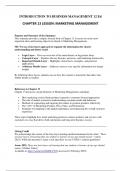
INTRODUCTION TO BUSINESS MANAGEMENT 12 Ed
CHAPTER 13 LESSON: MARKETING MANAGEMENT
Purpose and Structure of the Summary
This summary provides a simple, focused look at Chapter 13. It zeroes in on the most
important ideas and learning objectives related to Marketing Management.
NB: We use a four-layer approach to organize the information for clearer
understanding and better recall:
• Logic Layer – Gives an overview of the main themes or big picture ideas.
• Concepts Layer – Explores the key theories, processes, and marketing frameworks.
• Important Details Layer – Highlights critical facts, examples, and practical
applications.
• Arbitrary Details Layer – Addresses extra or very specific information for deeper
insight.
By following these layers, students can see how the content is structured, then delve into
further details as needed.
Reference to Chapter 13
Chapter 13 discusses crucial elements of Marketing Management, including:
• How marketing evolved from product-centered to customer-focused approaches
• The role of market research in understanding consumer needs and behaviors
• Methods of segmenting and targeting the market to position products effectively
• The “4 Ps” of Marketing (Product, Price, Place, and Promotion)
• Strategies for adapting to the digital marketplace and enhancing the overall customer
experience
These topics highlight how smart marketing practices connect products and services with
customers in a way that drives both satisfaction and long-term business success.
Giving Credit
We acknowledge the creator of the four-layer learning method mentioned in the video “There
are four layers of learning that any student or learner of any age should master” (Anon.
2022). While the presenter’s name is not specified, we use UNISA’s citation guidelines:
Anon. 2022. There are four layers of learning that any student or learner of any age should
master. [Online Video].
Available at: https://youtu.be/2rtSSM-C91I [Accessed 21 February 2025].
,
,
,
, CHAPTER 13 LESSON: MARKETING MANAGEMENT
LAYER 01: CHAPTER 13 OVERVIEW: MARKETING MANAGEMENT
Marketing Management
1. Evolution of Marketing Thought
o 1.1. Operation-Oriented Management
o 1.2. Sales-Oriented Management
o 1.3. Marketing-Oriented Management
o 1.4. Consumer-Oriented Management
o 1.5. Strategic Approach Incorporating Relationship Marketing
2. Marketing Concept
o 2.1. Profitability
o 2.2. Consumer Orientation
o 2.3. Social Responsibility
o 2.4. Organizational Integration
3. Defining Marketing
o 3.1. Management Functions and Decisions
o 3.2. Identifying Opportunities and Threats
o 3.3. Developing Need-Satisfying Market Offerings
o 3.4. Achieving Business, Consumer, and Societal Objectives
4. Components of the Marketing Process
o 4.1. Market Research
▪ 4.1.1. Collecting, Analyzing, and Interpreting Information
▪ 4.1.2. Defining the Problem
▪ 4.1.3. Analyzing the Situation
▪ 4.1.4. Conducting Research
▪ 4.1.5. Making Recommendations
o 4.2. Consumer Behavior
▪ 4.2.1. Influenced by Individual and Group Factors
▪ 4.2.2. Needs, Attitudes, and Perception
▪ 4.2.3. Culture, Social Class, and Reference Groups
▪ 4.2.4. Influences on Purchasing Decisions
o 4.3. Market Segmentation
▪ 4.3.1. Dividing Total Market into Groups
▪ 4.3.2. Total-Market Approach
▪ 4.3.3. Single-Segment Approach
▪ 4.3.4. Multi-Segment Approach
CHAPTER 13 LESSON: MARKETING MANAGEMENT
Purpose and Structure of the Summary
This summary provides a simple, focused look at Chapter 13. It zeroes in on the most
important ideas and learning objectives related to Marketing Management.
NB: We use a four-layer approach to organize the information for clearer
understanding and better recall:
• Logic Layer – Gives an overview of the main themes or big picture ideas.
• Concepts Layer – Explores the key theories, processes, and marketing frameworks.
• Important Details Layer – Highlights critical facts, examples, and practical
applications.
• Arbitrary Details Layer – Addresses extra or very specific information for deeper
insight.
By following these layers, students can see how the content is structured, then delve into
further details as needed.
Reference to Chapter 13
Chapter 13 discusses crucial elements of Marketing Management, including:
• How marketing evolved from product-centered to customer-focused approaches
• The role of market research in understanding consumer needs and behaviors
• Methods of segmenting and targeting the market to position products effectively
• The “4 Ps” of Marketing (Product, Price, Place, and Promotion)
• Strategies for adapting to the digital marketplace and enhancing the overall customer
experience
These topics highlight how smart marketing practices connect products and services with
customers in a way that drives both satisfaction and long-term business success.
Giving Credit
We acknowledge the creator of the four-layer learning method mentioned in the video “There
are four layers of learning that any student or learner of any age should master” (Anon.
2022). While the presenter’s name is not specified, we use UNISA’s citation guidelines:
Anon. 2022. There are four layers of learning that any student or learner of any age should
master. [Online Video].
Available at: https://youtu.be/2rtSSM-C91I [Accessed 21 February 2025].
,
,
,
, CHAPTER 13 LESSON: MARKETING MANAGEMENT
LAYER 01: CHAPTER 13 OVERVIEW: MARKETING MANAGEMENT
Marketing Management
1. Evolution of Marketing Thought
o 1.1. Operation-Oriented Management
o 1.2. Sales-Oriented Management
o 1.3. Marketing-Oriented Management
o 1.4. Consumer-Oriented Management
o 1.5. Strategic Approach Incorporating Relationship Marketing
2. Marketing Concept
o 2.1. Profitability
o 2.2. Consumer Orientation
o 2.3. Social Responsibility
o 2.4. Organizational Integration
3. Defining Marketing
o 3.1. Management Functions and Decisions
o 3.2. Identifying Opportunities and Threats
o 3.3. Developing Need-Satisfying Market Offerings
o 3.4. Achieving Business, Consumer, and Societal Objectives
4. Components of the Marketing Process
o 4.1. Market Research
▪ 4.1.1. Collecting, Analyzing, and Interpreting Information
▪ 4.1.2. Defining the Problem
▪ 4.1.3. Analyzing the Situation
▪ 4.1.4. Conducting Research
▪ 4.1.5. Making Recommendations
o 4.2. Consumer Behavior
▪ 4.2.1. Influenced by Individual and Group Factors
▪ 4.2.2. Needs, Attitudes, and Perception
▪ 4.2.3. Culture, Social Class, and Reference Groups
▪ 4.2.4. Influences on Purchasing Decisions
o 4.3. Market Segmentation
▪ 4.3.1. Dividing Total Market into Groups
▪ 4.3.2. Total-Market Approach
▪ 4.3.3. Single-Segment Approach
▪ 4.3.4. Multi-Segment Approach