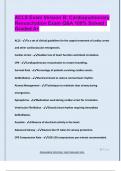
ACLS Exam Version B: Cardiopulmonary
Resuscitation Exam Q&A 100% Solved |
Graded A+
ACLS - ✔✔is a set of clinical guidelines for the urgent treatment of cardiac arrest
and other cardiovascular emergencies.
Cardiac Arrest - ✔✔Sudden loss of heart function and blood circulation.
CPR - ✔✔Cardiopulmonary resuscitation to restore breathing.
Survival Rate - ✔✔Percentage of patients surviving cardiac events.
Defibrillation - ✔✔Electrical shock to restore normal heart rhythm.
Airway Management - ✔✔Techniques to maintain clear airway during
emergencies.
Epinephrine - ✔✔Medication used during cardiac arrest for circulation.
Ventricular Fibrillation - ✔✔Chaotic heart rhythm requiring immediate
defibrillation.
Asystole - ✔✔Absence of electrical activity in the heart.
Advanced Airway - ✔✔Devices like ET tubes for airway protection.
CPR Compression Rate - ✔✔100-120 compressions per minute recommended.
1|Page
©NINJANERD 2025/2026. YEAR PUBLISHED 2025.
, Rescue Breaths - ✔✔Breaths given during CPR to provide oxygen.
Chain of Survival - ✔✔Critical steps for improving survival from cardiac arrest.
Automated External Defibrillator (AED) - ✔✔Device that analyzes heart rhythm
and delivers shock.
Post-Cardiac Arrest Care - ✔✔Management after return of spontaneous
circulation.
Cardiac Rhythm Monitoring - ✔✔Continuous observation of heart's electrical
activity.
Resuscitation Drugs - ✔✔Medications used during resuscitation efforts.
Hypoxia - ✔✔Deficiency of oxygen reaching tissues.
Hypothermia - ✔✔Abnormally low body temperature affecting resuscitation.
Rhythm Check - ✔✔Assessment of heart rhythm every 2 minutes.
Compression Depth - ✔✔At least 2-2.4 inches for adult CPR.
Rescue Breathing Ratio - ✔✔30 compressions to 2 breaths in CPR.
Acidosis - ✔✔Excess acidity in body fluids affecting heart function.
Capnography - ✔✔Monitoring of carbon dioxide levels during CPR.
Return of Spontaneous Circulation (ROSC) - ✔✔Restoration of effective heart
function post-arrest.
2|Page
©NINJANERD 2025/2026. YEAR PUBLISHED 2025.
Resuscitation Exam Q&A 100% Solved |
Graded A+
ACLS - ✔✔is a set of clinical guidelines for the urgent treatment of cardiac arrest
and other cardiovascular emergencies.
Cardiac Arrest - ✔✔Sudden loss of heart function and blood circulation.
CPR - ✔✔Cardiopulmonary resuscitation to restore breathing.
Survival Rate - ✔✔Percentage of patients surviving cardiac events.
Defibrillation - ✔✔Electrical shock to restore normal heart rhythm.
Airway Management - ✔✔Techniques to maintain clear airway during
emergencies.
Epinephrine - ✔✔Medication used during cardiac arrest for circulation.
Ventricular Fibrillation - ✔✔Chaotic heart rhythm requiring immediate
defibrillation.
Asystole - ✔✔Absence of electrical activity in the heart.
Advanced Airway - ✔✔Devices like ET tubes for airway protection.
CPR Compression Rate - ✔✔100-120 compressions per minute recommended.
1|Page
©NINJANERD 2025/2026. YEAR PUBLISHED 2025.
, Rescue Breaths - ✔✔Breaths given during CPR to provide oxygen.
Chain of Survival - ✔✔Critical steps for improving survival from cardiac arrest.
Automated External Defibrillator (AED) - ✔✔Device that analyzes heart rhythm
and delivers shock.
Post-Cardiac Arrest Care - ✔✔Management after return of spontaneous
circulation.
Cardiac Rhythm Monitoring - ✔✔Continuous observation of heart's electrical
activity.
Resuscitation Drugs - ✔✔Medications used during resuscitation efforts.
Hypoxia - ✔✔Deficiency of oxygen reaching tissues.
Hypothermia - ✔✔Abnormally low body temperature affecting resuscitation.
Rhythm Check - ✔✔Assessment of heart rhythm every 2 minutes.
Compression Depth - ✔✔At least 2-2.4 inches for adult CPR.
Rescue Breathing Ratio - ✔✔30 compressions to 2 breaths in CPR.
Acidosis - ✔✔Excess acidity in body fluids affecting heart function.
Capnography - ✔✔Monitoring of carbon dioxide levels during CPR.
Return of Spontaneous Circulation (ROSC) - ✔✔Restoration of effective heart
function post-arrest.
2|Page
©NINJANERD 2025/2026. YEAR PUBLISHED 2025.