
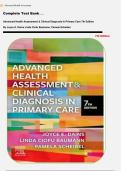
1 Advanced Health Assessment
Complete Test Bank___
Advanced Health Assessment & Clinical Diagnosis In Primary Care 7th Edition
By Joyce E. Dains Linda Ciofu Baumann, Pamela Scheibel
7th Edition
, Table Of Content
Part I An Introduction To Clinical Reasoning
Chapter 1 Clinical Reasoning, Evidence-Based Practice, And Symptom Analysis
Chapter 2 Evidence-Based Clinical Practice Guidelines
Chapter 3 Contemporary Approaches In Primary Care Settings
Part Ii Common Symptoms In Primary Care
Chapter 4 Abdominal Pain
Chapter 5 Affective Changes
Chapter 6 Amenorrhea
Chapter 7 Breast Lumps And Nipple Discharge
Chapter 8 Breast Pain
Chapter 9 Chest Pain
Chapter 10 Confusion In Older Adults
Chapter 11 Constipation
Chapter 12 Cough
Chapter 13 Diarrhea
Chapter 14 Dizziness
Chapter 15 Dyspnea
Chapter 16 Earache
Chapter 17 Fatigue
Chapter 18 Fever
Chapter 19 Genitourinary Problems In Patients With A Penis Or Prostate Gland
Chapter 20 Headache
Chapter 21 Heartburn And Indigestion
Chapter 22 Hoarseness
Chapter 23 Limb Pain: Lower Extremity
, Chapter 24 Limb Pain: Upper Extremity
Chapter 25 Low Back Pain
Chapter 26 Nasal Symptoms And Sinus Congestion
Chapter 27 Palpitations
Chapter 28 Penile Discharge
Chapter 29 Rashes And Skin Lesions
Chapter 30 Rectal Pain, Itching, And Bleeding
Chapter 31 Red Eye
Chapter 32 Scrotal Pain And Masses
Chapter 33 Sleep Problems
Chapter 34 Sore Throat
Chapter 35 Syncope
Chapter 36 Urinary Incontinence
Chapter 37 Urinary Problems In Patients With A Vagina And Associated Anatomical Structures
38 Vaginal Bleeding
Chapter 39 Vaginal Discharge And Itching
Chapter 40 Vision Loss
Chapter 41 Unintentional Weight Loss Or Gain
Part Iii Population-Centered Care
Chapter 42 Care Of Transgender And Gender-Diverse Patients
Chapter 43 Veterans’ Health
Part Iv Diagnostic Imaging
Chapter 44 Abdominal X-Ray
Chapter 45 Chest X-Ray
, Advanced Health Assessment & Clinical Diagnosis In Primary Care 7th Edition
Dains Test Bank
Chapter 1: Clinical Reasoning, Differential Diagnosis, Evidence-Based Practice, And Symptom Ana
Multiple Choice
Identify The Choice That Best Completes The Statement Or Answers The Question.
1. Which Type Of Clinical Decision-Making Is Most Reliable?
A. Intuitive
B. Analytical
C. Experiential
D. Augenblick
2. Which Of The Following Is False? To Obtain Adequate History, Health-Care Providers Must Be:
A. Methodical And Systematic
B. Attentive To The Patient’s Verbal And Nonverbal
Language
C. Able To Accurately Interpret The Patient’s Responses
D. Adept At Reading Into The Patient’s Statements
3. Essential Parts Of A Health History Include All Of The Following Except:
A. Chief Complaint
B. History Of The Present Illness
C. Current Vital Signs
D. All Of The Above Are Essential History
Components
4. Which Of The Following Is False? While Performing The Physical Examination, The Examiner Must Be Able To:
A. Differentiate Between Normal And Abnormal Findings
B. Recall Knowledge Of A Range Of Conditions And Their Associated Signs And
Symptoms
C. Recognize How Certain Conditions Affect The Response To Other Conditions
D. Foresee Unpredictable Findings
5. The Following Is The Least Reliable Source Of Information For Diagnostic Statistics:
A. Evidence-Based Investigations
B. Primary Reports Of Research
C. Estimation Based On A Provider’s
Experience
D. Published Meta-Analyses
6. The Following Can Be Used To Assist In Sound Clinical Decision-Making:
A. Algorithm published in a peer-reviewed journal article
B. Clinical practice guidelines
C. Evidence-based research
D. All of the above
7. If A Diagnostic Study Has High Sensitivity, This Indicates A:
A. High Percentage Of Persons With The Given Condition Will Have An Abnormal
Result
B. Low Percentage Of Persons With The Given Condition Will Have An Abnormal
Result
C. Low Likelihood Of Normal Result In Persons Without A Given Condition
D. None Of The Above
8. If A Diagnostic Study Has High Specificity, This Indicates A:
A. Low Percentage Of Healthy Individuals Will Show A Normal Result
B. High Percentage Of Healthy Individuals Will Show A Normal Result
C. High Percentage Of Individuals With A Disorder Will Show A Normal
Result
D. Low Percentage Of Individuals With A Disorder Will Show An Abnormal
Result
9. A Likelihood Ratio Above 1 Indicates That A Diagnostic Test Showing A:
A. Positive Result Is Strongly Associated With The Disease
B. Negative Result Is Strongly Associated With Absence Of The
Disease
C. Positive Result Is Weakly Associated With The Disease
D. Negative Result Is Weakly Associated With Absence Of The
Disease
10. Which Of The Following Clinical Reasoning Tools Is Defined As Evidence-Based Resource Based On
Mathematical Modelingto Express The Likelihood Of A Condition In Select Situations, Settings, And/Or Patients?
, A. Clinical Practice Guideline
B. Clinical Decision Rule
C. Clinical Algorithm
Chapter 1: Clinical Reasoning, Differential Diagnosis, Evidence-Based Practice, And Symptom Ana
Answer Section
Multiple Choice
1. ANS>> B
Croskerry (2009) Describes Two Major Types Of Clinical Diagnostic Decision-Making: Intuitive And Analytical. Intuitive
Decision- Making (Similar To Augenblink Decision-Making) Is Based On The Experience And Intuition Of The Clinician And
Is Less Reliable Andpaired With Fairly Common Errors. In Contrast, Analytical Decision-Making Is Based On Careful
Consideration And Has Greater Reliability With Rare Errors.
Pts: 1
2. ANS>> D
To Obtain Adequate History, Providers Must Be Well Organized, Attentive To The Patient’s Verbal And Nonverbal Language,
And Able To Accurately Interpret The Patient’s Responses To Questions. Rather Than Reading Into The Patient’s Statements,
They Clarify Any Areas Of Uncertainty.
Pts: 1
3. ANS>> C
Vital Signs Are Part Of The Physical Examination Portion Of Patient Assessment, Not Part Of The Health History.
Pts: 1
4. ANS>> D
While Performing The Physical Examination, The Examiner Must Be Able To Differentiate Between Normal And Abnormal
Findings, Recall Knowledge Of A Range Of Conditions, Including Their Associated Signs And Symptoms, Recognize How
Certain Conditions Affectthe Response To Other Conditions, And Distinguish The Relevance Of Varied Abnormal Findings.
Pts: 1
5. ANS>> C
Sources For Diagnostic Statistics Include Textbooks, Primary Reports Of Research, And Published Meta-Analyses. Another
Source Of Statistics, The One That Has Been Most Widely Used And Available For Application To The Reasoning Process, Is
The Estimation Based On A Provider’s Experience, Although These Are Rarely Accurate. Over The Past Decade, The
Availability Of Evidence On Which To Base Clinical Reasoning Is Improving, And There Is An Increasing Expectation That
Clinical Reasoning Be Based On Scientific Evidence.
Evidence-Based Statistics Are Also Increasingly Being Used To Develop Resources To Facilitate Clinical Decision-Making.
Pts: 1
6. ANS>> D
To Assist In Clinical Decision-Making, A Number Of Evidence-Based Resources Have Been Developed To Assist The
Clinician.Resources, Such As Algorithms And Clinical Practice Guidelines, Assist In Clinical Reasoning When Properly
Applied.
Pts: 1
7. ANS>> A
The Sensitivity Of A Diagnostic Study Is The Percentage Of Individuals With The Target Condition Who Show An Abnormal,
Or Positive,Result. A High Sensitivity Indicates That A Greater Percentage Of Persons With The Given Condition Will Have An
Abnormal Result.
Pts: 1
8. ANS>> B
The Specificity Of A Diagnostic Study Is The Percentage Of Normal, Healthy Individuals Who Have A Normal Result. The
Greater Thespecificity, The Greater The Percentage Of Individuals Who Will Have Negative, Or Normal, Results If They
Do Not Have The Target Condition.
Pts: 1
9. ANS>> A
The Likelihood Ratio Is The Probability That A Positive Test Result Will Be Associated With A Person Who Has The Target
Condition And A Negative Result Will Be Associated With A Healthy Person. A Likelihood Ratio Above 1 Indicates That A
Positive Result Is Associated With The Disease; A Likelihood Ratio Less Than 1 Indicates That A Negative Result Is Associated
With An Absence Of The Disease.
Complete Test Bank___
Advanced Health Assessment & Clinical Diagnosis In Primary Care 7th Edition
By Joyce E. Dains Linda Ciofu Baumann, Pamela Scheibel
7th Edition
, Table Of Content
Part I An Introduction To Clinical Reasoning
Chapter 1 Clinical Reasoning, Evidence-Based Practice, And Symptom Analysis
Chapter 2 Evidence-Based Clinical Practice Guidelines
Chapter 3 Contemporary Approaches In Primary Care Settings
Part Ii Common Symptoms In Primary Care
Chapter 4 Abdominal Pain
Chapter 5 Affective Changes
Chapter 6 Amenorrhea
Chapter 7 Breast Lumps And Nipple Discharge
Chapter 8 Breast Pain
Chapter 9 Chest Pain
Chapter 10 Confusion In Older Adults
Chapter 11 Constipation
Chapter 12 Cough
Chapter 13 Diarrhea
Chapter 14 Dizziness
Chapter 15 Dyspnea
Chapter 16 Earache
Chapter 17 Fatigue
Chapter 18 Fever
Chapter 19 Genitourinary Problems In Patients With A Penis Or Prostate Gland
Chapter 20 Headache
Chapter 21 Heartburn And Indigestion
Chapter 22 Hoarseness
Chapter 23 Limb Pain: Lower Extremity
, Chapter 24 Limb Pain: Upper Extremity
Chapter 25 Low Back Pain
Chapter 26 Nasal Symptoms And Sinus Congestion
Chapter 27 Palpitations
Chapter 28 Penile Discharge
Chapter 29 Rashes And Skin Lesions
Chapter 30 Rectal Pain, Itching, And Bleeding
Chapter 31 Red Eye
Chapter 32 Scrotal Pain And Masses
Chapter 33 Sleep Problems
Chapter 34 Sore Throat
Chapter 35 Syncope
Chapter 36 Urinary Incontinence
Chapter 37 Urinary Problems In Patients With A Vagina And Associated Anatomical Structures
38 Vaginal Bleeding
Chapter 39 Vaginal Discharge And Itching
Chapter 40 Vision Loss
Chapter 41 Unintentional Weight Loss Or Gain
Part Iii Population-Centered Care
Chapter 42 Care Of Transgender And Gender-Diverse Patients
Chapter 43 Veterans’ Health
Part Iv Diagnostic Imaging
Chapter 44 Abdominal X-Ray
Chapter 45 Chest X-Ray
, Advanced Health Assessment & Clinical Diagnosis In Primary Care 7th Edition
Dains Test Bank
Chapter 1: Clinical Reasoning, Differential Diagnosis, Evidence-Based Practice, And Symptom Ana
Multiple Choice
Identify The Choice That Best Completes The Statement Or Answers The Question.
1. Which Type Of Clinical Decision-Making Is Most Reliable?
A. Intuitive
B. Analytical
C. Experiential
D. Augenblick
2. Which Of The Following Is False? To Obtain Adequate History, Health-Care Providers Must Be:
A. Methodical And Systematic
B. Attentive To The Patient’s Verbal And Nonverbal
Language
C. Able To Accurately Interpret The Patient’s Responses
D. Adept At Reading Into The Patient’s Statements
3. Essential Parts Of A Health History Include All Of The Following Except:
A. Chief Complaint
B. History Of The Present Illness
C. Current Vital Signs
D. All Of The Above Are Essential History
Components
4. Which Of The Following Is False? While Performing The Physical Examination, The Examiner Must Be Able To:
A. Differentiate Between Normal And Abnormal Findings
B. Recall Knowledge Of A Range Of Conditions And Their Associated Signs And
Symptoms
C. Recognize How Certain Conditions Affect The Response To Other Conditions
D. Foresee Unpredictable Findings
5. The Following Is The Least Reliable Source Of Information For Diagnostic Statistics:
A. Evidence-Based Investigations
B. Primary Reports Of Research
C. Estimation Based On A Provider’s
Experience
D. Published Meta-Analyses
6. The Following Can Be Used To Assist In Sound Clinical Decision-Making:
A. Algorithm published in a peer-reviewed journal article
B. Clinical practice guidelines
C. Evidence-based research
D. All of the above
7. If A Diagnostic Study Has High Sensitivity, This Indicates A:
A. High Percentage Of Persons With The Given Condition Will Have An Abnormal
Result
B. Low Percentage Of Persons With The Given Condition Will Have An Abnormal
Result
C. Low Likelihood Of Normal Result In Persons Without A Given Condition
D. None Of The Above
8. If A Diagnostic Study Has High Specificity, This Indicates A:
A. Low Percentage Of Healthy Individuals Will Show A Normal Result
B. High Percentage Of Healthy Individuals Will Show A Normal Result
C. High Percentage Of Individuals With A Disorder Will Show A Normal
Result
D. Low Percentage Of Individuals With A Disorder Will Show An Abnormal
Result
9. A Likelihood Ratio Above 1 Indicates That A Diagnostic Test Showing A:
A. Positive Result Is Strongly Associated With The Disease
B. Negative Result Is Strongly Associated With Absence Of The
Disease
C. Positive Result Is Weakly Associated With The Disease
D. Negative Result Is Weakly Associated With Absence Of The
Disease
10. Which Of The Following Clinical Reasoning Tools Is Defined As Evidence-Based Resource Based On
Mathematical Modelingto Express The Likelihood Of A Condition In Select Situations, Settings, And/Or Patients?
, A. Clinical Practice Guideline
B. Clinical Decision Rule
C. Clinical Algorithm
Chapter 1: Clinical Reasoning, Differential Diagnosis, Evidence-Based Practice, And Symptom Ana
Answer Section
Multiple Choice
1. ANS>> B
Croskerry (2009) Describes Two Major Types Of Clinical Diagnostic Decision-Making: Intuitive And Analytical. Intuitive
Decision- Making (Similar To Augenblink Decision-Making) Is Based On The Experience And Intuition Of The Clinician And
Is Less Reliable Andpaired With Fairly Common Errors. In Contrast, Analytical Decision-Making Is Based On Careful
Consideration And Has Greater Reliability With Rare Errors.
Pts: 1
2. ANS>> D
To Obtain Adequate History, Providers Must Be Well Organized, Attentive To The Patient’s Verbal And Nonverbal Language,
And Able To Accurately Interpret The Patient’s Responses To Questions. Rather Than Reading Into The Patient’s Statements,
They Clarify Any Areas Of Uncertainty.
Pts: 1
3. ANS>> C
Vital Signs Are Part Of The Physical Examination Portion Of Patient Assessment, Not Part Of The Health History.
Pts: 1
4. ANS>> D
While Performing The Physical Examination, The Examiner Must Be Able To Differentiate Between Normal And Abnormal
Findings, Recall Knowledge Of A Range Of Conditions, Including Their Associated Signs And Symptoms, Recognize How
Certain Conditions Affectthe Response To Other Conditions, And Distinguish The Relevance Of Varied Abnormal Findings.
Pts: 1
5. ANS>> C
Sources For Diagnostic Statistics Include Textbooks, Primary Reports Of Research, And Published Meta-Analyses. Another
Source Of Statistics, The One That Has Been Most Widely Used And Available For Application To The Reasoning Process, Is
The Estimation Based On A Provider’s Experience, Although These Are Rarely Accurate. Over The Past Decade, The
Availability Of Evidence On Which To Base Clinical Reasoning Is Improving, And There Is An Increasing Expectation That
Clinical Reasoning Be Based On Scientific Evidence.
Evidence-Based Statistics Are Also Increasingly Being Used To Develop Resources To Facilitate Clinical Decision-Making.
Pts: 1
6. ANS>> D
To Assist In Clinical Decision-Making, A Number Of Evidence-Based Resources Have Been Developed To Assist The
Clinician.Resources, Such As Algorithms And Clinical Practice Guidelines, Assist In Clinical Reasoning When Properly
Applied.
Pts: 1
7. ANS>> A
The Sensitivity Of A Diagnostic Study Is The Percentage Of Individuals With The Target Condition Who Show An Abnormal,
Or Positive,Result. A High Sensitivity Indicates That A Greater Percentage Of Persons With The Given Condition Will Have An
Abnormal Result.
Pts: 1
8. ANS>> B
The Specificity Of A Diagnostic Study Is The Percentage Of Normal, Healthy Individuals Who Have A Normal Result. The
Greater Thespecificity, The Greater The Percentage Of Individuals Who Will Have Negative, Or Normal, Results If They
Do Not Have The Target Condition.
Pts: 1
9. ANS>> A
The Likelihood Ratio Is The Probability That A Positive Test Result Will Be Associated With A Person Who Has The Target
Condition And A Negative Result Will Be Associated With A Healthy Person. A Likelihood Ratio Above 1 Indicates That A
Positive Result Is Associated With The Disease; A Likelihood Ratio Less Than 1 Indicates That A Negative Result Is Associated
With An Absence Of The Disease.



