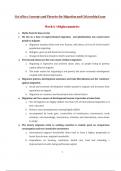
List of Key Concepts and Theories for Migration and Citizenship Exam
Week 1: Origin countries
● Myths from De Haas (2005)
1. We live in a time of unprecedented migration and globalization has caused more
people to migrate.
a. Migration remains fairly even over history, with about 2.5% to 3% of the world's
population migrating
b. Refugees: goes up and down but not increasing
c. Change of direction (South to North) and more visibility of migrants
2. Poverty and misery are the root causes of labour migration
a. Migrating is expensive and involves many risks, so people living in poverty
cannot afford to migrate.
b. The main reason for migrating is not poverty but socio-economic development
coupled with relative deprivation.
3. Migration policies, development assistance and trade liberalization are the 'solutions'
against migration.
a. Social and economic development enables people to migrate and increases their
aspirations to migrate
b. Migration as a resource and investment into a better future
4. Migration can’t be a source of development because it provokes a brain drain
a. Not all migrants are highly skilled: less than 10% of international migration is of
best-educated
b. Reason: mass unemployment among highly skilled
c. Accompanied by brain gain: counterflow of remittances, investments, trade
relations, new knowledge, innovations, attitudes and information; more desire
to study;
5. The money migrants remit to sending countries is mainly spent on conspicuous
consumption and non-productive investment
a. International migrant households often tend to have a higher propensity to
invest than do non-migrant households
b. Expenditure on housing, sanitation, health care, food and schooling =
improvements in well-being and human capital
1
, c. Increase local economic activity
6. The orientation of migrants towards their countries of origin is an indication of the
lack of social and economic integration in the receiving countries' societies
a. There are examples of well integrated individuals who are still very orientated
towards their country of origin
b. Loyalty to sending countries is not necessarily in conflict with good citizenship
in receiving countries
7. States are able to 'manage', largely control or stop migration
a. Impossible to do without curtailing human and civil rights
b. Abandons values of democratic societies
c. Immigration will find a way through undocumented migration and human
smuggling
d. Immigration restriction can lead to more (permanent) migration
Week 2: Why do people migrate? Voluntary
● Functionalist theories
○ Economic perspective, supply and demand
○ Increasing productivity and contributing to greater equality within and between
societies
○ Individual (micro) perspective
○ Migration as a choice
○ Migration is a function of the supply and demand of labour
○ Migration as an equilibrium tool to optimally distribute labour: increasing
productivity and contributing to greater equality between societies
○ Criticism: agency (actors as rational actors with perfect information), lack of
interplay between different non-economic factors to make decisions
● Neoclassical approach
○ Migration is a response to inequality, discrepancy of the economic opportunities
available at the destination and the lack of it at the place of residence - leading to
a more equal distribution of wealth
2
, ○ Focus on the economic drivers of migration.
○ Migration is a choice
○ Inequalities in wealth, labour shortages, wages
○ Workers find jobs that fit their skills better.
○ Critique: agency is missing, doesn’t explain why majority of people don’t
migrate
● New Economics of Labour Migration (NELM)
○ Migration is a household decision, migration is not always individuals’ decision
but a family decision
○ Migration as an investment.
○ Household risk-alleviating strategies: diversify income sources through
remittances
■ Can explain why migration occurs despite the absence of wage
differentials.
■ Proactive, deliberate decision to improve livelihoods and to reduce
fluctuations in rural family incomes
○ Relative deprivation within the original community as a motivating factor, rather
than absolute poverty.
○ Classical example: Sending one family member aboard to work and send wages
back
■ Think of women migrant workers in the UAE as house workers sending
money back to families, mainly in Africa
● Push-pull model
○ disadvantage: it is never entirely clear how the various factors combine together
to cause population movement, only list of factors that may contribute in some
way
● Human capital theory of migration
3
Week 1: Origin countries
● Myths from De Haas (2005)
1. We live in a time of unprecedented migration and globalization has caused more
people to migrate.
a. Migration remains fairly even over history, with about 2.5% to 3% of the world's
population migrating
b. Refugees: goes up and down but not increasing
c. Change of direction (South to North) and more visibility of migrants
2. Poverty and misery are the root causes of labour migration
a. Migrating is expensive and involves many risks, so people living in poverty
cannot afford to migrate.
b. The main reason for migrating is not poverty but socio-economic development
coupled with relative deprivation.
3. Migration policies, development assistance and trade liberalization are the 'solutions'
against migration.
a. Social and economic development enables people to migrate and increases their
aspirations to migrate
b. Migration as a resource and investment into a better future
4. Migration can’t be a source of development because it provokes a brain drain
a. Not all migrants are highly skilled: less than 10% of international migration is of
best-educated
b. Reason: mass unemployment among highly skilled
c. Accompanied by brain gain: counterflow of remittances, investments, trade
relations, new knowledge, innovations, attitudes and information; more desire
to study;
5. The money migrants remit to sending countries is mainly spent on conspicuous
consumption and non-productive investment
a. International migrant households often tend to have a higher propensity to
invest than do non-migrant households
b. Expenditure on housing, sanitation, health care, food and schooling =
improvements in well-being and human capital
1
, c. Increase local economic activity
6. The orientation of migrants towards their countries of origin is an indication of the
lack of social and economic integration in the receiving countries' societies
a. There are examples of well integrated individuals who are still very orientated
towards their country of origin
b. Loyalty to sending countries is not necessarily in conflict with good citizenship
in receiving countries
7. States are able to 'manage', largely control or stop migration
a. Impossible to do without curtailing human and civil rights
b. Abandons values of democratic societies
c. Immigration will find a way through undocumented migration and human
smuggling
d. Immigration restriction can lead to more (permanent) migration
Week 2: Why do people migrate? Voluntary
● Functionalist theories
○ Economic perspective, supply and demand
○ Increasing productivity and contributing to greater equality within and between
societies
○ Individual (micro) perspective
○ Migration as a choice
○ Migration is a function of the supply and demand of labour
○ Migration as an equilibrium tool to optimally distribute labour: increasing
productivity and contributing to greater equality between societies
○ Criticism: agency (actors as rational actors with perfect information), lack of
interplay between different non-economic factors to make decisions
● Neoclassical approach
○ Migration is a response to inequality, discrepancy of the economic opportunities
available at the destination and the lack of it at the place of residence - leading to
a more equal distribution of wealth
2
, ○ Focus on the economic drivers of migration.
○ Migration is a choice
○ Inequalities in wealth, labour shortages, wages
○ Workers find jobs that fit their skills better.
○ Critique: agency is missing, doesn’t explain why majority of people don’t
migrate
● New Economics of Labour Migration (NELM)
○ Migration is a household decision, migration is not always individuals’ decision
but a family decision
○ Migration as an investment.
○ Household risk-alleviating strategies: diversify income sources through
remittances
■ Can explain why migration occurs despite the absence of wage
differentials.
■ Proactive, deliberate decision to improve livelihoods and to reduce
fluctuations in rural family incomes
○ Relative deprivation within the original community as a motivating factor, rather
than absolute poverty.
○ Classical example: Sending one family member aboard to work and send wages
back
■ Think of women migrant workers in the UAE as house workers sending
money back to families, mainly in Africa
● Push-pull model
○ disadvantage: it is never entirely clear how the various factors combine together
to cause population movement, only list of factors that may contribute in some
way
● Human capital theory of migration
3