1|Pag e
ACLS PRE-TEST 2|| PHARMACOLOGY AND
PRACTICAL APPLICATION EXAM
QUESTIONS AND 100% CORRECT ANSWERS||
LATEST AND COMPLETE VERSION 2024-2025
WITH EXPERT VERIFIED SOLUTIONS||
ASSURED PASS!!!
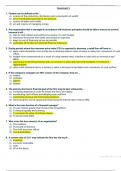
A patient is in cardiac arrest. Ventricular fibrillation has been refractory to an
initial shock. If no pathway for medication administration is in place, which
method is preferred?
Central line
Endotracheal tube
External jugular vein
IV or IO - ANSWER> IV or IO
A patient has sinus bradycardia with a heart rate of 36/min. Atropine has been
administered to a total dose of 3 mg. A transcutaneous pacemaker has failed to
capture. The patient is confused, and her blood pressure is 88/56 mm Hg. Which
therapy is now indicated?
Atropine 1 mg
Epinephrine 2 to 10 mcg/min
Adenosine 6 mg
Normal saline 250 mL to 500 mL bolus - ANSWER> Epinephrine 2 to 10
mcg/min
,2|Pag e
A 62-year-old man suddenly experienced difficulty speaking and left-sided
weakness. He meets initial criteria for fibrinolytic therapy, and a CT scan of the
brain is ordered. Which best describes the guidelines for antiplatelet and
fibrinolytic therapy?
Give aspirin 160 to 325 mg to be chewed immediately
Give aspirin 160 mg and clopidogrel 75 mg orally
Give heparin if the CT scan is negative for hemorrhage
Hold aspirin for at least 24 hours if rtPA is administered - ANSWER> Hold
aspirin for at least 24 hours if rtPA is administered
What is the indication for the use of magnesium in cardiac arrest?
Ventricular tachycardia associated with a normal QT interval
Shock-refractory monomorphic ventricular tachycardia
Pulseless ventricular tachycardia-associated torsades de pointes
Shock-refractory ventricular fibrillation - ANSWER> Pulseless ventricular
tachycardia-associated torsades de pointes
A patient is in cardiac arrest. Ventricular fibrillation has been refractory to a
second shock. Which drug should be administered first?
Atropine 1 mg IV/IO
, 3|Pag e
Epinephrine 1 mg IV/IO
Lidocaine 1 mg/kg IV/IO
Sodium bicarbonate 50 mEq IV/IO - ANSWER> Epinephrine 1 mg IV/IO
Which action should you take immediately after providing an AED shock?
Check the pulse rate
Prepare to deliver a second shock
Resume chest compressions
Start rescue breathing - ANSWER> Resume chest compressions
What action minimizes the risk of air entering the victim's stomach during bag-
mask ventilation?
Ventilating until you see the chest rise
Ventilating as quickly as you can
Squeezing the bag with both hands
Delivering the largest breath you can - ANSWER> Ventilating until you see the
chest rise
Your patient is a 56-year-old woman with a history of type 2 diabetes who reports
feeling dizzy. She is pale and diaphoretic. Her blood pressure is 80/60 mm Hg. The
cardiac monitor documents the rhythm shown here. She is receiving oxygen at 4
L/min by nasal cannula, and an IV has been established. What do you administer
next? (sinus brady)
ACLS PRE-TEST 2|| PHARMACOLOGY AND
PRACTICAL APPLICATION EXAM
QUESTIONS AND 100% CORRECT ANSWERS||
LATEST AND COMPLETE VERSION 2024-2025
WITH EXPERT VERIFIED SOLUTIONS||
ASSURED PASS!!!
A patient is in cardiac arrest. Ventricular fibrillation has been refractory to an
initial shock. If no pathway for medication administration is in place, which
method is preferred?
Central line
Endotracheal tube
External jugular vein
IV or IO - ANSWER> IV or IO
A patient has sinus bradycardia with a heart rate of 36/min. Atropine has been
administered to a total dose of 3 mg. A transcutaneous pacemaker has failed to
capture. The patient is confused, and her blood pressure is 88/56 mm Hg. Which
therapy is now indicated?
Atropine 1 mg
Epinephrine 2 to 10 mcg/min
Adenosine 6 mg
Normal saline 250 mL to 500 mL bolus - ANSWER> Epinephrine 2 to 10
mcg/min
,2|Pag e
A 62-year-old man suddenly experienced difficulty speaking and left-sided
weakness. He meets initial criteria for fibrinolytic therapy, and a CT scan of the
brain is ordered. Which best describes the guidelines for antiplatelet and
fibrinolytic therapy?
Give aspirin 160 to 325 mg to be chewed immediately
Give aspirin 160 mg and clopidogrel 75 mg orally
Give heparin if the CT scan is negative for hemorrhage
Hold aspirin for at least 24 hours if rtPA is administered - ANSWER> Hold
aspirin for at least 24 hours if rtPA is administered
What is the indication for the use of magnesium in cardiac arrest?
Ventricular tachycardia associated with a normal QT interval
Shock-refractory monomorphic ventricular tachycardia
Pulseless ventricular tachycardia-associated torsades de pointes
Shock-refractory ventricular fibrillation - ANSWER> Pulseless ventricular
tachycardia-associated torsades de pointes
A patient is in cardiac arrest. Ventricular fibrillation has been refractory to a
second shock. Which drug should be administered first?
Atropine 1 mg IV/IO
, 3|Pag e
Epinephrine 1 mg IV/IO
Lidocaine 1 mg/kg IV/IO
Sodium bicarbonate 50 mEq IV/IO - ANSWER> Epinephrine 1 mg IV/IO
Which action should you take immediately after providing an AED shock?
Check the pulse rate
Prepare to deliver a second shock
Resume chest compressions
Start rescue breathing - ANSWER> Resume chest compressions
What action minimizes the risk of air entering the victim's stomach during bag-
mask ventilation?
Ventilating until you see the chest rise
Ventilating as quickly as you can
Squeezing the bag with both hands
Delivering the largest breath you can - ANSWER> Ventilating until you see the
chest rise
Your patient is a 56-year-old woman with a history of type 2 diabetes who reports
feeling dizzy. She is pale and diaphoretic. Her blood pressure is 80/60 mm Hg. The
cardiac monitor documents the rhythm shown here. She is receiving oxygen at 4
L/min by nasal cannula, and an IV has been established. What do you administer
next? (sinus brady)