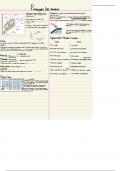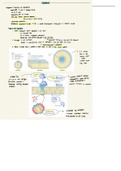
Prokaryotic(ell structure
*
prokaryotes are single-celled organisms which Flagellum -
long ,
fail-like structures adding movement (like a propeller
don't contain a nucleus + its organites are not
Le some have than . 1
membrane-bound
↳ thinner than the equivalent structure in
eutayores (undiitipodia -
sperm flagellam)
and
a ions acros a sempenneable membrane
,
not in a+2 arrangement the movement
↳ much smaller man eukaryotic cells du
meir
electrochemical gradient
↳the E to rotate the filement is provided by kn polso Chemiosmosis not ATP like
+ in
eukaryotes
↳ smaller bosomes >
- 70s compared to 80s in
eukaryores Me is attached to me cell membrane of
flagellum
>
-
a
but molecule instead bacterium by basal
↳ no nucleus
s circular
single a
body + rotated by a molecular motor
↳ all wase that contain murcin (gly lo proteins
>
-
the basal body compromises the Magellum the molecular
motor causes the hook to
urate ::
giving it a whip-like
movement
Differences between Prokaryotes + Eukaryoes :
-
* DNA Zukangsten Krokary
che
↳ the structure of Me DNA in prokaryotes is
fundamentally the same as
eukaryches but it is packaged
↳ has
dyferently a nucleus ↳ no nucleus
↳ they only are molecule
have y DNA , a chromosome , which is supercorted to make it umpact - me me
genes on
GDNA located within nucleus ↳ DNAuntained within
chromosomes are together into operons
oten grouped i a number of genes are switened on /op at me same time cytoplasm
↳ its DNA is circular (no clear start lend) wino proteins in
me cytoplasm
↳ DNA held on linear chromosomes ↳ DNA held on circular chromosomes
formed andear
↳
* Cell wall - made ↳
large
peptidoglycan (also known as murein)
80s bosomes ↳ small bosomes
from
-X more in out of see called mesosomes
Plasmids -
small loops of DNA
have plasmids
↳ ATP
production occurs in mitochondna ↳ ATP
production in infolded regionsof membrane
↳ separate from the main DNA molecule
>
-
only some prokary des
↳ contains h ↳
genes that can be passed between prokaryotes 1 .
g antibiotic resistance
. may have undulipodia may have flagella
Le
* slime capsule -
only some prokaryotes (bacrena) cemuse based all wall ↳
peptidoglycan based all wall
↳ a final layer
membranc
↳ prteck it
from drying out ↳ have phospholipid bi-layer ↳ ribosomes the site
I protects
a all are
y protein synthesis
↓
it from by
attacks cells of te immune
system of the host organism -
prevents phagocytosis
↳ has ↳ membrane bound
membrane bound
organales no
organdles
Binary fission :
ro+ any plasmids
O the single , circular DNA molecule undergo DNA replication
② parent cl divides - 2 cells
, cytoplasm roughly halved
between I daughter als
⑤ 2 daughter cells each contain a
copyy Ms circular
DNA molecule - avariable number o plasmids
* there are mechanisms to ensure that all daughter
cells inherit a copyy the single , circular DNA + plasmids
↳ wo it it will die
*
prokaryotes are single-celled organisms which Flagellum -
long ,
fail-like structures adding movement (like a propeller
don't contain a nucleus + its organites are not
Le some have than . 1
membrane-bound
↳ thinner than the equivalent structure in
eutayores (undiitipodia -
sperm flagellam)
and
a ions acros a sempenneable membrane
,
not in a+2 arrangement the movement
↳ much smaller man eukaryotic cells du
meir
electrochemical gradient
↳the E to rotate the filement is provided by kn polso Chemiosmosis not ATP like
+ in
eukaryotes
↳ smaller bosomes >
- 70s compared to 80s in
eukaryores Me is attached to me cell membrane of
flagellum
>
-
a
but molecule instead bacterium by basal
↳ no nucleus
s circular
single a
body + rotated by a molecular motor
↳ all wase that contain murcin (gly lo proteins
>
-
the basal body compromises the Magellum the molecular
motor causes the hook to
urate ::
giving it a whip-like
movement
Differences between Prokaryotes + Eukaryoes :
-
* DNA Zukangsten Krokary
che
↳ the structure of Me DNA in prokaryotes is
fundamentally the same as
eukaryches but it is packaged
↳ has
dyferently a nucleus ↳ no nucleus
↳ they only are molecule
have y DNA , a chromosome , which is supercorted to make it umpact - me me
genes on
GDNA located within nucleus ↳ DNAuntained within
chromosomes are together into operons
oten grouped i a number of genes are switened on /op at me same time cytoplasm
↳ its DNA is circular (no clear start lend) wino proteins in
me cytoplasm
↳ DNA held on linear chromosomes ↳ DNA held on circular chromosomes
formed andear
↳
* Cell wall - made ↳
large
peptidoglycan (also known as murein)
80s bosomes ↳ small bosomes
from
-X more in out of see called mesosomes
Plasmids -
small loops of DNA
have plasmids
↳ ATP
production occurs in mitochondna ↳ ATP
production in infolded regionsof membrane
↳ separate from the main DNA molecule
>
-
only some prokary des
↳ contains h ↳
genes that can be passed between prokaryotes 1 .
g antibiotic resistance
. may have undulipodia may have flagella
Le
* slime capsule -
only some prokaryotes (bacrena) cemuse based all wall ↳
peptidoglycan based all wall
↳ a final layer
membranc
↳ prteck it
from drying out ↳ have phospholipid bi-layer ↳ ribosomes the site
I protects
a all are
y protein synthesis
↓
it from by
attacks cells of te immune
system of the host organism -
prevents phagocytosis
↳ has ↳ membrane bound
membrane bound
organales no
organdles
Binary fission :
ro+ any plasmids
O the single , circular DNA molecule undergo DNA replication
② parent cl divides - 2 cells
, cytoplasm roughly halved
between I daughter als
⑤ 2 daughter cells each contain a
copyy Ms circular
DNA molecule - avariable number o plasmids
* there are mechanisms to ensure that all daughter
cells inherit a copyy the single , circular DNA + plasmids
↳ wo it it will die