

Isomerism
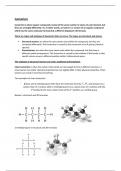
Isomerism is when organic compounds consist of the same number of atoms of each element, but
they are arranged differently. So, in other words, an isomer is a version of an organic compound
which has the same molecular formula but a different displayed /3D formula.
There are types and subtypes of isomerism that can occur. The types are structural and stereo:
Structural Isomers are when the same atoms exist within the compound, but they are
connected differently. This isomerism is caused by the movement of an R group (chemical
species).
Stereoisomers are when the same atoms exist within the compound, but they have a
different spatial arrangement. This isomerism is caused by the rotation of the bonds so that
specific atoms occupy a different position within 3-dimensional space.
The subtypes of structural isomers are chain, positional and functional:
Chain isomerism is when the carbon chain bonds are rearranged to form a different structure. A
chain isomer has similar chemical properties but can slightly differ in their physical properties. Chain
isomers can result in more/less branching.
Two examples of chain isomerism:
Butane and 2-methylpropane both have the molecular formula, C 4 H 10 but butane has a
carbon chain of 4 carbons while 2-methylpropane has a carbon chain of 3 carbons with the
4th bonded to the main carbon chain at the 2 nd position as a methyl group.
Butane’s structural and 3D formulae:
2-methylpropane's structural and 3D formulae:
, Difference of chemical properties Difference of physical properties
2-methylpropane is less reactive. The 2-methylpropane has a lower boiling
hyper conjugated resonance structure point. The more branching, the lower
of butane involves a primary the boiling point because branching
carbocation while the hyper conjugated weakens the intermolecular forces that
resonance structure of 2- exist between linear carbons and
methylpropane involves a more stable decreases the surface area.
secondary carbocation. 2-methylpropane is slightly more
soluble in water. The more branching,
the higher the solubility of the
molecule because of the decreased
surface area.
2-methylpropane has a lower density.
The more branching, the lower the
density.
Pentane and 2-methylbutane both have the molecular formula, C 5 H 12 but pentane has a
carbon chain of 5 carbons while 2-methylbutnane has a carbon chain of 4 carbons with the
5th carbon bonded at the 2nd position of the main chain as a methyl group.
Pentane’s structural and 3D formulae:
2-methylbutane's structural and 3D formulae:
Difference of chemical properties Difference of physical properties
2-methylbutane is less reactive. 2-methylbutane has a lower boiling
point.
2-methylbutane is slightly more soluble
in water.
2-methylbutane has a lower density.
Isomerism is when organic compounds consist of the same number of atoms of each element, but
they are arranged differently. So, in other words, an isomer is a version of an organic compound
which has the same molecular formula but a different displayed /3D formula.
There are types and subtypes of isomerism that can occur. The types are structural and stereo:
Structural Isomers are when the same atoms exist within the compound, but they are
connected differently. This isomerism is caused by the movement of an R group (chemical
species).
Stereoisomers are when the same atoms exist within the compound, but they have a
different spatial arrangement. This isomerism is caused by the rotation of the bonds so that
specific atoms occupy a different position within 3-dimensional space.
The subtypes of structural isomers are chain, positional and functional:
Chain isomerism is when the carbon chain bonds are rearranged to form a different structure. A
chain isomer has similar chemical properties but can slightly differ in their physical properties. Chain
isomers can result in more/less branching.
Two examples of chain isomerism:
Butane and 2-methylpropane both have the molecular formula, C 4 H 10 but butane has a
carbon chain of 4 carbons while 2-methylpropane has a carbon chain of 3 carbons with the
4th bonded to the main carbon chain at the 2 nd position as a methyl group.
Butane’s structural and 3D formulae:
2-methylpropane's structural and 3D formulae:
, Difference of chemical properties Difference of physical properties
2-methylpropane is less reactive. The 2-methylpropane has a lower boiling
hyper conjugated resonance structure point. The more branching, the lower
of butane involves a primary the boiling point because branching
carbocation while the hyper conjugated weakens the intermolecular forces that
resonance structure of 2- exist between linear carbons and
methylpropane involves a more stable decreases the surface area.
secondary carbocation. 2-methylpropane is slightly more
soluble in water. The more branching,
the higher the solubility of the
molecule because of the decreased
surface area.
2-methylpropane has a lower density.
The more branching, the lower the
density.
Pentane and 2-methylbutane both have the molecular formula, C 5 H 12 but pentane has a
carbon chain of 5 carbons while 2-methylbutnane has a carbon chain of 4 carbons with the
5th carbon bonded at the 2nd position of the main chain as a methyl group.
Pentane’s structural and 3D formulae:
2-methylbutane's structural and 3D formulae:
Difference of chemical properties Difference of physical properties
2-methylbutane is less reactive. 2-methylbutane has a lower boiling
point.
2-methylbutane is slightly more soluble
in water.
2-methylbutane has a lower density.


