

Unit 14.2 – Aromatic ring chemistry for designer chemicals
Aromatic compounds are any compound than include a benzene ring:
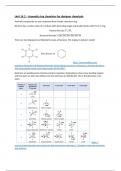
Benzene has a carbon chain of 6 carbons with alternating single and double bonds which form a ring.
General formula: 𝐶 6 𝐻 6
Structural formula: 𝐶𝐻𝐶𝐻𝐶𝐻𝐶𝐻𝐶𝐻𝐶𝐻
There are two Displayed and Skeletal formulas of benzene. The original is kekule’s model:
https://www.embibe.com/
questions/Draw-the-full-displayed-formula-of-the-Kekule-structure-of-benzene,-showing-all-atoms-
and-using-double-bonds-and-single-bonds./EM8110617
Electrons are positioned to minimise electron repulsion. Depending on how many bonding regions
and lone pairs an atom has defines how the electrons are distributed. This is the geometry of an
atom.
https://
courses.lumenlearning.com/sanjacinto-atdcoursereview-chemistry1-1/chapter/molecular-structure-
and-polarity/
, Each carbon within benzene has 3 bonding regions and no lone pairs which is trigonal planar
geometry meaning the bond angle is 120.
The Kekule model did not support benzene’s physical/chemical properties and was proved incorrect
by 3 major faults:
The double bonds of unsaturated compounds cause them to readily undergo nucleophilic
/electrophilic addition. Typically, when an unsaturated organic compound is added to
bromine water, the double bond within the unsaturated compound attracts the bromine
electrophile and electrophilic addition occurs, resulting in decolourisation of the bromine
water. The double bonds within benzene should allow benzene to readily undergo
electrophilic addition, but when benzene is reacted with bromine water, the bromine water
remains its natural yellow colour. Benzene’s inability to decolourise the bromine water and
other reactions prove that benzene does not readily undergo electrophilic addition and has a
lower reactivity (electronegativity) than initially perceived in the model.
A hydrogenation reaction is when 𝐻 2 acts as a reactant. Unsaturated organic compounds
react with 𝐻 2 to become saturated. The more double bonds within the organic compound,
the more energy lost during the hydrogenation. Using the enthalpy change of the
hydrogenation of cyclohexene, you can predict the enthalpy change of the hydrogenation of
benzene.
https://www.goconqr.com/note/451767/structure-of-benzene
If the enthalpy change to saturate an organic compound with one double bond is 120 𝑘𝐽𝑚𝑜 𝑙− 1, the
expected enthalpy change to saturate an organic compound with three double bonds should be 3
times as much; -360𝑘𝐽𝑚𝑜 𝑙− 1. However, based on experimental data, the enthalpy change of the
hydrogenation of benzene is -208𝑘𝐽𝑚𝑜 𝑙− 1 which is means benzene released 152𝑘𝐽𝑚𝑜 𝑙− 1 less
than expected. This proves that benzene is more energetically stable than predicted by the model.
Typically, double bonds are shorter than single bonds; double bond length is 0.134nm, single
bond length is 0.153nm. So, the Kekule model of benzene represents the length difference
between the alternating single and double bonds. However, based on x-ray crystallography
studies, all carbon-carbon bonds within benzene have the same length of 0.140nm.
As a result, the Kekule model was officially disproved. A more accurate model of benzene known as
the delocalised model was developed:
Aromatic compounds are any compound than include a benzene ring:
Benzene has a carbon chain of 6 carbons with alternating single and double bonds which form a ring.
General formula: 𝐶 6 𝐻 6
Structural formula: 𝐶𝐻𝐶𝐻𝐶𝐻𝐶𝐻𝐶𝐻𝐶𝐻
There are two Displayed and Skeletal formulas of benzene. The original is kekule’s model:
https://www.embibe.com/
questions/Draw-the-full-displayed-formula-of-the-Kekule-structure-of-benzene,-showing-all-atoms-
and-using-double-bonds-and-single-bonds./EM8110617
Electrons are positioned to minimise electron repulsion. Depending on how many bonding regions
and lone pairs an atom has defines how the electrons are distributed. This is the geometry of an
atom.
https://
courses.lumenlearning.com/sanjacinto-atdcoursereview-chemistry1-1/chapter/molecular-structure-
and-polarity/
, Each carbon within benzene has 3 bonding regions and no lone pairs which is trigonal planar
geometry meaning the bond angle is 120.
The Kekule model did not support benzene’s physical/chemical properties and was proved incorrect
by 3 major faults:
The double bonds of unsaturated compounds cause them to readily undergo nucleophilic
/electrophilic addition. Typically, when an unsaturated organic compound is added to
bromine water, the double bond within the unsaturated compound attracts the bromine
electrophile and electrophilic addition occurs, resulting in decolourisation of the bromine
water. The double bonds within benzene should allow benzene to readily undergo
electrophilic addition, but when benzene is reacted with bromine water, the bromine water
remains its natural yellow colour. Benzene’s inability to decolourise the bromine water and
other reactions prove that benzene does not readily undergo electrophilic addition and has a
lower reactivity (electronegativity) than initially perceived in the model.
A hydrogenation reaction is when 𝐻 2 acts as a reactant. Unsaturated organic compounds
react with 𝐻 2 to become saturated. The more double bonds within the organic compound,
the more energy lost during the hydrogenation. Using the enthalpy change of the
hydrogenation of cyclohexene, you can predict the enthalpy change of the hydrogenation of
benzene.
https://www.goconqr.com/note/451767/structure-of-benzene
If the enthalpy change to saturate an organic compound with one double bond is 120 𝑘𝐽𝑚𝑜 𝑙− 1, the
expected enthalpy change to saturate an organic compound with three double bonds should be 3
times as much; -360𝑘𝐽𝑚𝑜 𝑙− 1. However, based on experimental data, the enthalpy change of the
hydrogenation of benzene is -208𝑘𝐽𝑚𝑜 𝑙− 1 which is means benzene released 152𝑘𝐽𝑚𝑜 𝑙− 1 less
than expected. This proves that benzene is more energetically stable than predicted by the model.
Typically, double bonds are shorter than single bonds; double bond length is 0.134nm, single
bond length is 0.153nm. So, the Kekule model of benzene represents the length difference
between the alternating single and double bonds. However, based on x-ray crystallography
studies, all carbon-carbon bonds within benzene have the same length of 0.140nm.
As a result, the Kekule model was officially disproved. A more accurate model of benzene known as
the delocalised model was developed:


