Bioethics:
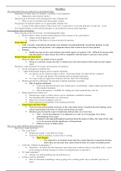
The relationship between medical law and medical ethics:
- Importance of ethics due to its tradition - tradition of self-regulation
o Hippocratic oath [Ancient Greek]
- Questions go to the heart of the meaning and value of human life
o What we do to our bodies and other people’s bodies.
- The practice of medicine affects us in a particularly intimate way
o ie some of the subject matter of this course will be personal in a way that land law or trusts law is not.
- If no shared religion, secular ethical principles or moral theories become more important
From medical ethics to bioethics:
- Shift took place from last 50 years- not interchangeable terms.
o Medical ethics= ethics of good medical practice-what it means to be a good doctor.
Origins in the Hippocratic oath
Emphasis of the duties of a doctor towards his patients.
- Susan Sherwin
o Until v recently, conscientious physicians were trained to act paternalistically toward their patients, to treat
patients according to the physician’s own judgement about what would be best for their patients
o Problem:
Health care may involve such intimate and central aspects of a patient’s life = difficult for anyone other
than the patient to make choices that will be compatible with that patient’s personal value system
- Heather Draper and Tom Sorrell
o There are duties not to use health services casually
Doing so is morally wrong since they’re taking away time and resources better spent on more urgent
cases
- Bioethics= wider questions for society in the practice of medicine:
o Social consequences medicine has
o ‘–rapid technological progress poses complex dilemmas
eg what do you do if parents refuse to allow brain dead child to be taken off the ventilator?
Is it up to the parent? The potential limits of paternal autonomy.
Is it okay to take an organ from someone who has ‘died’ but is breathing?
o Medical paternalism challenged, the principle of patient autonomy ascendant.
Rise of patient autonomy.
Used to be that doctors knew best. People aren’t as deferential - right to make decisions about
their medical treatment.
Due to the internet-> WebMD etc- finding out what treatment they want etc.
o Might patients have duties too?
Patients have a duty to follow advice- not to contribute to antibiotic resistant
Not spreading false information e.g. antivaxxers
Duty not to overuse healthcare services.
Public/political accountability of the medical profession
o Helga Kuhse and Peter Singer
There has been greater public awareness of the value-laden nature of medical decision-making, and a
critical questioning of the basis on which such decisions are made
Bioethics goes beyond the scope of traditional medical ethics in several ways.
Goal = not the development of, or adherence to a code or set of precepts, but a better
understanding of the issues
Prepared to ask deep philosophical questions about the nature of ethics, the value of life, what
it is to be a person and the significance of being human
Embraces issues of public policy
How do we make difficult ethical decisions?
- Bad ways to make decisions:
o The ‘yuck factor’:
People just saying: ‘I just think its wrong’
Need to be able to articulate a reason why it’s wrong
Mark Sheehan
o The subjectivity of emotions means that they cannot function in arguments because,
unless they are universal, they cannot form the basis of a claim on another person
o Is this the ‘wisdom of repugnance’?
Bioethicist - he thinks that this represents some deep inner wisdom [when we just think yuck] - says it
in the context of human cloning- we know its wrong because we just feel it
o Or ‘nasal reasoning’?
Orwell- you sniff a problem and can tell what it is
o Is there a role for emotions?
How we feel about something is always going to be a starting point- but we shouldn’t just leave it
there.
The relationship between medical law and medical ethics:
- Importance of ethics due to its tradition - tradition of self-regulation
o Hippocratic oath [Ancient Greek]
- Questions go to the heart of the meaning and value of human life
o What we do to our bodies and other people’s bodies.
- The practice of medicine affects us in a particularly intimate way
o ie some of the subject matter of this course will be personal in a way that land law or trusts law is not.
- If no shared religion, secular ethical principles or moral theories become more important
From medical ethics to bioethics:
- Shift took place from last 50 years- not interchangeable terms.
o Medical ethics= ethics of good medical practice-what it means to be a good doctor.
Origins in the Hippocratic oath
Emphasis of the duties of a doctor towards his patients.
- Susan Sherwin
o Until v recently, conscientious physicians were trained to act paternalistically toward their patients, to treat
patients according to the physician’s own judgement about what would be best for their patients
o Problem:
Health care may involve such intimate and central aspects of a patient’s life = difficult for anyone other
than the patient to make choices that will be compatible with that patient’s personal value system
- Heather Draper and Tom Sorrell
o There are duties not to use health services casually
Doing so is morally wrong since they’re taking away time and resources better spent on more urgent
cases
- Bioethics= wider questions for society in the practice of medicine:
o Social consequences medicine has
o ‘–rapid technological progress poses complex dilemmas
eg what do you do if parents refuse to allow brain dead child to be taken off the ventilator?
Is it up to the parent? The potential limits of paternal autonomy.
Is it okay to take an organ from someone who has ‘died’ but is breathing?
o Medical paternalism challenged, the principle of patient autonomy ascendant.
Rise of patient autonomy.
Used to be that doctors knew best. People aren’t as deferential - right to make decisions about
their medical treatment.
Due to the internet-> WebMD etc- finding out what treatment they want etc.
o Might patients have duties too?
Patients have a duty to follow advice- not to contribute to antibiotic resistant
Not spreading false information e.g. antivaxxers
Duty not to overuse healthcare services.
Public/political accountability of the medical profession
o Helga Kuhse and Peter Singer
There has been greater public awareness of the value-laden nature of medical decision-making, and a
critical questioning of the basis on which such decisions are made
Bioethics goes beyond the scope of traditional medical ethics in several ways.
Goal = not the development of, or adherence to a code or set of precepts, but a better
understanding of the issues
Prepared to ask deep philosophical questions about the nature of ethics, the value of life, what
it is to be a person and the significance of being human
Embraces issues of public policy
How do we make difficult ethical decisions?
- Bad ways to make decisions:
o The ‘yuck factor’:
People just saying: ‘I just think its wrong’
Need to be able to articulate a reason why it’s wrong
Mark Sheehan
o The subjectivity of emotions means that they cannot function in arguments because,
unless they are universal, they cannot form the basis of a claim on another person
o Is this the ‘wisdom of repugnance’?
Bioethicist - he thinks that this represents some deep inner wisdom [when we just think yuck] - says it
in the context of human cloning- we know its wrong because we just feel it
o Or ‘nasal reasoning’?
Orwell- you sniff a problem and can tell what it is
o Is there a role for emotions?
How we feel about something is always going to be a starting point- but we shouldn’t just leave it
there.