Mucosal immunity and innate lymphoid cells – Bianca
Blom
3-25
Natural killer (NK) cells should be able to distinguish between infected and healthy cells. An NK cell
expresses various combinations of germline encoded activating and inhibitory receptors. Overall
balance of signalling of these receptors kill or not to kill (integration of signals). Receptors
recognise changes in expression of surface proteins dysregulated self.
The activating receptors recognise surface proteins induced by metabolic stress stress induced
self. DNA damage, signals related to proliferation, heat shock stress, innate sensors including TLRs
expression surface proteins recognised by activating receptors NK cells release IFNgamma
killing via cytotoxic granules.
The inhibitory receptors recognise surface molecules that are constitutively expressed, loss of these
missing self. Recognising MHC class I molecules are most famous, they are expressed on every
cell of the body (except red blood cells) and inhibit NK cells from killing the target cell. More MHC I
more protection.
Interferons induce expression of MHC I & activates NK cell to kill infected cells.
Downregulation of MHC I by pathogens to prevent display of antigens to T cells
From figure: NK expresses TRAIL on surface, binds and activate DR4 & DR5 by target cells signal
via FADD activate caspase 8 apoptosis.
12-1
First line of defence mucus secreting epithelium (gastrointestinal tract, upper and lower
respiratory tract, urogenital tract and middle ear) & exocrine glands of eye, salivary, breast. Also
skin. This is called the mucosal immune system.
The lymph nodes and spleen: Systemic immune system.
Mucosal surfaces are thin and permeable barriers to the interior of the body need defence.
Mucosal surfaces are also portals of entry for antigens that are not pathogenic like in the gut (food).
There are also commensal
microorganisms/microbiota. We have more bacteria
than body cells and there are also viruses and fungi.
Normally these do not harm beneficial for host
(metabolic and immune function). When the immune
system reacts:
Celiac disease: Immune response to gluten.
Crohn’s disease: Response to commensal
bacteria.
12-3
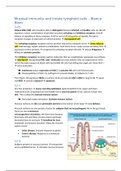
Antigens present at mucosal surfaces transported
across epithelial barrier stimulate mucosal immune
, system. Peyer’s patches and isolated lymphoid follicles (both M cells: endo/phagocytosis) are
adapted for uptake of antigens from intestinal lumen.
M cells recognise FimH protein on bacteria via glycoprotein 2 (GP2). Material is transported through
interior of the cell in membrane bound vesicles basal cell membrane released into
extracellular space (transcytosis). Some pathogens target M cells to gain excess to subepithelial
space (salmonella, shigella, yersinia pestis, poliovirus, reovirus, retroviruses like HIV, prions from
scrapie) because they lack glycocalyx (mucous layer?). After entry into M cell proteins produced
by bacteria that reorganise M cell cytoskeleton more transcytosis.
Basal cell membrane of M cell extremely folded pocket that encloses lymphocytes and makes
close contacts with local myeloid cells like DCs. Macrophages and DCs take up materials from M cells
processed presentation for T cells. DCs are recruited to follicle associated epithelium by
chemokines CCL20, CCL9 which bind to CCR6, CCR1 (respectively).
The antigen loaded DCs migrate from dome region to T cell areas of Peyer’s patch activate
naive T cells T cells & DC activate B cells & IgA class switch
12-4
Mucosal surfaces such as gut and lung contain enormous numbers of lymphocytes and other
leukocytes scattered throughout the tissue (not only organised). Most of them are effector cells,
found in two main compartments: epithelium & lamina propria.
Epithelium: Mainly lymphocytes (small intestine: CD8 T cells).
o Intraepithelial lymphocytes (IELs) mostly CD8 with conventional alfa:beta CD8 or
alfa:alfa CD8 homodimer probably dampens T cell activation. Express CCR9 and
integrin alfaEbeta7 binds E cadherin on epithelial cells.
Lamina propria: IgA producing plasma cells, conventional CD4 and CD8 T cells (effector &
memory), innate lymphoid cells, DCs, macrophages & mast cells.
o T cells in lamina propria express integrin alfa4beta7 and chemokine receptor CCR9
go into tissue from blood. Mostly CD4 T cells.
Healthy intestinal mucosa many characteristics of chronic inflammatory response (presence of
many effector cells). It is essential for maintaining beneficial symbiosis between host and microbiota.
Balanced generation of effector and regulatory T cells.
12-7
DCs are important for initiating and shaping immune responses in mucosal tissues, located in
secondary mucosal lymphoid organs and scattered throughout mucosal surfaces.
Blom
3-25
Natural killer (NK) cells should be able to distinguish between infected and healthy cells. An NK cell
expresses various combinations of germline encoded activating and inhibitory receptors. Overall
balance of signalling of these receptors kill or not to kill (integration of signals). Receptors
recognise changes in expression of surface proteins dysregulated self.
The activating receptors recognise surface proteins induced by metabolic stress stress induced
self. DNA damage, signals related to proliferation, heat shock stress, innate sensors including TLRs
expression surface proteins recognised by activating receptors NK cells release IFNgamma
killing via cytotoxic granules.
The inhibitory receptors recognise surface molecules that are constitutively expressed, loss of these
missing self. Recognising MHC class I molecules are most famous, they are expressed on every
cell of the body (except red blood cells) and inhibit NK cells from killing the target cell. More MHC I
more protection.
Interferons induce expression of MHC I & activates NK cell to kill infected cells.
Downregulation of MHC I by pathogens to prevent display of antigens to T cells
From figure: NK expresses TRAIL on surface, binds and activate DR4 & DR5 by target cells signal
via FADD activate caspase 8 apoptosis.
12-1
First line of defence mucus secreting epithelium (gastrointestinal tract, upper and lower
respiratory tract, urogenital tract and middle ear) & exocrine glands of eye, salivary, breast. Also
skin. This is called the mucosal immune system.
The lymph nodes and spleen: Systemic immune system.
Mucosal surfaces are thin and permeable barriers to the interior of the body need defence.
Mucosal surfaces are also portals of entry for antigens that are not pathogenic like in the gut (food).
There are also commensal
microorganisms/microbiota. We have more bacteria
than body cells and there are also viruses and fungi.
Normally these do not harm beneficial for host
(metabolic and immune function). When the immune
system reacts:
Celiac disease: Immune response to gluten.
Crohn’s disease: Response to commensal
bacteria.
12-3
Antigens present at mucosal surfaces transported
across epithelial barrier stimulate mucosal immune
, system. Peyer’s patches and isolated lymphoid follicles (both M cells: endo/phagocytosis) are
adapted for uptake of antigens from intestinal lumen.
M cells recognise FimH protein on bacteria via glycoprotein 2 (GP2). Material is transported through
interior of the cell in membrane bound vesicles basal cell membrane released into
extracellular space (transcytosis). Some pathogens target M cells to gain excess to subepithelial
space (salmonella, shigella, yersinia pestis, poliovirus, reovirus, retroviruses like HIV, prions from
scrapie) because they lack glycocalyx (mucous layer?). After entry into M cell proteins produced
by bacteria that reorganise M cell cytoskeleton more transcytosis.
Basal cell membrane of M cell extremely folded pocket that encloses lymphocytes and makes
close contacts with local myeloid cells like DCs. Macrophages and DCs take up materials from M cells
processed presentation for T cells. DCs are recruited to follicle associated epithelium by
chemokines CCL20, CCL9 which bind to CCR6, CCR1 (respectively).
The antigen loaded DCs migrate from dome region to T cell areas of Peyer’s patch activate
naive T cells T cells & DC activate B cells & IgA class switch
12-4
Mucosal surfaces such as gut and lung contain enormous numbers of lymphocytes and other
leukocytes scattered throughout the tissue (not only organised). Most of them are effector cells,
found in two main compartments: epithelium & lamina propria.
Epithelium: Mainly lymphocytes (small intestine: CD8 T cells).
o Intraepithelial lymphocytes (IELs) mostly CD8 with conventional alfa:beta CD8 or
alfa:alfa CD8 homodimer probably dampens T cell activation. Express CCR9 and
integrin alfaEbeta7 binds E cadherin on epithelial cells.
Lamina propria: IgA producing plasma cells, conventional CD4 and CD8 T cells (effector &
memory), innate lymphoid cells, DCs, macrophages & mast cells.
o T cells in lamina propria express integrin alfa4beta7 and chemokine receptor CCR9
go into tissue from blood. Mostly CD4 T cells.
Healthy intestinal mucosa many characteristics of chronic inflammatory response (presence of
many effector cells). It is essential for maintaining beneficial symbiosis between host and microbiota.
Balanced generation of effector and regulatory T cells.
12-7
DCs are important for initiating and shaping immune responses in mucosal tissues, located in
secondary mucosal lymphoid organs and scattered throughout mucosal surfaces.