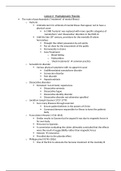
Lecture 7 - Behaviourism
Introduction
o Associationism turn to behaviourism and learning by association became known
as conditioning
o Different types of behaviourism
Logical behaviourism
A movement in philosophy that consider mental states as nothing
more than behavioural tendencies that are motivated by the
environment
Problematic in relation to epistemic mental states
o Sometimes our behaviour is driven by what we believe
rather than what is actually the case
Methodological/psychological behaviourism
A movement in psychology that seeks to explain human and
animal behaviour in terms of environmental stimuli and learning
histories
Key People
o J.B. Watson (1878-1958)
Behaviourist like Watson (1913) discarded ‘inner’ mental processes and
pursued only scientifically observable facts
Stimulus response psychology
Organisms viewed as tabula rasa (blank slate) upon which all knowledge
is inscribed by learning
The approach became so influential that it led to a re-definition of
‘psychology’ as the science of behaviour
Away from science of the mind
Provided an ‘antidote’ to Freudian Psychodynamic theory
Suggested that individuals and society can be shaped almost at will
“its theoretical goal is the prediction and control of behaviour”
behaviourist principles included:
reflex is the basic unit of analysis
o all behaviour consists of reflexes
no distinction between animal/human behaviour
all learning is by classical conditioning
complex behaviours based on simpler ones
o simpler behaviours build together into complex
behaviours
complete explanations are possible
“personality is the totality of all reflexes we have built into our
repertoire of behaviours”
almost entirely opposed to nativism
o thought there were some predispositions to learning
Watson & Rayner (1920)
Introduction
o Associationism turn to behaviourism and learning by association became known
as conditioning
o Different types of behaviourism
Logical behaviourism
A movement in philosophy that consider mental states as nothing
more than behavioural tendencies that are motivated by the
environment
Problematic in relation to epistemic mental states
o Sometimes our behaviour is driven by what we believe
rather than what is actually the case
Methodological/psychological behaviourism
A movement in psychology that seeks to explain human and
animal behaviour in terms of environmental stimuli and learning
histories
Key People
o J.B. Watson (1878-1958)
Behaviourist like Watson (1913) discarded ‘inner’ mental processes and
pursued only scientifically observable facts
Stimulus response psychology
Organisms viewed as tabula rasa (blank slate) upon which all knowledge
is inscribed by learning
The approach became so influential that it led to a re-definition of
‘psychology’ as the science of behaviour
Away from science of the mind
Provided an ‘antidote’ to Freudian Psychodynamic theory
Suggested that individuals and society can be shaped almost at will
“its theoretical goal is the prediction and control of behaviour”
behaviourist principles included:
reflex is the basic unit of analysis
o all behaviour consists of reflexes
no distinction between animal/human behaviour
all learning is by classical conditioning
complex behaviours based on simpler ones
o simpler behaviours build together into complex
behaviours
complete explanations are possible
“personality is the totality of all reflexes we have built into our
repertoire of behaviours”
almost entirely opposed to nativism
o thought there were some predispositions to learning
Watson & Rayner (1920)