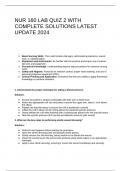
NUR 160 LAB QUIZ 2 WITH
COMPLETE SOLUTIONS LATEST
UPDATE 2024
1. Basic Nursing Skills: This could include vital signs, administering injections, wound
care, or catheterization.
2. Equipment and Instruments: Be familiar with the purpose and proper use of various
lab tools and equipment.
3. Procedural Knowledge: Understanding step-by-step procedures for common nursing
tasks.
4. Safety and Hygiene: Protocols for infection control, proper hand washing, and use of
personal protective equipment (PPE).
5. Critical Thinking and Application: Scenarios that test your ability to apply theoretical
knowledge in practical situations.
1. Demonstrate the proper technique for taking a blood pressure.
Solution:
● Ensure the patient is seated comfortably with their arm at heart level.
● Select the appropriate cuff size and place it around the upper arm, about 1 inch above
the elbow.
● Palpate the brachial artery to ensure the cuff is positioned correctly.
● Inflate the cuff to about 20-30 mmHg above the expected systolic pressure.
● Slowly deflate the cuff while listening with a stethoscope placed over the brachial artery.
● Note the systolic pressure (first sound) and diastolic pressure (last sound).
2. What are the key steps in performing sterile wound dressing?
Solution:
● Perform hand hygiene before starting the procedure.
● Open the sterile dressing pack and prepare sterile gloves.
● Gently remove the old dressing, being careful not to disturb the wound.
● Clean the wound as per the wound care protocol using sterile saline or an appropriate
antiseptic.
● Apply a new sterile dressing, ensuring it covers the wound completely and securely.
COMPLETE SOLUTIONS LATEST
UPDATE 2024
1. Basic Nursing Skills: This could include vital signs, administering injections, wound
care, or catheterization.
2. Equipment and Instruments: Be familiar with the purpose and proper use of various
lab tools and equipment.
3. Procedural Knowledge: Understanding step-by-step procedures for common nursing
tasks.
4. Safety and Hygiene: Protocols for infection control, proper hand washing, and use of
personal protective equipment (PPE).
5. Critical Thinking and Application: Scenarios that test your ability to apply theoretical
knowledge in practical situations.
1. Demonstrate the proper technique for taking a blood pressure.
Solution:
● Ensure the patient is seated comfortably with their arm at heart level.
● Select the appropriate cuff size and place it around the upper arm, about 1 inch above
the elbow.
● Palpate the brachial artery to ensure the cuff is positioned correctly.
● Inflate the cuff to about 20-30 mmHg above the expected systolic pressure.
● Slowly deflate the cuff while listening with a stethoscope placed over the brachial artery.
● Note the systolic pressure (first sound) and diastolic pressure (last sound).
2. What are the key steps in performing sterile wound dressing?
Solution:
● Perform hand hygiene before starting the procedure.
● Open the sterile dressing pack and prepare sterile gloves.
● Gently remove the old dressing, being careful not to disturb the wound.
● Clean the wound as per the wound care protocol using sterile saline or an appropriate
antiseptic.
● Apply a new sterile dressing, ensuring it covers the wound completely and securely.