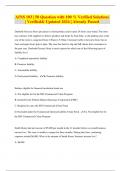
AINS 103 | 50 Question with 100 % Verified Solutions
| Verified& Updated 2024 | Already Passed
Danforth Grocery Store specializes in fresh produce and is open 24 hours year-round. The store
has contracts with suppliers to deliver produce and foods by 5am daily, so the parking area at the
rear of the store is congested from 4:30am to 5:30am. Customer traffic is heaviest from 7am to
9am, and again from 3pm to 6pm. The store has had six slip and fall claims from customers in
the past year. Danforth Grocery Store is most exposed to which one of the following types of
liability loss?
A. Completed operations liability
B. Premises liability
C. Automobile liability
D. Professional liability - ✔✔B. Premises liability
Entities eligible for financial institution bonds are
A. Not eligible for for the ISO Commercial Crime Program
B. Insured by the Federal Deposit Insurance Corporation (FDIC)
C. Required to carry the ISO Commercial Crime Form
D. Excluded under the Commercial General Liability Crime Form - ✔✔A. Not eligible for for
the ISO Commercial Crime Program
Smith Stores had net income of $5,000 per month in the 12 months before a covered business
income loss. The store is unable to reopen for three months. During that time, continuing
expenses totaled $6,000. What is the amount of Smith Stores' business income loss?
A. $6,000
,B. $15,000
C. $21,000
D. $66,000 - ✔✔C. $21,000
The business was interrupted for three months, for a business income loss of $15,000, plus
continuing expenses of $6,000.
The Malvern Company is a small business insured under a BOP for both building and BPP.
Which one of the following would be covered under the definition of a building under the
company's BOP?
A. Product manufactured by Malvern Company
B. The land that the building sits on
C. Air conditioning equipment attached to the building
D. The fence that surrounds the building - ✔✔C. Air conditioning equipment attached to the
building
The Workers Compensation and Employers Liability Insurance Policy provides that the insured
is responsible to reimburse the insurer to which one of the following situations?
A. Any benefits paid by the insurer even though the insured has failed to comply with policy
conditions
B. Benefits paid to employees with pre-existing injuries
C. Penalties levied under a workers compensation law against the insured for noncompliance
with health and safety laws and regulations
D. A liability suit was filed against the insured for occupational injuries to employees - ✔✔C.
Penalties levied under a workers compensation law against the insured for noncompliance with
health and safety laws and regulations
, With advancements in technology, underwriting data is becoming increasingly abundant and
more reliable. Which one of the following is an example of how technological advancements are
changing underwriting?
A. Olivia has been asked to spend the next week analyzing unique risks presented by specialized
accounts
B. Liam works for ABC Underwriters and scheduled a meeting with a reinsurer to discuss
additional limits for his accounts
C. ABC Underwriters are spending less time cultivating relationships and trust with insureds
D. Bethany works for ABC Underwriters and dedicates more time each day to collecting and
evaluating her underwriting applications - ✔✔A. Olivia has been asked to spend the next week
analyzing unique risks presented by specialized accounts
Technology is providing underwriters with opportunities to shift their focus to performing other
functions, such as performing more personalized services, cultivating customer relationships,
evaluating books of business, and analyzing unique risks presented by specialized accounts
A carrier is prevented from delivering cargo aboard its ship due to an accident that occurred
while at sea. One of the losses the carrier may face is loss of freight. Loss of freight refers to
which of the following?
A. The liability for loss and damage to the cargo entrusted to it
B. The cost of disposing of undeliverable goods
C. The compensation the carrier received for transporting cargo
D. A penalty the carrier pays the shipper for nondelivery - ✔✔C. The compensation the carrier
received for transporting cargo
| Verified& Updated 2024 | Already Passed
Danforth Grocery Store specializes in fresh produce and is open 24 hours year-round. The store
has contracts with suppliers to deliver produce and foods by 5am daily, so the parking area at the
rear of the store is congested from 4:30am to 5:30am. Customer traffic is heaviest from 7am to
9am, and again from 3pm to 6pm. The store has had six slip and fall claims from customers in
the past year. Danforth Grocery Store is most exposed to which one of the following types of
liability loss?
A. Completed operations liability
B. Premises liability
C. Automobile liability
D. Professional liability - ✔✔B. Premises liability
Entities eligible for financial institution bonds are
A. Not eligible for for the ISO Commercial Crime Program
B. Insured by the Federal Deposit Insurance Corporation (FDIC)
C. Required to carry the ISO Commercial Crime Form
D. Excluded under the Commercial General Liability Crime Form - ✔✔A. Not eligible for for
the ISO Commercial Crime Program
Smith Stores had net income of $5,000 per month in the 12 months before a covered business
income loss. The store is unable to reopen for three months. During that time, continuing
expenses totaled $6,000. What is the amount of Smith Stores' business income loss?
A. $6,000
,B. $15,000
C. $21,000
D. $66,000 - ✔✔C. $21,000
The business was interrupted for three months, for a business income loss of $15,000, plus
continuing expenses of $6,000.
The Malvern Company is a small business insured under a BOP for both building and BPP.
Which one of the following would be covered under the definition of a building under the
company's BOP?
A. Product manufactured by Malvern Company
B. The land that the building sits on
C. Air conditioning equipment attached to the building
D. The fence that surrounds the building - ✔✔C. Air conditioning equipment attached to the
building
The Workers Compensation and Employers Liability Insurance Policy provides that the insured
is responsible to reimburse the insurer to which one of the following situations?
A. Any benefits paid by the insurer even though the insured has failed to comply with policy
conditions
B. Benefits paid to employees with pre-existing injuries
C. Penalties levied under a workers compensation law against the insured for noncompliance
with health and safety laws and regulations
D. A liability suit was filed against the insured for occupational injuries to employees - ✔✔C.
Penalties levied under a workers compensation law against the insured for noncompliance with
health and safety laws and regulations
, With advancements in technology, underwriting data is becoming increasingly abundant and
more reliable. Which one of the following is an example of how technological advancements are
changing underwriting?
A. Olivia has been asked to spend the next week analyzing unique risks presented by specialized
accounts
B. Liam works for ABC Underwriters and scheduled a meeting with a reinsurer to discuss
additional limits for his accounts
C. ABC Underwriters are spending less time cultivating relationships and trust with insureds
D. Bethany works for ABC Underwriters and dedicates more time each day to collecting and
evaluating her underwriting applications - ✔✔A. Olivia has been asked to spend the next week
analyzing unique risks presented by specialized accounts
Technology is providing underwriters with opportunities to shift their focus to performing other
functions, such as performing more personalized services, cultivating customer relationships,
evaluating books of business, and analyzing unique risks presented by specialized accounts
A carrier is prevented from delivering cargo aboard its ship due to an accident that occurred
while at sea. One of the losses the carrier may face is loss of freight. Loss of freight refers to
which of the following?
A. The liability for loss and damage to the cargo entrusted to it
B. The cost of disposing of undeliverable goods
C. The compensation the carrier received for transporting cargo
D. A penalty the carrier pays the shipper for nondelivery - ✔✔C. The compensation the carrier
received for transporting cargo