Psychopathology:
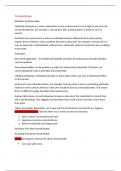
Definition of abnormality-
Statistical infrequency is when a behaviour is seen as abnormal if it is too high or low from the
normal distribution. For example, a normal IQ is 100, anything above or below is seen as
normal.
Deviation from social norms is when an individual behaves differently from what society
expects them to behave, which would be deemed as abnormal. For example, hearing voices is
seen as abnormal in individualistic cultures but in collectivist cultures it would be seen as talking
to the dead.
Evaluation:
Real world application – SI (intellectual disability disorder) SN (antisocial personality disorder,
can treat patients
Some abnormalities can be positive e.g. high IQ is abnormal but desirable. Therefore, we
cannot distinguish what is desirable and undesirable.
Labelling individuals. Individuals will take on these labels which can have a detrimental effect
on the person.
Social norms are culturally relative. For example, hearing voices is seen as something spiritually
relative in some cultures whereas in the UK it would be seen as a mental disorder. This means
that it is difficult to judge Deviation from social norms.
Human rights abuse. As such behaviours is seen as abnormal, this could lead to a lack of free
will in human beings. This suggests that Deviation from social norms can lead to more harm
than good.
Failure to function adequately- can’t cope with the demands of everyday life e.g. hygiene.
Rosenhan and Seligman said that there are 3 criteria to failure to function.
1. Don’t conform to interpersonal rules
2. Experience severe personal distress
3. Behave irrationally and dangerously
Deviation from ideal mental health:
Deviating from good mental health.
Jahoda developed a criterion for ideal mental health.
Can cope with stress
, No symptoms or distress
Self-actualise
Evaluation:
Easy way to self-assess us to see if we need professional help. E.g. CBT
Could lead to labelling. In some households they have different views about work etc so
labelling this as abnormal restricts the freedom of choice.
Some conditions could be normal e.g. bereavement but would be labelled as abnormal. This
means that it is hard to distinguish what is failure to function depending on everyone.
However, someone may be experiencing severe bereavement and may need professional
help.
Extremely high standards and can’t be maintained for long which could be disheartening. It
is hard to be able to reach all 8 criteria to have good mental health and some of them are
unrealistic like not being distressed. However, on the other hand it could help some
improve their mental health as they have something to work towards. This means that it
can’t be useful for all.
Cultural differences. Individualistic cultures find it easier to self-actualise then collectivists
cultures. This means that it is difficult to apply it to all cultures.
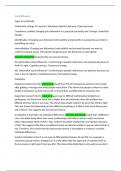
Phobias Depression OCD
Behavioural Panic, Avoidance Activity levels, Repetitive
disruption to compulsions
sleep/eating
Emotional Anxiety – high Lowered mood, Anxiety – high
arousal, fear Anger leads to self- arousal, fear
harm
Cognitive Irrational beliefs, Negative thinking, Irrational beliefs,
Cognitive distortions poor concentration obsessive thoughts
– unrealistic thinking
The two process model:
Mowrer: Classical conditioning -
UCS (phobia) - UCR (fear), NS (association#) + UCS –UCR, CS (association) - CR (fear)
Watson and Rayner Little Albert – fear of rats due to the loud bang – now scared of anything
that has white fur e.g. Santa Claus
Operant conditioning – negative reinforcement – avoid something unpleasant
Definition of abnormality-
Statistical infrequency is when a behaviour is seen as abnormal if it is too high or low from the
normal distribution. For example, a normal IQ is 100, anything above or below is seen as
normal.
Deviation from social norms is when an individual behaves differently from what society
expects them to behave, which would be deemed as abnormal. For example, hearing voices is
seen as abnormal in individualistic cultures but in collectivist cultures it would be seen as talking
to the dead.
Evaluation:
Real world application – SI (intellectual disability disorder) SN (antisocial personality disorder,
can treat patients
Some abnormalities can be positive e.g. high IQ is abnormal but desirable. Therefore, we
cannot distinguish what is desirable and undesirable.
Labelling individuals. Individuals will take on these labels which can have a detrimental effect
on the person.
Social norms are culturally relative. For example, hearing voices is seen as something spiritually
relative in some cultures whereas in the UK it would be seen as a mental disorder. This means
that it is difficult to judge Deviation from social norms.
Human rights abuse. As such behaviours is seen as abnormal, this could lead to a lack of free
will in human beings. This suggests that Deviation from social norms can lead to more harm
than good.
Failure to function adequately- can’t cope with the demands of everyday life e.g. hygiene.
Rosenhan and Seligman said that there are 3 criteria to failure to function.
1. Don’t conform to interpersonal rules
2. Experience severe personal distress
3. Behave irrationally and dangerously
Deviation from ideal mental health:
Deviating from good mental health.
Jahoda developed a criterion for ideal mental health.
Can cope with stress
, No symptoms or distress
Self-actualise
Evaluation:
Easy way to self-assess us to see if we need professional help. E.g. CBT
Could lead to labelling. In some households they have different views about work etc so
labelling this as abnormal restricts the freedom of choice.
Some conditions could be normal e.g. bereavement but would be labelled as abnormal. This
means that it is hard to distinguish what is failure to function depending on everyone.
However, someone may be experiencing severe bereavement and may need professional
help.
Extremely high standards and can’t be maintained for long which could be disheartening. It
is hard to be able to reach all 8 criteria to have good mental health and some of them are
unrealistic like not being distressed. However, on the other hand it could help some
improve their mental health as they have something to work towards. This means that it
can’t be useful for all.
Cultural differences. Individualistic cultures find it easier to self-actualise then collectivists
cultures. This means that it is difficult to apply it to all cultures.
Phobias Depression OCD
Behavioural Panic, Avoidance Activity levels, Repetitive
disruption to compulsions
sleep/eating
Emotional Anxiety – high Lowered mood, Anxiety – high
arousal, fear Anger leads to self- arousal, fear
harm
Cognitive Irrational beliefs, Negative thinking, Irrational beliefs,
Cognitive distortions poor concentration obsessive thoughts
– unrealistic thinking
The two process model:
Mowrer: Classical conditioning -
UCS (phobia) - UCR (fear), NS (association#) + UCS –UCR, CS (association) - CR (fear)
Watson and Rayner Little Albert – fear of rats due to the loud bang – now scared of anything
that has white fur e.g. Santa Claus
Operant conditioning – negative reinforcement – avoid something unpleasant