NREMT Paramedic Exam
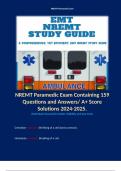
NREMT Paramedic Exam Containing 159
Questions and Answers/ A+ Score
Solutions 2024-2025.
(Dark Back Ground for better Visibility and eye Care)
Crenation - Answer: Shrinking of a cell due to osmosis.
Hemolysis - Answer: Breaking of a cell.
, NREMT Paramedic Exam
Atrophy (of a cell) - Answer: Also involves the shrinking of a cell, but is not due to
an osmotic force, and is usually due to tissue breakdown.
Hypertrophy (of a cell) - Answer: Enlarging or thickening of a cell.
Class 1 research - Answer: Most reliable and valid, it is the highest and best for
citation, research and policy development is derived from prospective, controlled,
randomized, double-blind studies.
Class 2 research - Answer: Biased, non-randomized, or retrospective studies with
weaker evidence.
Class 3 research - Answer: Case studies, medical opinions, or consensus
documents.
Clinical research - Answer: Focuses on improving pt outcomes.
Evidence-based research - Answer: Aims to improve medical practices.
Descriptive statistics - Answer: Describes a phenomenon.
Inferential statistics - Answer: Can use information learned in the groups to make
predictions about the general public.
, NREMT Paramedic Exam
Pandemic disease - Answer: Meets two criteria, number 1 is it affects many
people across a large region, and number 2, is the disease is infectious in nature.
Trigeminal nerve - Answer: 5th cranial nerve, it is responsible for chewing and
facial sensation.
Oculomotor nerve - Answer: 3rd cranial nerve, controls eye movement.
Olfactory nerve - Answer: 1st cranial nerve, controls sense of smell.
Where do you cric someone? - Answer: Inferior to the thyroid cartilage, and
superior to the cricoid cartilage is the cricothyroid ligament (or membrane).
EMS systems do not rely on mobile phones only for long distance communication
why? - Answer: It can be overwhelmed, esp in a MCI.
What is the drug name most health care workers use? - Answer: Generic.
You have a neonate who is bradycardic at 48bpm, what should you do first? -
Answer: Begin compressions.
What is the antidote for a tylenol OD? - Answer: Mucomyst.
A pt who is in cardiac arrest and is intubated should get how many breaths per
minute? - Answer: 10, one breath every 6 seconds.
NREMT Paramedic Exam Containing 159
Questions and Answers/ A+ Score
Solutions 2024-2025.
(Dark Back Ground for better Visibility and eye Care)
Crenation - Answer: Shrinking of a cell due to osmosis.
Hemolysis - Answer: Breaking of a cell.
, NREMT Paramedic Exam
Atrophy (of a cell) - Answer: Also involves the shrinking of a cell, but is not due to
an osmotic force, and is usually due to tissue breakdown.
Hypertrophy (of a cell) - Answer: Enlarging or thickening of a cell.
Class 1 research - Answer: Most reliable and valid, it is the highest and best for
citation, research and policy development is derived from prospective, controlled,
randomized, double-blind studies.
Class 2 research - Answer: Biased, non-randomized, or retrospective studies with
weaker evidence.
Class 3 research - Answer: Case studies, medical opinions, or consensus
documents.
Clinical research - Answer: Focuses on improving pt outcomes.
Evidence-based research - Answer: Aims to improve medical practices.
Descriptive statistics - Answer: Describes a phenomenon.
Inferential statistics - Answer: Can use information learned in the groups to make
predictions about the general public.
, NREMT Paramedic Exam
Pandemic disease - Answer: Meets two criteria, number 1 is it affects many
people across a large region, and number 2, is the disease is infectious in nature.
Trigeminal nerve - Answer: 5th cranial nerve, it is responsible for chewing and
facial sensation.
Oculomotor nerve - Answer: 3rd cranial nerve, controls eye movement.
Olfactory nerve - Answer: 1st cranial nerve, controls sense of smell.
Where do you cric someone? - Answer: Inferior to the thyroid cartilage, and
superior to the cricoid cartilage is the cricothyroid ligament (or membrane).
EMS systems do not rely on mobile phones only for long distance communication
why? - Answer: It can be overwhelmed, esp in a MCI.
What is the drug name most health care workers use? - Answer: Generic.
You have a neonate who is bradycardic at 48bpm, what should you do first? -
Answer: Begin compressions.
What is the antidote for a tylenol OD? - Answer: Mucomyst.
A pt who is in cardiac arrest and is intubated should get how many breaths per
minute? - Answer: 10, one breath every 6 seconds.