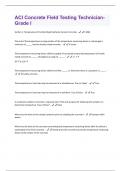
ACI Concrete Field Testing Technician- Grade I Graded A Q&A Complete
Section 1: Temperature of Freshly Mixed Hydraulic-Cement Concrete - C1064 The end of the temperature sensing portion of the temperature measuring device is submerged a minimum of _____ into the freshly mixed concrete. - 3 inches The temperature measuring device shall be capable of accurately measuring temperature of freshly mixed concrete to _____, throughout a range of _____. - +/- 1 °F 30 °F to 120 °F The temperature measuring device shall be verified _____, or whenever there is a question of _____. - Annually, accuracy The temperature of concrete may be measured in a wheelbarrow. True or False? - True The temperature of concrete may be measured in a wall form. True of False - True A composite sample of concrete is required even if the only purpose for obtaining the sample is to determine temperature. True of False? - False What must be done to the sample container prior to sampling the concrete? - Dampen (with water) What must be done to the concrete surrounding the temperature measuring device after the device is submerged in the fresh concrete. - Gently press the concrete around the temperature measuring device at the surface of the concreteHow long must the temperature measuring device remain in the freshly mixed concrete? - At least 2 minutes but not more than 5 minutes After the temperature of the concrete is read, what is required? - Reporting of temperature The temperature of concrete is reported to the nearest _____. - 1 °F According to ASTM C1064, what is one reason to take the temperature of concrete? - Verify conformance to a specified requirement for temperature of concrete A maximum temperature of freshly mixed concrete is specified in ASTM C1064. True of False? - False Section 2: Sampling Freshly Mixed Concrete - C172 The sample of concrete used for temperature determination must be rodded 25 times. True or False? - False Sampling by this method is required when tests are to be made to determine _____ with specification requirements. - Compliance This method covers sampling from four types of mixtures which are _____, _____, _____, _____, and _____. - Stationary mixers, Paving mixers, Revolving Drum mixers Continuous mixers, and Open Top mixers The maximum allowable time between obtaining the first and final portions of a composite sample is _____ minutes. - 15Portions of a composite sample shall be thoroughly remixed bfore beginning tests on the sample. True of False? - True The maximum elapsed time allowed between obtaining the final portion of the composite sample and beginning the tests for slump, temperature, and air content is _____ minutes. - 5 The molding of strength test specimens shall begin within _____ minutes after fabricating the composite sample. - 15 The concrete sample must be protected from contamination and _____. - Rapid evaporation The minimum size sample for making strength test specimens is _____. - 1 ft³ When sampling from a stationary mixer, the batch must be sampled at _____ or more regularly spaced intervals during discharge of the middle portion of the batch - 2 The composite sample for a paving mixer must represent a minimum of _____ different portions of the batch of concrete taken from the pile after discharge. - 5 When sampling from a revolving drum truck mixer, concrete must be sampled at a minimum of _____ regularly spaced intervals during discharge of the middle portion of this batch. - 2 Concrete samples from a truck mixer must be obtained before any water or admixtures are added to the mixer at the job site. True or False? - False The composite samples from a truck mixer must be obtained from the _____ portion of the batch. - Middle When the concrete contains aggregate larger than that permitted for a particular test method, the sample of concrete must be __________ before making the test. - Wet sievedSection 3: Slump of Hydraulic-Cement Concrete - C143 The slump test is applicable to plastic concrete with a maximum size aggregate of _____. - 1.5 in. [37.5 mm] When the concrete contains aggregate larger than allowed for the slump test, the large aggregate must be _____. - Removed by wet sieving the sample over 1.5 in. [37.5 mm] sieve The mold for making the slump test is in the shape of _____. - The frustum of a cone The height of the slump mold is _____. - 12 in. [300 mm] The interior surface of the slump mold is allowed to have minor irregularities. True or False? - False For use in the slump test, the end or both ends of the tamping rod must be _____. - Rounded to a hemispherical tip The sample of concrete for use in making the slump test must be obained in accordance with ASTM Standard _____. - C172, Standard Practice for Sampling Freshly Mixed Concrete The slump mold should be in a dry condition before beginning the test. True or False? - False The surface on which the slump mold will be placed must be _____. - Flat, level, moist, nonabsorbent, and free of vibration The slump mold is filled in _____ layers. - 3 Each layer should fill approximately _____ the volume of the mold. - One-thirdThe approximate concrete depth (in verticle distance) after placing the first layer is _____, and the second layer is _____. - 2 5/8 in. [70 mm], 6 1/8 in. [160 mm] What is the specified number of roddings for each layer? - 25 How deep should the tamping rod penetrate into each layer? - Rod each layer throughout its depth; on the second and final layers, the rod should penetrate into the previous layer approximately 1 in. [25 mm] When rodding the bottom layer, the tamping rod must be _____ to uniformly distribute the strokes. - Slightly inclined What must be done if the concrete drops below the top of the slump mold while the top layer is being rodded? - Add additional concrete to keep an excess of concrete above the top of the mold at all times Prior to lifting the mold, concrete must be removed from _____. - The area surrounding the base of the mold After the final rodding, the sides of the slump mold should should be tapped lightly with the tamping rod. True or False? - False When raising the slump mold, it should not be rotated or twisted, True or False? - True How much time is allowed for lifting the slump mold? - 5 +- 2 seconds The measurement for slump is made from the top of the mold to what point of the concrete specimen? - The displaced original center of the top surface of the specimen The slump of the concrete is measured and reported to the nearest _____. - 1/4 in. [5 mm]How much time is allowed to conduct the slump test from beginning to completion? - 2 1/2 minutes The diameter of the tamping rod used in the test method is _____. - 5/8 in. [16 mm] What is the required shape of the tamping end of the rod? - Rounded to a hemispherical tip What is the required minimum frequency of the vibrator used in this test method? - 7000 vibrations per minute The outside diameter or side dimension of the vibrating element must be at least _____ but not greater than _____. - 0.75 in. [19 mm], 1.50 in. [38 mm] A plastic container can be used for the measure in this method. True or False? - False, measure must be steel or another suitable metal What is the minimum thickness of a metal strike-off plate? - 1/4 in. [6 mm] What is the minimum thickness for a glass or acrylic strike-off plate? - 1/2 in. [12 mm] What is the specified weight of the mallet used on measures that are 0.5 ft^3 [14 L] or smaller? - 1.25 +- 0.50 lb. [600 +- 200 g] Measures other than air meter bowls used for this test must conform to ASTM _____. - C29 Air meter bowls used for this test must conform to ASTM _____ and be calibrated for volumee according to ASTM _____. - C231, C29 The concrete sample must be obtained in accodance with what ASTM method? - C172What method of consolidation must be used when the slump is greater than 3 in. [75 mm]? - Rodding What method of consolidation must be used when the slump is less than 1 in. (25 mm]? - Vibration If rodding is the method of consolidation being used, the measure must be filled in how many layers? - 3 For a measure of 0.5 ft^3 [14 L], what is the required number of strokes of the tamping rod for consolidation of each layer? - 25 When rodding the middle and the top layers, the tamping rod should penetrate into the layer below approximately _____. - 1 in. [25 mm] If vibration is the method of consolidation, the measure must be filled in _____ approximately equal layers. - 2 If, after consolidation of the final layer, the concrete level is 1/2 in. (13 mm) above the top of the measure, what should be done? - Remove a representative portion of the excess concrete with a trowel or scoop After consolidation of the final layer, an excess of concrete ____ above the top of the measure is considered optimum. - 1/8 in. [3 mm] After completing the strike-off procedure, what must be done before weighing the measure and sample? - Clean off any excess concrete The pressure method of determining air content can be used on concrete containing _____ _____ aggregate. - Relatively DenseThe pressure method of determining air content cannot be used on concrete containing the following types of aggregates, _____, _____, _____. - Lightweight, air-cooled blast furnace slag, or aggregates of high porosity What is the minimum allowable capacity of the measuring bowl used in this test method? - 6 L (0.20 ft^3) What are the required characteristics of the tamping rod used in this test method? - Round, straight steel rod, with a 16 mm [5/8 in.] +- 2 mm [1/16 in.] diameter, length at least 100 mm [4 in.] greater than the depth of the measuring bowl, but not greater than 600 mm [24 in.] in overall length, with the tamping end rounded to a hemispherical tip of the same diameter as the rod. What is the specified size of the mallet required for this test method when the measuring bowl has the capacity of 14 L [0.5 ft^3] or less? - 0.60 +- 0.25 kg [1.25 +- 0.50 lb.] The sample of concrete used for this test is to be obtained in accordance with what ASTM Standard? - C172 The maximum size aggregate allowed for this test method is _____. - 50 mm (2 in.) If the concrete contains aggregate larger than the maximum allowed for this test, the sample must be _____. - Wet sieved over a 1 1/2 in. (37.5 mm) sieve If the concrete sample is to be consolidated by rodding, the measure is filled in _____ layers. - 3 equal If the concrete sample is to be consolidated by vibration, the measure is filled in _____ layers. - 2 equal When rodding the concrete sample, what is the specified number of strokes required for each layer? - 25Vibration of the concrete sample is not allowed when the slump of concrete exceeds _____. - 75 mm (3 in.) In rodding the sample, how deep should the rod penetrate each layer? - Rod bottom layer to full depth; rod second and final layer penetrating the previous layer about 25 mm (1 in.) After rodding each layer, what should be done to the measure before adding another layer of concrete? - Tap the sides of the measure smartly 10 to 15 times with the mallet When consolidating the concrete by vibration, how many times should the vibrator be inserted into each layer? - Three (3) What tools may be used to strike off the top surface of the concrete following consolidation of the final layer? - A strike-off bar; a metal, glass, or acrylic plate What must be done if there is a slight deficiency in the quantity of concrete in the measure of consolidation of final layer? - Add a quantity of representative concrete before strike off What must be done if there is an excessive amount of concrete in measure following consolidation of the final layer? - Remove a representative quantity of concrete with the scoop or trowel before the strike off The volumetric method of determining air content of concrete can be used on concrete containing what types of aggregate? - All types of aggregate What are the requirements for the tamping rod used in the test method? - Round, straight 5/8 [16 mm] +- 1/16 in. [2 mm] diameter rod at least 5 in. [300
Written for
- Institution
- ACI Concrete Field Testing Technician- Grade I
- Course
- ACI Concrete Field Testing Technician- Grade I
Document information
- Uploaded on
- April 24, 2024
- Number of pages
- 14
- Written in
- 2023/2024
- Type
- Exam (elaborations)
- Contains
- Questions & answers
Subjects
-
aci concrete field testing technician grade i

Also available in package deal