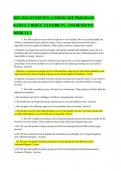
OVERVIEW of MEDICARE PROGRAM BASICS: CHOICE, ELIGIBILTY, AND BENEFITS MODULE 1
OVERVIEW of MEDICARE PROGRAM BASICS: CHOICE, ELIGIBILTY, AND BENEFITS MODULE 1 1. Ms. Moore plans to retire when she turns 65 in a few months. She is in excellent health and will have considerable income when she retires. She is concerned that her income will make it impossible for her to qualify for Medicare. What could you tell her to address her concern? a. Medicare is a program for people of all ages with specific mental health disabilities. Since she is in excellent health, she would not qualify, but should instead look into her state’s Medicaid program if she wants further coverage. Incorrect b. Eligibility for Medicare is based on whether or not a person has ever been employed by the federal government. If she or her husband were ever employed by the federal government, she can enroll in Medicare. Incorrect c. Medicare is a program for people age 65 or older and those under age 65 with certain disabilities, end- stage renal disease, and Lou Gehrig’s disease so she will be eligible for Medicare. Correct d. Medicare is a program for people who have incomes and assets below specific limits, so you will have to find out her exact financial situation before telling her whether she can obtain Medicare coverage. Incorrect 2. Mrs. Park is an elderly retiree. She has a low, fixed income. What could you tell Mrs. Park that might be of assistance? a. She should not sign up for a Medigap or Medicare Advantage plan. Incorrect b. She should only seek help from private organizations to cover her Medicare costs. Incorrect c. She can apply to the Medicare agency for lower premiums and cost-sharing. Incorrect d. She should contact her state Medicaid agency to see if she qualifies for one of several programs that can help with Medicare costs for which she is responsible. Correct 3. Mr. Wu is eligible for Medicare. He has limited financial resources but failed to qualify for the Part D low-income subsidy. Where might he turn for help with his prescription drug costs? a. Mr. Wu may still qualify for help in paying for Part D costs through the local Office of the Aging. Incorrect b. Mr. Wu has no alternative but to liquidate his remaining assets and apply for coverage through his state’s Medicaid program. Incorrect c. Mr. Wu may still qualify for help in paying Part D costs through his State Pharmaceutical AssistanceProgram. Correct d. Mr. Wu may still qualify for help in paying for Part D costs through the Federal Pharmaceutical Assistance Program. Incorrect 4. Mr. Schmidt would like to plan for retirement and has asked you what is covered under Original Fee-for-Service (FFS) Medicare? What could you tell him? a. Part A, which covers hospital, skilled nursing facility, hospice, and home health services and Part B, which covers professional services such as those provided by a doctor are covered under Original Medicare. Correct b. Part C, which always covers dental and vision services, is covered under Original Medicare. Incorrect c. Part A, which covers long term custodial care services, is covered under Original Medicare. Incorrect d. Part D, which covers prescription drug services, is covered under Original Medicare. Incorrect 5. Mr. Buck has several family members who died from different cancers. He wants to know if Medicare covers cancer screening. What should you tell him? a. Medicare covers the periodic performance of a range of screening tests that are meant to provide early detection of disease. Mr. Buck will need to check specific tests before obtaining them to see if theywill be covered. Correct b. Medicare covers all screening tests that have been approved by the FDA on a frequency determined by the treating physician. Incorrect c. Medicare covers some screening tests that must be performed within the first year after enrollment. Beyond that point expenses for screening tests is the responsibility of the beneficiary. Incorrect d. Medicare covers treatments for existing disease, injury and malformed limbs or body parts. As such, it does not cover any screening tests and these must be paid for by the beneficiary out of pocket. Incorrect 6. Mr. Patel is in good health and is preparing a budget in anticipation of his retirement when he turns 66. He wants to understand the health care costs he might be exposed to under Medicare if he were to require hospitalization as a result of an illness. In general terms, what could you tell him about his costs for inpatient hospital services under Original Medicare? a. Under Original Medicare, the inpatient hospital co-payment is a flat per-day amount that remains the same throughout the first 60 days of a beneficiary’s stay. After day 60 the amount gradually increases until day 90. After 90 days he would pay the full amount of all costs. Incorrect b. Under Original Medicare, there is a single deductible amount due for the first 60 days of any inpatient hospital stay, after which it converts into a per-day coinsurance amount through day 90. After day 90, he would pay a daily amount up to 60 days over his lifetime, after which he would be responsible for all costs Correct c. Under Original Medicare, the inpatient hospital co-payment is a percentage of allowed charges. The percentage increases after 60 days and again after 90 days. Incorrect d. Under Original Medicare, if the inpatient hospital service is provided by a participating Medicare provider, the co-payment is waived. Co-payments are only charged when a beneficiary opts to receive care from a non-participating provider. Incorrect 7. Mr. Bauer is 49 years old, but eighteen months ago he was declared disabled by the Social Security Administration and has been receiving disability payments. He is wondering whether he can obtain coverage under Medicare. What should you tell him? a. Individuals who become eligible for such disability payments only have to wait 12 months before they can apply for coverage under Medicare. Incorrect b. He became eligible for Medicare when his disability eligibility determination was first made. Incorrect c. After receiving such disability payments for 24 months he will be automatically enrolled in Medicare, regardless of age. Correct d. Individuals receiving such disability payments from the Social Security Administration continue to receive those payments, but only become eligible for Medicare upon reaching age 65. Incorrect 8. Mrs. Roberts has just received a new Medicare identity card in the mail. She is concerned thatit is a forgery since it does not have her Social Security number on it. What should you tell her? a. The card is indeed a forgery since all identity cards are being phased out in favor of a new electronic identity system developed by the Social Security Administration. Incorrect b. The card she received is valid but she should keep her old card for at least two years and present it whenever she receives health care. Incorrect c. The card she received is valid, the change has been made to protect Medicare beneficiaries from identity theft, and she should now destroy her old card. Correct d. The card is indeed a forgery since newly issued Medicare cards will have both a beneficiary’s SocialSecurity number and date of birth imprinted on them. Incorrect 9. Mrs. Kelly, age 65, is entitled to Part A but has not yet enrolled in Part B. She is considering enrollment in a Medicare health plan (Part C). What should you advise her to do before she will be able to enroll in a Medicare health plan? a. To enroll in a Medicare health plan, she need only be entitled to Part A, so she does not need to take any further steps. Incorrect b. In order to join a Medicare health plan, she must be enrolled in Parts A, B, and D. Incorrect c. Since she is age 65 she may enroll in any Medicare health plan, regardless of whether she is entitled to Part A or Part B coverage. Incorrect d. In order to join a Medicare health plan, she also must enroll in Part B. Correct
Written for
- Institution
- F MEDICARE PROGRAM BASICS
- Course
- F MEDICARE PROGRAM BASICS
Document information
- Uploaded on
- March 24, 2024
- Number of pages
- 39
- Written in
- 2023/2024
- Type
- Exam (elaborations)
- Contains
- Questions & answers
Subjects
-
overview of medicare program basics

Also available in package deal