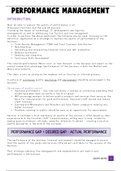
PERFORMANCE MANAGEMENT
INTRODUCTION:
Must be able to analyze the quality of performance in all
8 business functions and the overall business
(including the impact of technology, IT developments and logistics
management) as well as addressing risk factors and risk management.
In order to perform the above mentioned, the following may be used, focusing on the
definition, application as a strategy to improve the quality of performance of the
business:
• Total Quality Management (TQM) and Total Customer Satisfaction
• Benchmarking
• Calculating and interpreting financial ratios and self-evaluation
• Balance scorecard
• Sampling and inspection
• Continuous Skills Development
The internal performance (Micro env), or lack thereof, in the business will impact on the
overall competitive advantage (performance) of the business in both the Market and
Macro environments.
The chain is only as strong as the weakest link or function or internal process.
A culture of continuous quality monitoring and improvement should be encouraged in the
business.
Advantages of quality control:
• Improved profitability – less time and money is wasted on correcting something that
should have been done correctly in the first place.
• Will encourage workers to deliver quality products and services that serve as the
basis for remuneration for good performance. Improved staff morale and reduce
staff turnover.
• Distributors/Wholesalers and Retailers will have fewer complaints relating into
higher turnover.
• Problems relating to quality should be seen as an opportunity for improvement.
Service: A customer’s first impression of quality of the service is often based on their
experience with the frontline staff (responsiveness, willing ness to help, reliability,
making good on promises, attitude, empathy, attention to detail) – creating a positive
quality perception in the mind of the customer.
PERFORMANCE GAP = DESIRED GAP – ACTUAL PERFORMANCE
The performance of the business (internal environment) should be managed to ensure
that the quality of the goods and services offered will contribute to the success of the
business.
Poor strategic planning (top management) and implementation will lead to poor
performance in the business.
SASHTI NOTES 1
, GENERAL MA NAGEMENT:
• Poor strategic planning at top management will fail to provide the business with
direction.
• Ensuring that the plan is in writing and there is a common understanding of what is
to be achieved will improve the implementation of the plan by lower level
management. Effective communication.
• The plan should be aimed at setting up future objectives but should be flexible and
adaptable enough to deal with current realities and challenges.
• Plans should be accurate and objective – incorrect information could impact areas
such as incorrect market analysis, environmental scanning decisions etc.
• Plans should be realistic and economical.
• Contingency plans should be available.
• Implementation of the plan in every business function is vital regarding the inter-
relatedness of the 8 functions.
HUMAN RESOURCES / HUMAN CA PITAL:
• Through continuous training and coaching, quality improvement can be created
within staff.
• Every employee should prioritize improving quality in performance.
• The Skills Development Act ensures that businesses continuously develop and
upgrade their workforce’s skills and learning.
• HR must ensure that there are efficient feedback mechanisms like performance
appraisals in place to evaluate and improve the quality of performance of
employees. Feedback provides people with information on how well goals were
achieved and to correct errors.
• 360-degree feedback to measure performance from peers, subordinates,
customers and self-evaluation.
• The HR function and functional managers must create a climate where employees
are motivated and able to perform at a desired level.
FIN ANCE:
• The owners invest capital in the business and expect a return on this investment.
The Financial department must through prudent financial management ensure that
these expectations are met.
• The financial function uses tools such as drafting various financial statements of
the business, budgeting and looking at certain performance ratios to see how well
the business is performing.
RATIOS:
Liquidity Ratios:
• Current capital ratio (Current Ratio)
CURRENT ASSETS∶CURRENT LIABILITIES
o Acceptable ratio is 2:1
SASHTI NOTES 2
INTRODUCTION:
Must be able to analyze the quality of performance in all
8 business functions and the overall business
(including the impact of technology, IT developments and logistics
management) as well as addressing risk factors and risk management.
In order to perform the above mentioned, the following may be used, focusing on the
definition, application as a strategy to improve the quality of performance of the
business:
• Total Quality Management (TQM) and Total Customer Satisfaction
• Benchmarking
• Calculating and interpreting financial ratios and self-evaluation
• Balance scorecard
• Sampling and inspection
• Continuous Skills Development
The internal performance (Micro env), or lack thereof, in the business will impact on the
overall competitive advantage (performance) of the business in both the Market and
Macro environments.
The chain is only as strong as the weakest link or function or internal process.
A culture of continuous quality monitoring and improvement should be encouraged in the
business.
Advantages of quality control:
• Improved profitability – less time and money is wasted on correcting something that
should have been done correctly in the first place.
• Will encourage workers to deliver quality products and services that serve as the
basis for remuneration for good performance. Improved staff morale and reduce
staff turnover.
• Distributors/Wholesalers and Retailers will have fewer complaints relating into
higher turnover.
• Problems relating to quality should be seen as an opportunity for improvement.
Service: A customer’s first impression of quality of the service is often based on their
experience with the frontline staff (responsiveness, willing ness to help, reliability,
making good on promises, attitude, empathy, attention to detail) – creating a positive
quality perception in the mind of the customer.
PERFORMANCE GAP = DESIRED GAP – ACTUAL PERFORMANCE
The performance of the business (internal environment) should be managed to ensure
that the quality of the goods and services offered will contribute to the success of the
business.
Poor strategic planning (top management) and implementation will lead to poor
performance in the business.
SASHTI NOTES 1
, GENERAL MA NAGEMENT:
• Poor strategic planning at top management will fail to provide the business with
direction.
• Ensuring that the plan is in writing and there is a common understanding of what is
to be achieved will improve the implementation of the plan by lower level
management. Effective communication.
• The plan should be aimed at setting up future objectives but should be flexible and
adaptable enough to deal with current realities and challenges.
• Plans should be accurate and objective – incorrect information could impact areas
such as incorrect market analysis, environmental scanning decisions etc.
• Plans should be realistic and economical.
• Contingency plans should be available.
• Implementation of the plan in every business function is vital regarding the inter-
relatedness of the 8 functions.
HUMAN RESOURCES / HUMAN CA PITAL:
• Through continuous training and coaching, quality improvement can be created
within staff.
• Every employee should prioritize improving quality in performance.
• The Skills Development Act ensures that businesses continuously develop and
upgrade their workforce’s skills and learning.
• HR must ensure that there are efficient feedback mechanisms like performance
appraisals in place to evaluate and improve the quality of performance of
employees. Feedback provides people with information on how well goals were
achieved and to correct errors.
• 360-degree feedback to measure performance from peers, subordinates,
customers and self-evaluation.
• The HR function and functional managers must create a climate where employees
are motivated and able to perform at a desired level.
FIN ANCE:
• The owners invest capital in the business and expect a return on this investment.
The Financial department must through prudent financial management ensure that
these expectations are met.
• The financial function uses tools such as drafting various financial statements of
the business, budgeting and looking at certain performance ratios to see how well
the business is performing.
RATIOS:
Liquidity Ratios:
• Current capital ratio (Current Ratio)
CURRENT ASSETS∶CURRENT LIABILITIES
o Acceptable ratio is 2:1
SASHTI NOTES 2