PMHNP Practice Questions with correct Answers
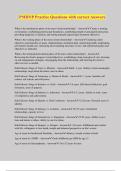
PMHNP Practice Questions with correct Answers What is the introduction phase of the nurse-client relationship? - Answer️️ -Creates a trusting environment, establishing professional boundaries, establishing length of anticipated interaction, providing diagnostic evaluation, and setting mutually agreed-upon treatment objectives What is the working phase of the nurse-client relationship? - Answer️️ -Clarifying client objectives and mutually set goals, implementing a treatment plan, monitoring health, undertaking preventative health care, measuring and evaluating outcomes of care, and reprioritizing plan and objectives as indicated What is the termination/resolution phase of the nurse-client relationship? - Answer️️ - Reviewing the client's progress toward objectives, establishing a long-term plan of care, focusing on self-management strategies, disengaging from the relationship, and referring the client to other services as needed Erik Erikson's Stage of Trust vs. Mistrust - Answer️️ -Birth- 1 year. Ability to form meaningful relationships, hope about the future, trust in others Erik Erikson's Stage of Autonomy vs. Shame & Doubt - Answer️️ -1-3 years. Includes self control, self esteem, and will power. Erik Erikson's Stage of Initiative vs. Guilt - Answer️️ -3-6 years. Self-directed behavior, goal formation, sense of purpose. Erik Erikson's Stage of Industry vs. Inferiority - Answer️️ -6-12 years. Ability to work, sense of competency and achievement. Erik Erikson's Stage of Identity vs. Role Confusion - Answer️️ -12-20 years. Personal sense of identity. Erik Erikson's Stage of Intimacy vs. Isolation - Answer️️ -20-35 years. Committed relationships, capacity to love. Erik Erikson's Stage of Generativity vs. Stagnation - Answer️️ -35-65 years. Ability to give time and talents to others, ability to care for others. Erik Erikson's Stage of Integrity vs. Despair - Answer️️ ->65 years. Fulfillment and comfort with life, willingness to face death, insight and balanced perspective on life's events. Age of onset for Intellectual Disability - Answer️️ -Infancy- usually evident at birth Age of onset for ADHD - Answer️️ -Early childhood, per DSM by age 12 Age of onset for Schizophrenia - Answer️️ -18 to 25 years for men 25 to 35 years for women Age of onset for Major Depression - Answer️️ -Late adolescence to young adulthood Age of onset for Dementia - Answer️️ -Most common after age 85 Interpersonal Theory by Henry Stack Sullivan - Answer️️ -Behavior occurs because of interpersonal dynamics, interpersonal relationships and experiences influence one's personality, two drives for behavior include: the drive for satisfaction and the drive for security. When these needs are interfered with by the self-system, mental illness occurs. Sullivan also described stages of interpersonal development. Health Belief Model by Marshall Becker - Answer️️ -Explains that healthy people do not always take advantage of screenings or preventative programs because of the following variables: Perception of susceptibility, Seriousness of illness, Perceived benefits of treatment, Perceived barriers to change, and Expectations of efficacy Transtheoretical Model of Change - Answer️️ -States that change such as in health behaviors occurs in six predictable stages: 1. Precontemplation: Person has no intention to change. 2. Contemplation: Thinking of changing, aware of the problem but not committed to changing. 3. Preparation: The person has made the decision to change, is ready for action. 4. Action: Engaging in specific, overt action to change. 5. Maintenance: Engaging in behaviors to prevent relapse. Qualitative hierarchy of research evidence - Answer️️ -1) randomized controlled trials (RCT), meta-analysis, systematic review 2) evidence-based guidelines based on systematic review 3) evidence from RCT without randomization 4) evidence from systemic review of descriptive and qualitative studies 5) evidence from expert opinion or committee reports Quantitative hierarchy of research evidence - Answer️️ - Internal Validity - Answer️️ -The independent variable (the treatment) caused a change in the dependent variable (the outcome) External Validity - Answer️️ -The sample is representative of the population and the results can be generaliz
Written for
- Institution
- PMHNP
- Course
- PMHNP
Document information
- Uploaded on
- March 3, 2024
- Number of pages
- 10
- Written in
- 2023/2024
- Type
- Exam (elaborations)
- Contains
- Questions & answers
Subjects
-
pmhnp practice questions with correct answers

Also available in package deal