🌿
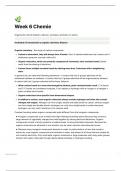
Week 6 Chemie
Organische chemie Alkanen, alkenen, aromaten, alcoholen en esters
Hoofdstuk 12 Introduction to organic chemistry Alkanes
Organic chemistry : the study of carbon compounds
Carbon is tetravalent, they will always form 4 bonds. Door 4 valentie elektronen kan carbon ook 4
elektronen opnemen voor een volle schil.
Organic molecules, which are primarily composed of nonmetals, have covalent bonds. Bonds
result from the sharing of electrons.
Carbon forms multiple covalent bonds by sharing more than 2 electrons with a neighboring
atom.
In general we can make the following statements : A carbon that has 4 groups attached will be
tetrahedral (ethaan en methaan). A carbon that has 3 groups attached will be trigonal planar (etheen).
A carbon that has 2 groups attached will be linear (ethyne)
When carbon bonds to a more electronegative element, polar covalent bonds result. C-H bonds
and C-C bonds are considered nonpolar, if you replace a hydrogen with an oxygen or a halogen a
polar covalent bond results.
Organic molecules have specific three dimensional shapes.
In addition to carbon, most organic molecules always contain hydrogen and often also contain
nitrogen and oxygen. Nitrogen can form single, double and triple bonds to carbon, wheras oxygen
can form single and double bonds. Hydrogen can only form single bonds to carbon because
hydrogen can only hold 2 electrons in its valence shell.
Covalent bonding makes organic compounds quite different from the inorganic compounds.
Inorganic compounds such as NaCl have high melting and boiling points because they consist a
large network of oppositely charged ions held together by strong electrical attractions. Organic
compounds consist of atoms joined by covalent bonds, forming individual molecules. Because the
organic molecules are attracted to one another only by weak nonionic intermolecular forces.
Whereas many inorganic compounds dissolve in water to yield solutions of ions that conduct
electricity, most organic compounds are insoluble in water, and almost all of those that are soluble do
not conduct electricity. Only small polar organic molecules or large molecules with many polar groups
interact with water molecules through dipole dipole bondings or hydrogen bonding.
Week 6 Chemie 1
, The structural features that allow us to classify organic compounds into distinct chemical families are
called functional groups : an atom or group of atoms within a molecule that has a characteristic
physical and chemical behavior.
Week 6 Chemie 2
Week 6 Chemie
Organische chemie Alkanen, alkenen, aromaten, alcoholen en esters
Hoofdstuk 12 Introduction to organic chemistry Alkanes
Organic chemistry : the study of carbon compounds
Carbon is tetravalent, they will always form 4 bonds. Door 4 valentie elektronen kan carbon ook 4
elektronen opnemen voor een volle schil.
Organic molecules, which are primarily composed of nonmetals, have covalent bonds. Bonds
result from the sharing of electrons.
Carbon forms multiple covalent bonds by sharing more than 2 electrons with a neighboring
atom.
In general we can make the following statements : A carbon that has 4 groups attached will be
tetrahedral (ethaan en methaan). A carbon that has 3 groups attached will be trigonal planar (etheen).
A carbon that has 2 groups attached will be linear (ethyne)
When carbon bonds to a more electronegative element, polar covalent bonds result. C-H bonds
and C-C bonds are considered nonpolar, if you replace a hydrogen with an oxygen or a halogen a
polar covalent bond results.
Organic molecules have specific three dimensional shapes.
In addition to carbon, most organic molecules always contain hydrogen and often also contain
nitrogen and oxygen. Nitrogen can form single, double and triple bonds to carbon, wheras oxygen
can form single and double bonds. Hydrogen can only form single bonds to carbon because
hydrogen can only hold 2 electrons in its valence shell.
Covalent bonding makes organic compounds quite different from the inorganic compounds.
Inorganic compounds such as NaCl have high melting and boiling points because they consist a
large network of oppositely charged ions held together by strong electrical attractions. Organic
compounds consist of atoms joined by covalent bonds, forming individual molecules. Because the
organic molecules are attracted to one another only by weak nonionic intermolecular forces.
Whereas many inorganic compounds dissolve in water to yield solutions of ions that conduct
electricity, most organic compounds are insoluble in water, and almost all of those that are soluble do
not conduct electricity. Only small polar organic molecules or large molecules with many polar groups
interact with water molecules through dipole dipole bondings or hydrogen bonding.
Week 6 Chemie 1
, The structural features that allow us to classify organic compounds into distinct chemical families are
called functional groups : an atom or group of atoms within a molecule that has a characteristic
physical and chemical behavior.
Week 6 Chemie 2