Chapter 4: What Changes in Organisatin
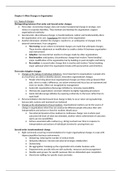
4.1: Types of changes
Distnguishing beteeen Firstoireer ane eeoineoireer ohanges
o First-order, incremental change: does not involve fundamental change in strategy, core
values or corporate identtes. They maintain and develop the organisaton: support
organisatonal contnuity
o Second-order, discontnuous change: is transformatonal, radical, and fundamentally alters
the organisaton at its core. Transforms the nature of the organisaton
o Another dimension: whether the change is reactve to, or antcipatory of changes in the
external environment. Four categories
o Fineotuning: occurs where incremental changes are made that antcipate changes.
These involve adjustment or modifcaton to enable a beter ft between organisaton
and environment
o Aeaptive: incremental but reactve to changes made by other organisatons
o Reirientatin: antcipatory, discontnuous change that involves fframe bending::
major modifcaton of the organisaton but by building on past strengths and history
o Reooreatin: is second-order change that is reactve and involves fframe breaking:
major upheaval where the organisaton breaks with past practces and directons
Firstoireer Aeaptive ohanges
o Change as the taking of individual initatves : most important to organisatons is people who
at a local level, are able to identfy relevant, innovatve organisatonal changes
o People who bring about local organisatonal changes are those who go beyond their
jobs, strive to make a diference, are acton-oriented and focus less on teamwork and
more on results. Ofen not recognized by management
o Autocratc organisatons discourage initatve by removing responsibility
o Meritocratc organisatons constrain initatve by tghtly regulatng procedures
o Social club discourage initatve by requiring conformity to the team rather than to
work itself
o Personal initatve directed toward local change is likely to occur when strong leadership,
bureaucratc systems and teamwork are balanced
o Change as the development of local routnes: organisatonal routnes can be the source of
change in organisatons when they are enacted by diferent people who place their own
interpretatons and actons on how the routnes should occur
o Two internal dynamics drive routnes to contnuous change: one is where past
outcomes fall short of what was intended, another where achievement of outcomes
opens up new possibilites
o Actons associated with routnes (e.g. riringH evolved over tme in response to
interpretatons and actons of individuals involved in carrying them out
eeoineoireer transfirmatinaa ohange
o Eight commonly occurring recommendatons for major organisatonal change, to cope with
rypercompettve business environments
o Delayering: reducing the number of vertcal levels
o Networks/alliances: internal and external strategic collaboraton
o Outsourcing
o Dis aggregaton: breaking up the organisaton into smaller business units
o Empowerment: provide milo yes with authority, resources and encouragement
o Flexible work groups: for specifc purposes that are disbanded upon completon
o Short-term stafng: for specifc issues and tasks
4.1: Types of changes
Distnguishing beteeen Firstoireer ane eeoineoireer ohanges
o First-order, incremental change: does not involve fundamental change in strategy, core
values or corporate identtes. They maintain and develop the organisaton: support
organisatonal contnuity
o Second-order, discontnuous change: is transformatonal, radical, and fundamentally alters
the organisaton at its core. Transforms the nature of the organisaton
o Another dimension: whether the change is reactve to, or antcipatory of changes in the
external environment. Four categories
o Fineotuning: occurs where incremental changes are made that antcipate changes.
These involve adjustment or modifcaton to enable a beter ft between organisaton
and environment
o Aeaptive: incremental but reactve to changes made by other organisatons
o Reirientatin: antcipatory, discontnuous change that involves fframe bending::
major modifcaton of the organisaton but by building on past strengths and history
o Reooreatin: is second-order change that is reactve and involves fframe breaking:
major upheaval where the organisaton breaks with past practces and directons
Firstoireer Aeaptive ohanges
o Change as the taking of individual initatves : most important to organisatons is people who
at a local level, are able to identfy relevant, innovatve organisatonal changes
o People who bring about local organisatonal changes are those who go beyond their
jobs, strive to make a diference, are acton-oriented and focus less on teamwork and
more on results. Ofen not recognized by management
o Autocratc organisatons discourage initatve by removing responsibility
o Meritocratc organisatons constrain initatve by tghtly regulatng procedures
o Social club discourage initatve by requiring conformity to the team rather than to
work itself
o Personal initatve directed toward local change is likely to occur when strong leadership,
bureaucratc systems and teamwork are balanced
o Change as the development of local routnes: organisatonal routnes can be the source of
change in organisatons when they are enacted by diferent people who place their own
interpretatons and actons on how the routnes should occur
o Two internal dynamics drive routnes to contnuous change: one is where past
outcomes fall short of what was intended, another where achievement of outcomes
opens up new possibilites
o Actons associated with routnes (e.g. riringH evolved over tme in response to
interpretatons and actons of individuals involved in carrying them out
eeoineoireer transfirmatinaa ohange
o Eight commonly occurring recommendatons for major organisatonal change, to cope with
rypercompettve business environments
o Delayering: reducing the number of vertcal levels
o Networks/alliances: internal and external strategic collaboraton
o Outsourcing
o Dis aggregaton: breaking up the organisaton into smaller business units
o Empowerment: provide milo yes with authority, resources and encouragement
o Flexible work groups: for specifc purposes that are disbanded upon completon
o Short-term stafng: for specifc issues and tasks