2023 NR 503 Final Study Guide (Version-2), Final Exam NR 503 Population Health, Epidemiology & Statistica
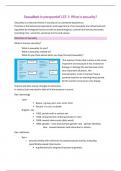
2023 NR 503 Final Study Guide (Version-2), Final Exam NR 503 Population Health, Epidemiology & Statistical Principles, Chamberlain. 1. Objectivesof epidemiology a. Understand the aetiologyor cause of adisease (risk factors) b. Find outthe extentthat a disease or health problemaffects a community or population c. Determine the natural history orprognosis d. Evaluateexisting and newlydevelopedpreventativetherapeuticmeasures and modes of healthcare delivery 2. Define, compare, calculate, and interpret Measures ofMorbidity a. Incidence rate: measurement ofthe number of new individuals who contract a disease during a particular period of time i. Calculation:Number of new cases of disease orinjury during specified period DIVIDED BY Size of population at start of period b. Attack rate: Same asrisk,proportion ofindividualsin apopulation (initially freeof disease) who develop the disease within a specified time interval. i. Calculation: Totalnumber of new casesDIVIDEDBY The total population c. Prevalence: measurement of all individuals affected by the disease at aparticular time i. Calculation:Number of new cases of disease orinjury during specified period DIVIDED BY Time each person was observed, totaled for all persons d. These rates are used to measure disease occurrence and make comparisons between population groups. They are commonlyusedmeasuresthat help our understanding of the distribution of disease in a given population. 3. Understand why incidence data are importantformeasuring risk. a. Incidence isimportantformeasuring risk because ittells you the rate at which new people are contracting the disease 4. Define, compare, calculate, andinterpret Measures ofMortality a. Mortality: a measure of the frequency of occurrence of death in a defined population during a specified interval. Morbidity and mortality measures are often the samemathematically; it'sjust amatter of what you choose tomeasure, illness or death. i. Calculation:Deaths occurring during a given time period DIVIDED BY Size of the population amongwhich the deaths occurred TIMES 10n b. Cause-specific mortality rate: Themortality rate froma specified cause for a population. i. Calculation: The number of deaths attributed to a specific cause DIVIDED BY The size ofthe population at the midpoint of the time period c. Annual mortality rate: The rate of death in a one-year period. i. Calculation:Deaths occurringwithin the one-yearperiod DIVIDED BY Size of population in which the deaths occure
Written for
- Institution
- 2023 NR 503
- Course
- 2023 NR 503
Document information
- Uploaded on
- November 19, 2023
- Number of pages
- 7
- Written in
- 2023/2024
- Type
- Exam (elaborations)
- Contains
- Questions & answers
Subjects
-
2023 nr 503 final study guide version 2 final e
-
2023 nr 503 final study guide version 2
-
2023 nr 503 final study guide