Introduction
Scientism Scepticism
Science excel all other attempts at Science doesn’t assure certainty.
securing knowledge because its laws There is no objectivity of observation,
provide certainty. no truth in scientific theories.
But there are doubts about certainty
that science secures, because science
is created by humans. Humans are
limited beings, and our rational and
sensory capacities are far from being
perfect. We are prone to making
mistakes.
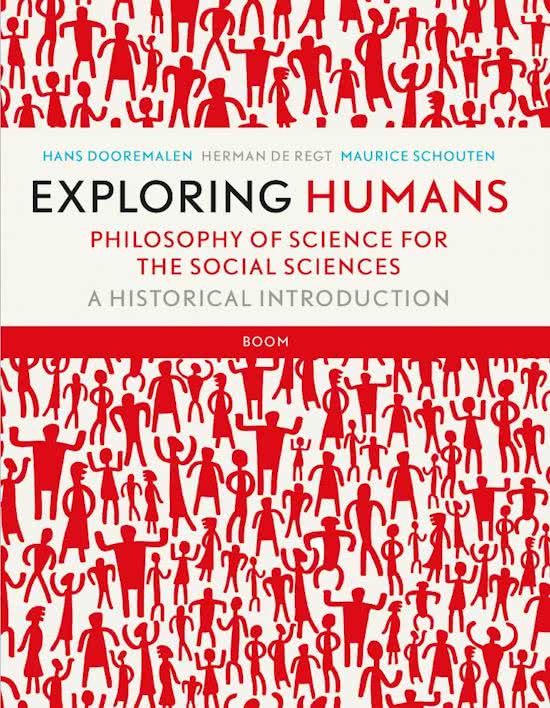
- The chapters will explore, in a historical vein, the philosophy of science in general to answer the
possibility of knowledge.
Chapter 1. Out of the Cave: Rationalism and Empiricism in Antiquity
1.1 Introduction
There are two approaches (rationalism vs. empiricism) in answering philosophical questions such
as ‘what is knowledge?’, ‘how can we justify knowledge?’, ‘what is the ultimate source of knowledge?’
- Rationalism: true knowledge about reality derives from the proper use of our reasoning capacities
(intellect, reason or ratio).
- Empiricism: sense experience is the ultimate source of knowledge.
1.2 Plato’s Rationalism
- Plato: pupil of Socrates
- Socrates
Questions mainly about “what it takes to live well”.
Q & A style (interllectual midwifery): assist others in their philosophizing by asking
questions to give birth to true ideas.
Examined instances of concepts to determine true essence.
- Ancient Greece was engaged in fierce debates about what exists and what does not.
1
, Being vs. Becoming (meaning, staying still vs. changing)
Heraclites Parmenides
- The essence of reality is change. - Nothing ever really changes, and it is
- Everything changes. Nothing stays. our senses that deceive us to believe
- Only a handful of people who can grasp things change.
the hidden & fundamental law, or Logos - There is a permanent unchanging reality
behind appearances can attain knowledge. underlying all the change and movement.
The debate between Heraclites and Parmenides relates to the question, what is
knowledge?
Plato: world of senses is in perpetual flux: everything flows ‘like leaky pots’ or like
people with the common cold whose noses are ‘flowing and running all the time’ – senses
are unreliable, it breeds skepticism with respect to knowledge.
Plato disqualified Protagoras’ theory ‘man is the measure of all things’ because, from
Protagoras’ perspective, every opinion should be true. Instead, Plato claimed that truth
and knowledge are about how things really are, not about how they are for me or for you.
He also argues that true knowledge should be attained from Idea (true from which is
eternal and perfect, a.k.a. world of Forms).
Idea: Plato believed that the real world cannot be the ever-changing world of
appearances, but a supernatural realm which contains the eternal and perfect Forms of
almost everything. Everything in the world we see through our senses are imperfect
representations of the real essence.
Plato used an analogy of a prisoner that is chained with their hands and necks so that only
thing he can see is the wall in front of him. Behind the prisoner, there is a big fire blazing.
Between the prisoner and the fire is a low raised walkway along which people are passing
by, holding up statues and figures of animals so that the fire casts flickering shadows on
the wall in front of the prisoners.
Prisoners have never seen anything but the projections of the real things.
We believe that the world we experience through sensory impression, but we must learn
to ‘see’ behind the appearances into the world of Forms.
2
, Nativism: we can obtain knowledge not through sensory experience but through
reasoning, because we possess innate ideas.
We have all the knowledge, it’s just that we all lost them at birth. We can remember it all
by correct use of reason.
Plato tried to prove it by getting one of his ignorant, uneducated slave boy to remember a
geometry that he already know but forgot at birth, but the slave boy didn’t really
“remember” it since Plato explained it all to the boy and what the boy said was “yes,
master”, “I agree”.
1.3 Aristotle’s empiricism
- Aristotle
Knowledge is based on experiences, which are attained through our senses.
Earth-bound empiricist: knowledge has to be based on empirical facts of nature.
Aristotle’s metaphysics: there’s only one world and that is the natural world we inhabit.
All knowledge come ultimately from observing nature.
Tabula rasa (there can be no such thing as inborn knowledge): the mind is like a tabula
rasa, a blank slate, before it receives impressions from reality.
Organon (‘instrument’): his views on the methods of science are set out in detail in his
six logical treatises which are assembled as the Organon; ‘we only have knowledge of a
thing when we know its cause’.
Syllogism: a deductive argument; basic theoretical principles to particular cases.
(a) All human beings are mortal
(b) Socrates is a human being
-------------------------------------
(c) Hence, Socrates is mortal
To construe a true knowledge, syllogism has to fulfill the basic condition: universal
validity of the premises (a) & (b), conclusion (c) drawn with absolute certainty.
Aristotle: the principles on which scientific knowledge rests must be causative,
immediate, and true.
Aristotle dismissed Plato’s argument that we can recollect knowledge that we forgot. He
said our minds are like blank slates and when we experience through our sensory
perception, we gain knowledge. So the right way, according to Aristotle, to gain
knowledge would be empirical procedure by which we move from concrete to the
abstract: induction.
Induction: observations of particular cases to universal laws.
(a) All human beings have two ears
(b) Socrates is a human being
------------------------------------------------
(c) Hence, Socrates has two ears
Limit of induction: there is always a possibility that exception could exist.
Although, induction method has a limitation, true knowledge can be acquired by those
who have intuitions or insights. Such intuitive induction by the mind (nous) guarantees
the truth of the empirically acquired correlations.
3
, Because Aristotle used intuition (nous) in the process of induction, it gets controversial
whether Aristotle is totally an empiricist.
Aristotle distinguishes four types of cause.
(a) The formal cause,
(b) The material cause,
(c) The efficient cause, and
(d) The final cause
Limitation of Aristotle: his theories are mostly based on very limited and superficial data
sets.
Chapter 2. Beyond the Pillars of Hercules: A New (Philosophy of) Science
2.1 Introduction
- Francis Bacon
Published a philosophical essay titled The Novum Organum (New Method), which is intended to
replace Aristotle’s Organon (‘tool’ or ‘instrument’).
His motto: ‘Plus ultra’ – science would now go far beyond the limitations of ancient and medieval
scholarship.
Scientific revolution: science would no longer rely on faith, tradition, the theological canon, and
church authority, but would instead be guided by observation and experiment.
2.2 The Aristotelian – Medieval Worldview
During the middle ages, questions were usually answered by quoting Aristoteles, the Bible or
both.
Aristotle’s worldview – Geocentrism
1) The earth is heavy and immobile, and is located at the center of the universe.
2) Cosmos is comprised of two realms
Superlunary world: everything is eternal and perfect. Things never change.
Sublunary world: everything is corruptible and perishable. Things always change.
3) Sublunary world is comprised of various combinations of four elements: earth, air, fire, and
water.
Geocentrism vs. Heliocentrism
Geocentrism: Along with Ptolemy’s view (Earth sits motionless in the center of the
universe with all the planets circling around it), Aristotelian cosmology formed a
comprehensive view of the universe til 16th century.
4
Scientism Scepticism
Science excel all other attempts at Science doesn’t assure certainty.
securing knowledge because its laws There is no objectivity of observation,
provide certainty. no truth in scientific theories.
But there are doubts about certainty
that science secures, because science
is created by humans. Humans are
limited beings, and our rational and
sensory capacities are far from being
perfect. We are prone to making
mistakes.
- The chapters will explore, in a historical vein, the philosophy of science in general to answer the
possibility of knowledge.
Chapter 1. Out of the Cave: Rationalism and Empiricism in Antiquity
1.1 Introduction
There are two approaches (rationalism vs. empiricism) in answering philosophical questions such
as ‘what is knowledge?’, ‘how can we justify knowledge?’, ‘what is the ultimate source of knowledge?’
- Rationalism: true knowledge about reality derives from the proper use of our reasoning capacities
(intellect, reason or ratio).
- Empiricism: sense experience is the ultimate source of knowledge.
1.2 Plato’s Rationalism
- Plato: pupil of Socrates
- Socrates
Questions mainly about “what it takes to live well”.
Q & A style (interllectual midwifery): assist others in their philosophizing by asking
questions to give birth to true ideas.
Examined instances of concepts to determine true essence.
- Ancient Greece was engaged in fierce debates about what exists and what does not.
1
, Being vs. Becoming (meaning, staying still vs. changing)
Heraclites Parmenides
- The essence of reality is change. - Nothing ever really changes, and it is
- Everything changes. Nothing stays. our senses that deceive us to believe
- Only a handful of people who can grasp things change.
the hidden & fundamental law, or Logos - There is a permanent unchanging reality
behind appearances can attain knowledge. underlying all the change and movement.
The debate between Heraclites and Parmenides relates to the question, what is
knowledge?
Plato: world of senses is in perpetual flux: everything flows ‘like leaky pots’ or like
people with the common cold whose noses are ‘flowing and running all the time’ – senses
are unreliable, it breeds skepticism with respect to knowledge.
Plato disqualified Protagoras’ theory ‘man is the measure of all things’ because, from
Protagoras’ perspective, every opinion should be true. Instead, Plato claimed that truth
and knowledge are about how things really are, not about how they are for me or for you.
He also argues that true knowledge should be attained from Idea (true from which is
eternal and perfect, a.k.a. world of Forms).
Idea: Plato believed that the real world cannot be the ever-changing world of
appearances, but a supernatural realm which contains the eternal and perfect Forms of
almost everything. Everything in the world we see through our senses are imperfect
representations of the real essence.
Plato used an analogy of a prisoner that is chained with their hands and necks so that only
thing he can see is the wall in front of him. Behind the prisoner, there is a big fire blazing.
Between the prisoner and the fire is a low raised walkway along which people are passing
by, holding up statues and figures of animals so that the fire casts flickering shadows on
the wall in front of the prisoners.
Prisoners have never seen anything but the projections of the real things.
We believe that the world we experience through sensory impression, but we must learn
to ‘see’ behind the appearances into the world of Forms.
2
, Nativism: we can obtain knowledge not through sensory experience but through
reasoning, because we possess innate ideas.
We have all the knowledge, it’s just that we all lost them at birth. We can remember it all
by correct use of reason.
Plato tried to prove it by getting one of his ignorant, uneducated slave boy to remember a
geometry that he already know but forgot at birth, but the slave boy didn’t really
“remember” it since Plato explained it all to the boy and what the boy said was “yes,
master”, “I agree”.
1.3 Aristotle’s empiricism
- Aristotle
Knowledge is based on experiences, which are attained through our senses.
Earth-bound empiricist: knowledge has to be based on empirical facts of nature.
Aristotle’s metaphysics: there’s only one world and that is the natural world we inhabit.
All knowledge come ultimately from observing nature.
Tabula rasa (there can be no such thing as inborn knowledge): the mind is like a tabula
rasa, a blank slate, before it receives impressions from reality.
Organon (‘instrument’): his views on the methods of science are set out in detail in his
six logical treatises which are assembled as the Organon; ‘we only have knowledge of a
thing when we know its cause’.
Syllogism: a deductive argument; basic theoretical principles to particular cases.
(a) All human beings are mortal
(b) Socrates is a human being
-------------------------------------
(c) Hence, Socrates is mortal
To construe a true knowledge, syllogism has to fulfill the basic condition: universal
validity of the premises (a) & (b), conclusion (c) drawn with absolute certainty.
Aristotle: the principles on which scientific knowledge rests must be causative,
immediate, and true.
Aristotle dismissed Plato’s argument that we can recollect knowledge that we forgot. He
said our minds are like blank slates and when we experience through our sensory
perception, we gain knowledge. So the right way, according to Aristotle, to gain
knowledge would be empirical procedure by which we move from concrete to the
abstract: induction.
Induction: observations of particular cases to universal laws.
(a) All human beings have two ears
(b) Socrates is a human being
------------------------------------------------
(c) Hence, Socrates has two ears
Limit of induction: there is always a possibility that exception could exist.
Although, induction method has a limitation, true knowledge can be acquired by those
who have intuitions or insights. Such intuitive induction by the mind (nous) guarantees
the truth of the empirically acquired correlations.
3
, Because Aristotle used intuition (nous) in the process of induction, it gets controversial
whether Aristotle is totally an empiricist.
Aristotle distinguishes four types of cause.
(a) The formal cause,
(b) The material cause,
(c) The efficient cause, and
(d) The final cause
Limitation of Aristotle: his theories are mostly based on very limited and superficial data
sets.
Chapter 2. Beyond the Pillars of Hercules: A New (Philosophy of) Science
2.1 Introduction
- Francis Bacon
Published a philosophical essay titled The Novum Organum (New Method), which is intended to
replace Aristotle’s Organon (‘tool’ or ‘instrument’).
His motto: ‘Plus ultra’ – science would now go far beyond the limitations of ancient and medieval
scholarship.
Scientific revolution: science would no longer rely on faith, tradition, the theological canon, and
church authority, but would instead be guided by observation and experiment.
2.2 The Aristotelian – Medieval Worldview
During the middle ages, questions were usually answered by quoting Aristoteles, the Bible or
both.
Aristotle’s worldview – Geocentrism
1) The earth is heavy and immobile, and is located at the center of the universe.
2) Cosmos is comprised of two realms
Superlunary world: everything is eternal and perfect. Things never change.
Sublunary world: everything is corruptible and perishable. Things always change.
3) Sublunary world is comprised of various combinations of four elements: earth, air, fire, and
water.
Geocentrism vs. Heliocentrism
Geocentrism: Along with Ptolemy’s view (Earth sits motionless in the center of the
universe with all the planets circling around it), Aristotelian cosmology formed a
comprehensive view of the universe til 16th century.
4