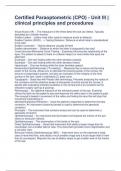
Certified Paraoptometric (CPO) - Unit III | clinical principles and procedures
Certified Paraoptometric (CPO) - Unit III | clinical principles and procedures Visual Acuity (VA) - The meausure of the finest detail the eye can detect. Typically described as a Snellen fraction. Snellen Letters - Letters most often used to measure acuity at distance. Snellen Fraction (20/20) - = Testing Distance / Distance at which letter is standardized to be read Snellen numerator - Testing distance (usually 20 feet) Snellen denominator - Distance at which the letter is supposed to be read. Cover/Uncover/Alternative-Cover Testing - Examines the binocular relationship of the eyes. The patient is asked to fixate on a distant object (or near) while their eyes are observed. Exotropia - One eye fixating while the other deviates outward. Esotropia - One eye fixating while the other deviates inward. Hypertropia - One eye fixating while the other deviates upward. Keratometry/Ophthalmometry ("K-reading") - Measures the curvature and focusing power of the cornea. Allows you to estimate the focusing power of the cornea, the amount of astigmatism present, and give an evaluation of the integrity of the front surface of the eye. Used in estimating CL base curve. Topography - Basis lies with Placido disk technology. Precisely analyzing the radius of the curvature and the refractive power at thousands of points across the cornea. It assists with evaluating refractive problems in the cornea and is an excellent tool for refractive surgery (pre-op & post-op). Retinoscopy - An objective measure of the refractive power of the eye. Examiner shines the light into the patient's eye and observes the reflex seen in the patient's pupil. The concept is based in movement of the reflex and finding the lens that will stop that movement (neutralizing it). Manifest/Subjective Refraction - Uses the patient's responses to determine the best correction. An instrument containing lenses is used to determine the spectacle correction. Phoropter - The instrument that contains lenses and can be used to determine a spectacle correction. Ophthalmoscope - An instrument that illuminates and inspects the interior of the eye (direct or binocular indirect). Ophthalmoscopy - The examination of the inside of the eye. Direct Ophthalmoscope - Hand-held instrument that yields a larger image than its counterpart, but a smaller field of view. This instrument provides more magnification and a narrower view. Binocular Indirect Ophthalmoscopy (BIO) - Instrument worn on the examiner's head, uses a hand-held lens, and yields a much smaller image and a much larger field of view than its counterpart. Requires the use of dilation drops to get a better view of the interior of the eye. Binocular Vision - The ability
Written for
- Institution
- CPO - Certified Paraoptometric
- Course
- CPO - Certified Paraoptometric
Document information
- Uploaded on
- September 23, 2023
- Number of pages
- 4
- Written in
- 2023/2024
- Type
- Exam (elaborations)
- Contains
- Questions & answers
Subjects
-
certified paraoptometric cpo unit iii clinic

Also available in package deal