100% satisfaction guarantee Immediately available after payment Both online and in PDF No strings attached 4.2 TrustPilot
logo-home
Exam (elaborations)

PMHNP ANCC Review questions with 100% correct answers

Rating
-
Sold
-
Pages
61
Grade
A+
Uploaded on
22-09-2023
Written in
2023/2024

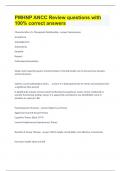
Characteristics of a Therapeutic Relationship Genuineness Acceptance Nonjudgement Authenticity Empathy Respect Professional boundaries Single most important goal in transformation of mental health care in the past two decades Recovery Sadness can be pathological when... It is disproportionate to events and sustained over a significant time period; It significantly impairs normal social functioning (occupational, social, school, relational) or somatic functioning (eating, sleep); it is apparently unrelated to any identifiable event or situation in a person's life Psychodynamic Theories Object Loss Theory Aggression-Turned-Inward Theory Cognitive Theory (Beck 1979) Learned Helplessness-Hopelessness Theory Benefits of Group Therapy (ISCC) Insight, Social Skills, Cost-effective, Community Increases insight about oneself Increases social skills Is cost-effective Develops a sense of community Who created Humanistic Therapy? Carl Rogers Person-Centered Therapy is also known as Humanistic Therapy Who created DBT? Marsha Linehan (born 1943) Who developed definition of group phases? Tuckman Name the group phases Pregroup Forming Storming Norming Performing Adjourning Pregroup Phase Leader considers direction and framework of the group Purpose, goals, membership size, pregroup interview, informed consent Forming Phase Members worried about self-disclosure and being rejected. Goals and expectations identified, boundaries established Development of trust and rapport very important in this phase Storming Phase Members resistant; may use testing behaviors. Issues begin to surface related to inclusion, control, affection Leader's tasks: Allow expression of positive and negative feelings, assist group in understanding underlying conflict, examine nonproductive behaviors Norming Phase Resistance to group overcome by members Strong attraction to group and others emerges Open and spontaneous communication occurs Group norms established Performing Phase Group's work becomes more focused. Creative problem-solving & solutions emerge Experiential learning takes place. Group energy directed towards completion of goals Adjourning Phase Preparation made to end group Members & leaders express their feelings about each other and termination Discussion about what was learned and what issues still exist takes place When does work of termination begin (what group stage)? First stage Solution-Focused Therapy - what techniques are involved? Miracle Questions Exception-finding questions Scaling questions Focus of Solution-Focused Therapy To rework for the present situation solutions that have worked in the past Strategic Therapy - techniques? Straightforward directives Paradoxical directives Reframing belief systems Family Systems Theory One could not understand any family member (part) without understanding how all family members operate together (system) Family Homeostasis Tendency of families to resist change and to maintain a steady state Morphogenesis A family's tendency to adapt to change when changes are necessary Morphostasis Family's tendency to remain stable in the midst of change Who created Family Systems Therapy? Murray Bowen Family Systems Therapy - summarize Originated by: Murray Bowen Focus on: Chronic anxiety within families Treatment goals: Increase family's awareness of each member's function within the family and increase levels of self-differentiation (level at which one's sense of self-worth is not dependent on external relationships) Cognitive Therapy - creator? Aaron Beck, 1979 Primary Prevention - what is it? Aimed at decreasing the incidence (number of new cases) of mental disorders Examples of Primary Prevention? Helping people avoid stressors or cope with them more adaptively: Smoking prevention classes Stress management classes for grad students D.A.R.E. Secondary Prevention - what is it? Aimed at decreasing the prevalence (number of existing cases) of mental disorders Examples of Secondary Prevention Early case finding Screening Prompt & effective treatment Examples: Telephone hotlines, crisis intervention, disaster responses Tertiary Prevention - what is it? Aimed at decreasing the disability and severity of a mental disorder Examples of Tertiary Prevention? Rehabilitation Services Avoidance or postponement of complications Day treatment programs, case management for physical/housing/vocational needs, social skills training Common indicators of physical child abuse Hx of unexplained multiple fractures Burns, hand or bite marks Injuries at various stages of healing Evidence of neglect Bruising on padded parts of body Repression involuntary or unconscious exclusion of painful/disturbing thoughts or feelings from awareness. Suppression intentional or conscious exclusion of painful or disturbing thoughts or emotions from awareness Strategies to Manage Flashbacks Identify phenomenon as a flashback or dissociative period Use grounding techniques (bring person's level of awareness to immediate therapeutic environment) - rubbing upholstery, stomping one's feet, good eye contact, proper room lighting, deep breathing, walking outside, supportive self-talk Help individual develop dual awareness of flashback being linked to traumatic events of past associated with traumatic feelings so individual can talk about traumatic feelings in present as memories Monitoring responses of other group members who may have similar flashbacks triggered is important but the initial focus is on the member experiencing the flashback What does activation do? Allows memories stored in the amygdala to be processed What does Systemic Family Therapy use? Triangles, genograms, differentiation of self What is sublimation? redirecting unacceptable feelings into an acceptable channel MADD Minimum standard of therapy for a child with history of trauma? Trauma focused CBT TSH normal values 2-10 mU/l Medications used to treat mood disorders & bipolar disorders Valproic acid (Depakene) Divalproex sodium (Depakote) Lithium carbonate Carbamazepine Carbamazepine ER Oxacarbazepine (Trileptal - off label) Typical Antipsychotics Haldol Loxitane (Loxapine) Navane (thiothixene) Prolixin (fluphenazine, fluphenazine dec) Mesoridazine (Serentil) Trifluoperazine (Stelazine) Clorpromazine (Thorazine) Perphenazine (Trilafon) FDA pregnancy risks for medications A: Controlled studies show no risk B: No evidence of risk in humans C: Risk cannot be ruled out D: Positive evidence of risk X: Absolutely contraindicated in pregnancy Medications that induce mania Steroids Disulfiram (Antabuse) Isoniazid (INH) Antidepressants (in persons with bipolar disorder) With oral medications, absorption usually occurs... in the small intestine and then in the liver Pharmacology study of what drugs do and how they do it Pharmacokinetics Study of what the body does to drugs; includes: absorption distribution metabolism excretion Pharmacodynamics Study of what drugs do to the body; target sites for drug actions include receptors, ion channels, enzymes & carrier proteins First-pass metabolism process by which the drug is metabolized by cytochrome P450 (P450) enzymes in the intestines and liver prior to going to the systemic circulation Half-life (T 1/2) Time needed to clear 50% of the drug from plasma Half-life also determines the dosing interval and the length of time to reach a steady state Typical antipsychotics are also known as First-generation antipsychotics Top goal/priority in acute phase of MDD Ensuring patient safety First sign of temporofrontal dementia Behavior and personality change For there to be damages, what must exist first? Negligence ACE Inhibitors Drug of choice for hypertension & heart failure Can increase lithium levels to toxic levels - must collaborate with PCP to determine whether to change ACE or change lithium - cannot use both Agoraphobia fear of open spaces an anxiety disorder - fear of places and situations that might cause panic, helplessess or embarassment Agoraphobia treatment Benzos - short-term relief SSRIs - long-term maintenance: Fluoxetine (Prozac) paroxetine (Paxil) Sertraline (Zoloft) SNRIs - long-term maintenance Venlafaxine (Effexor)

Show more Read less
Institution
Course


Whoops! We can’t load your doc right now. Try again or contact support.

Written for

Institution
Study
Unknown
Course

Document information

Uploaded on
September 22, 2023
Number of pages
61
Written in
2023/2024
Type
Exam (elaborations)
Contains
Questions & answers

Subjects

Content preview

PMHNP ANCC Review questions with
100% correct answers
Characteristics of a Therapeutic Relationship - answer Genuineness
Acceptance
Nonjudgement
Authenticity
Empathy
Respect
Professional boundaries


Single most important goal in transformation of mental health care in the past two decades -
answer Recovery


Sadness can be pathological when... - answer It is disproportionate to events and sustained over
a significant time period;
It significantly impairs normal social functioning (occupational, social, school, relational) or
somatic functioning (eating, sleep); it is apparently unrelated to any identifiable event or
situation in a person's life


Psychodynamic Theories - answer Object Loss Theory
Aggression-Turned-Inward Theory
Cognitive Theory (Beck 1979)
Learned Helplessness-Hopelessness Theory


Benefits of Group Therapy - answer (ISCC) Insight, Social Skills, Cost-effective, Community


Increases insight about oneself

,Increases social skills


Is cost-effective


Develops a sense of community


Who created Humanistic Therapy? - answer Carl Rogers


Person-Centered Therapy is also known as - answer Humanistic Therapy


Who created DBT? - answer Marsha Linehan (born 1943)


Who developed definition of group phases? - answer Tuckman


Name the group phases - answer Pregroup
Forming
Storming
Norming
Performing
Adjourning


Pregroup Phase - answer Leader considers direction and framework of the group


Purpose, goals, membership size, pregroup interview, informed consent


Forming Phase - answer Members worried about self-disclosure and being rejected.

,Goals and expectations identified, boundaries established


Development of trust and rapport very important in this phase


Storming Phase - answer Members resistant; may use testing behaviors.


Issues begin to surface related to inclusion, control, affection


Leader's tasks: Allow expression of positive and negative feelings, assist group in understanding
underlying conflict, examine nonproductive behaviors


Norming Phase - answer Resistance to group overcome by members


Strong attraction to group and others emerges


Open and spontaneous communication occurs


Group norms established


Performing Phase - answer Group's work becomes more focused.


Creative problem-solving & solutions emerge


Experiential learning takes place.


Group energy directed towards completion of goals

, Adjourning Phase - answer Preparation made to end group


Members & leaders express their feelings about each other and termination


Discussion about what was learned and what issues still exist takes place


When does work of termination begin (what group stage)? - answer First stage


Solution-Focused Therapy - what techniques are involved? - answer Miracle Questions


Exception-finding questions


Scaling questions


Focus of Solution-Focused Therapy - answer To rework for the present situation solutions that
have worked in the past


Strategic Therapy - techniques? - answer Straightforward directives


Paradoxical directives


Reframing belief systems


Family Systems Theory - answer One could not understand any family member (part) without
understanding how all family members operate together (system)
$14.99
Get access to the full document:

100% satisfaction guarantee
Immediately available after payment
Both online and in PDF
No strings attached


Also available in package deal

Get to know the seller

Seller avatar
Reputation scores are based on the amount of documents a seller has sold for a fee and the reviews they have received for those documents. There are three levels: Bronze, Silver and Gold. The better the reputation, the more your can rely on the quality of the sellers work.
BRAINBOOSTERS Chamberlain College Of Nursing
Follow You need to be logged in order to follow users or courses
Sold
640
Member since
2 year
Number of followers
249
Documents
22507
Last sold
12 hours ago

In this page you will find all documents , flashcards and package deals offered by seller BRAINBOOSTERS

4.5

339 reviews

5
264
4
29
3
21
2
5
1
20

Why students choose Stuvia

Created by fellow students, verified by reviews

Quality you can trust: written by students who passed their tests and reviewed by others who've used these notes.

Didn't get what you expected? Choose another document

No worries! You can instantly pick a different document that better fits what you're looking for.

Pay as you like, start learning right away

No subscription, no commitments. Pay the way you're used to via credit card and download your PDF document instantly.

Student with book image

“Bought, downloaded, and aced it. It really can be that simple.”

Alisha Student

Frequently asked questions