

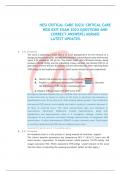
HESI CRITICAL CARE 2023/ CRITICAL CARE HESI EXIT EXAM 2023 QUESTIONS AND CORRECT ANSWERS|AGRADE LATEST UPDATES
HESI CRITICAL CARE 2023/ CRITICAL CARE HESI EXIT EXAM 2023 QUESTIONS AND CORRECT ANSWERS|AGRADE LATEST UPDATES. 1. 1.ID: The nurse is assessing a client who is 12 hours postoperative for the removal of a benign pituitary brain tumor and has been placed in a drug induced coma with normal saline 0.9% infusing at 125 mL/hr. The client's heart rate is 90 beats/minute, blood pressure 100/60 mmHg, and the indwelling urinary catheter has drained 250 mL of pale yellow urine in the last 30 minutes into the collection bag. After reporting these 昀椀 ndings to the healthcare provider, which action should the nurse implement? A. Identify the underlying cause of this condition. Incorrect B. Prepare to administer desmopressin (DDAVP). Correct C. Decrease the intravenous 昀氀 uids to a maintenance rate. D. Replace 昀氀 uid losses with D5W every shift. Neurogenic diabetes insipidus (DI) is a condition that can occur when there is trauma to the brain such as tumors or injury to the brain in particular the pituitary or hypothalamus area. DI can also occur with cerebral edema present. The antidiuretic hormone de 昀椀 ciency occurs rapidly and results in polyuria, anywhere between 5- 40 liters of urine/24 hours. The client demonstrates signs and symptoms of hypovolemia. Electrolyte imbalances include hypernatremia, along with hypokalemia and hypercalcemia when it is neurogenic etiology. Clients with neurogenic DI are primarily controlled through administration of exogenous ADH preparations, of which desmopressin (DDAVP) is most commonly used. Fluid output is carefully monitored and 昀氀 uids are replaced every hour. Awarded 0.0 points out of 1.0 possible points. 2. 2.ID: An intubated client is in the process of being weaned off ventilator support. The client's baseline parameters are temperature 98.2 F (36.8 C), heart rate 88 beats/minute, respirations 14 breaths/minute, blood pressure 112/78 mmHg, and oxygen saturation 94%. Which assessment 昀椀 ndings would indicate to the nurse that the client is tolerating the weaning procedure? (Select all that apply.) lOMoARcPSD| A. Oxygen saturation is 91%. Correct B. Slight nasal 昀氀 aring is present. C. Heart rate is 97 beats/minute. Correct D. Work of breathing is done by client. Correct E. Respiratory rate is 36 breaths/minute. Criteria that indicates a client is tolerating weaning off ventilator support are respirations greater than 8 breaths/minute, but less than 35 breaths/minute; oxygen saturation above 90%; heart rate that does not increase more than 20% from baseline heart rate; most of the work of breathing is performed by the client; and no signs of accessory muscles are used for breathing. Awarded 0.0 points out of 0.99 possible points. 3. 3.ID: The nurse is assessing a burn victim who suffered destruction of the epidermis and some of the dermis of the entire right arm and half the length of the right leg. How should the nurse document the burn assessment 昀椀 ndings? A. Super 昀椀 cial, 18% TBSA. B. Super 昀椀 cial partial-thickness, 18% TBSA. Correct C. Deep-partial thickness, 27% TBSA. D. Full-thickness, 27% TBSA. A "super 昀椀 cial partial-thickness" burn involves destruction of the epidermis layer and some of the dermis layer. The total body surface area (%TBSA) is easily calculated by using the "rule of nines" method. In this case, involvement of one arm is calculated as 9% TBSA and one-half of a leg is 9% TBSA for a combined total of 18% TBSA. A total leg involvement is calculated as 18% TBSA. Awarded 1.0 points out of 1.0 possible points. 4. 4.ID: The critical care nurse is providing care for a client diagnosed clinically brain dead and identi 昀椀 ed as an organ donor. Which are the nurse's priorities in providing care? (Select all that apply.) A. Sustaining a state of hypothermia. B. Maintaining a normal blood pressure. Correct C. Ensuring adequate oxygenation and ventilation. Correct D. Treating any coagulopathy, thrombocytopenia and anemia. Correct E. Monitoring arterial blood gases and serum electrolytes levels. Correct Once an identi昀椀 ed organ donor has been declared clinically brain dead, the primary focus of care changes from preserving life to preserving organ lOMoARcPSD| functioning. This is done by maintaining normal blood pressures, 昀氀 uid levels, electrolytes levels, serum glucose levels, and normothermia. Mechanical ventilation is provided to maintain adequate oxygenation and normal acid- base balance. If needed, pharmaceutical support is provided for the treatment of anemia, coagulopathy, thrombocytopenia, and diabetes insipidus. Physiological changes occur to bodily functions as the result of decreased perfusion within the brain. Awarded 1.0 points out of 1.0 possible points. 5. 5.ID: A client is admitted to the intensive care unit with hematemesis related to esophageal varices. Which assessment 昀椀 nding should the nurse identify that is the result of an estimated blood loss at 35% of total blood volume? A. Absent bowel sounds. Correct B. Coma. C. Anuria. D. Abdominal pain. Massive blood loss redirects a signi 昀椀 cant amount of blood 昀氀 ow to vital organs. A client who has lost 30% to 40% of the total blood volume will exhibit absent bowel sounds, lethargy, and increased serum potassium. Awarded 1.0 points out of 1.0 possible points. 6. 6.ID: The nurse is planning care for a client admitted to the intensive care unit with acute infected necrotizing pancreatitis. Which diagnostic procedure should the nurse prepare the client to expect the healthcare provider to prescribe? A. Contrast-enhanced computed tomography (CT). Correct B. Endoscopic retrograde cholangiopancreatography (ERCP). Incorrect C. Abdominal radiography. D. Abdominal ultrasound. Contrast-enhanced computed tomography (CT) is the imaging modality of choice to evaluate peripancreatic necrosis. Awarded 0.0 points out of 1.0 possible points. 7. 7.ID: The nurse is caring for a client admitted to the surgical intensive care unit (ICU) after undergoing gastrointestinal surgery. Which intervention should the nurse include in the plan of care to minimize the risk for vomiting?
Document information
- Uploaded on
- September 18, 2023
- Number of pages
- 24
- Written in
- 2023/2024
- Type
- Exam (elaborations)
- Contains
- Questions & answers


