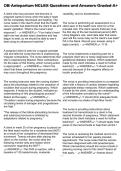
Respiratory System NCLEX questions
Respiratory System NCLEX questions The most important action the nurse should do before and after suctioning a client is: a. Placing the client in a supine position b. Making sure that suctioning takes only 10-15 seconds c. Evaluating for clear breath sounds d. Hyperventilating the client with 100% oxygen d. Hyperventilating the client with 100% oxygen The position of a conscious client during suctioning is: a. Fowler's b. Supine position c. Side-lying d. Prone a. Fowler's Position a conscious person who has a functional gag reflex in the semi fowler's position with the head turned to one side for oral suctioning or with the neck hyper extended for nasal suctioning. If the client is unconscious place the patient a lateral position facing you. Presence of overdistended and non-functional alveoli is a condition called: a. Bronchitis b. Emphysema c. Empyema d. Atelectasis Answer: B. An overdistended and non-functional alveoli is a condition called emphysema. Atelectasis is the collapse of a part or the whole lung. Empyema is the presence of pus in the lung. 23. The accumulation of fluids in the pleural space is called: a. Pleural effusion b. Hemothorax c. Hydrothorax d. Pyothorax a. Pleural effusion 2. Nurse Kim is caring for a client with a pneumothorax and who has had a chest tube inserted notes continuous gentle bubbling in the suction control chamber. What action is appropriate? a. Do nothing, because this is an expected finding. b. Immediately clamp the chest tube and notify the physician. c. Check for an air leak because the bubbling should be intermittent. d. Increase the suction pressure so that bubbling becomes vigorous. Answer A. Continuous gentle bubbling should be noted in the suction control chamber. Option B is incorrect. Chest tubes should only be clamped to check for an air leak or when changing drainage devices (according to agency policy). Option C is incorrect. Bubbling should be continuous and not intermittent. Option D is incorrect because bubbling should be gentle. Increasing the suction pressure only increases the rate of evaporation of water in the drainage system. 4. The nurse caring for a male client with a chest tube turns the client to the side, and the chest tube accidentally disconnects. The initial nursing action is to: a. Call the physician. b. Place the tube in a bottle of sterile water. c. Immediately replace the chest tube system. d. Place the sterile dressing over the disconnection site. Answer B. If the chest drainage system is disconnected, the end of the tube is placed in a bottle of sterile water held below the level of the chest. The system is replaced if it breaks or cracks or if the collection chamber is full. Placing a sterile dressing over the disconnection site will not prevent complications resulting from the disconnection. The physician may need to be notified, but this is not the initial action. While changing the tapes on a tracheostomy tube, the male client coughs and the tube is dislodged. The initial nursing action is to: a. Call the physician to reinsert the tube. b. Grasp the retention sutures to spread the opening. c. Call the respiratory therapy department to reinsert the tracheotomy. d. Cover the tracheostomy site with a sterile dressing to prevent infection. b. Grasp the retention sutures to spread the opening. A nurse is caring for a male client immediately after removal of the endotracheal tube. The nurse reports which of the following signs immediately if experienced by the client? a. Stridor b. Occasional pink-tinged sputum c. A few basilar lung crackles on the right d. Respiratory rate of 24 breaths/min Answer A. The nurse reports stridor to the physician immediately. This is a high-pitched, coarse sound that is heard with the stethoscope over the trachea. Stridor indicates airway edema and places the client at risk for airway obstruction An emergency room nurse is assessing a female client who has sustained a blunt injury to the chest wall. Which of these signs would indicate the presence of a pneumothorax in this client? a. A low respiratory b. Diminished breathe sounds c. The presence of a barrel chest d. A sucking sound at the site of injury Answer B. This client has sustained a blunt or a closed chest injury. Basic symptoms of a closed pneumothorax are shortness of breath and chest pain. A larger pneumothorax may cause tachypnea, cyanosis, diminished breath sounds, and subcutaneous emphysema. Hyperresonance also may occur on the affected side. A sucking sound at the site of injury would be noted with an open chest injury. A nurse is caring for a male client hospitalized with acute exacerbation of chronic obstructive pulmonary disease. Which of the following would the nurse expect to note on assessment of this client? a. Hypocapnia b. A hyperinflated chest noted on the chest x-ray c. Increase oxygen saturation with exercise d. A widened diaphragm noted on the chest x-ray Answer B. Clinical manifestations of chronic obstructive pulmonary disease (COPD) include hypoxemia, - hypercapnia, - dyspnea on exertion and at rest - oxygen desaturation with exercise - and the use of accessory muscles of respiration. Chest x-rays reveal a hyperinflated chest and a flattened diaphragm if the disease is advanced. A community health nurse is conducting an educational session with community members regarding tuberculosis. The nurse tells the group that one of the first symptoms associated with tuberculosis is: a. Dyspnea b. Chest pain c. A bloody, productive cough d. A cough with the expectoration of mucoid sputum Answer D. One of the first pulmonary symptoms is a slight cough with the expectoration of mucoid sputum. Options A, B, and C are late symptoms and signify cavitation and extensive lung involvement. A nurse is caring for a male client with emphysema who is receiving oxygen. The nurse assesses the oxygen flow rate to ensure that it does not exceed: a. 1 L/min b. 2 L/min c. 6 L/min d. 10 L/min Answer B. Oxygen is used cautiously and should not exceed 2 L/min. Because of the long-standing hypercapnia that occurs in emphysema, the respiratory drive is triggered by low oxygen levels rather than increased carbon dioxide levels, as is the case in a normal respiratory system. Upgrade to remove ads Only $3.99/month A nurse instructs a female client to use the pursed-lip method of breathing and the client asks the nurse about the purpose of this type of breathing. The nurse responds, knowing that the primary purpose of pursed-lip breathing is to: a. Promote oxygen intake. b. Strengthen the diaphragm. c. Strengthen the intercostal muscles. d. Promote carbon dioxide elimination. Answer D. Pursed-lip breathing facilitates maximal expiration for clients with obstructive lung disease. This type of breathing allows better expiration by increasing airway pressure that keeps air passages open during exhalation. Options A, B, and C are not the purposes of this type of breathing. Nurse Hannah is preparing to obtain a sputum specimen from a client. Which of the following nursing actions will facilitate obtaining the specimen? a. Limiting fluids b. Having the clients take three deep breaths c. Asking the client to split into the collection container d. Asking the client to obtain the specimen after eating Answer B. To obtain a sputum specimen, the client should rinse the mouth to reduce contamination, breathe deeply, and then cough into a sputum specimen container. The client should be encouraged to cough and not spit so as to obtain sputum. Sputum can be thinned by fluids or by a respiratory treatment such as inhalation of nebulized saline or water. The optimal time to obtain a specimen is on arising in the morning A nurse is caring for a female client after a bronchoscope and biopsy. Which of the following signs, if noted in the client, should be reported immediately to the physicians? a. Dry cough b. Hematuria c. Bronchospasm d. Blood-streaked sputum Answer C. If a biopsy was performed during a bronchoscopy, blood-streaked sputum is expected for several hours. Frank blood indicates hemorrhage. A dry cough may be expected. The client should be assessed for signs of complications, which would include cyanosis, dyspnea, stridor, bronchospasm, hemoptysis, hypotension, tachycardia, and dysrhythmias. Hematuria is unrelated to this procedure. A nurse is suctioning fluids from a male client via a tracheostomy tube. When suctioning, the nurse must limit the suctioning time to a maximum of: a. 1 minute b. 5 seconds c. 10 seconds d. 30 seconds Answer C. Hypoxemia can be caused by prolonged suctioning, which stimulates the pacemaker cells in the heart. A vasovagal response may occur, causing bradycardia. The nurse must preoxygenate the client before suctioning and limit the suctioning pass to 10 seconds. A nurse is suctioning fluids from a female client through an endotracheal tube. During the suctioning procedure, the nurse notes on the monitor that the heart rate is decreasing. Which of the following is the appropriate nursing intervention? a. Continue to suction. b. Notify the physician immediately. c. Stop the procedure and reoxygenate the client. d. Ensure that the suction is limited to 15 seconds. Answer C. During suctioning, the nurse should monitor the client closely for side effects, including hypoxemia, cardiac irregularities such as a decrease in heart rate resulting from vagal stimulation, mucosal trauma, hypotension, and paroxysmal coughing. If side effects develop, especially cardiac irregularities, the procedure is stopped and the client is reoxygenated. An unconscious male client is admitted to an emergency room. Arterial blood gas measurements reveal a pH of 7.30, a low bicarbonate level, a normal carbon dioxide level, a normal oxygen level, and an elevated potassium level. These results indicate the presence of: a. Metabolic acidosis b. Respiratory acidosis c. Overcompensated respiratory acidosis d. Combined respiratory and metabolic acidosis Answer A. In an acidotic condition, the pH would be low, indicating the acidosis. In addition, a low bicarbonate level along with the low pH would indicate a metabolic state. Therefore, options B, C, and D are incorrect. A female client is suspected of having a pulmonary embolus. A nurse assesses the client, knowing that which of the following is a common clinical manifestation of pulmonary embolism? a. Dyspnea b. Bradypnea c. Bradycardia d. Decreased respiratory Answer A. The common clinical manifestations of pulmonary embolism are tachypnea, tachycardia, dyspnea, and chest pain A nurse teaches a male client about the use of a respiratory inhaler. Which action by the client indicates a need for further teaching? a. Inhales the mist and quickly exhales b. Removes the cap and shakes the inhaler well before use c. Presses the canister down with the finger as he breathes in d. Waits 1 to 2 minutes between puffs if more than one puff has been prescribed Answer A. The client should be instructed to hold his or her breath for at least 10 to 15 seconds before exhaling the mist. Options B, C, and D are accurate instructions regarding the use of the inhaler. A female client has just returned to a nursing unit following bronchoscopy. A nurse would implement which of the following nursing interventions for this client? a. Administering atropine intravenously b. Administering small doses of midazolam (Versed) c. Encouraging additional fluids for the next 24 hours d. Ensuring the return of the gag reflex before offering food or fluids Answer D. After bronchoscopy, the nurse keeps the client on NPO status until the gag reflex returns because the preoperative sedation and local anesthesia impair swallowing and the protective laryngeal reflexes for a number of hours. Additional fluids are unnecessary because no contrast dye is used that would need flushing from the system. Atropine and midazolam would be administered before the procedure, not after. A nurse is assessing the respiratory status of a male client who has suffered a fractured rib. The nurse would expect to note which of the following? a. Slow deep respirations b. Rapid deep respirations c. Paradoxical respirations d. Pain, especially with inspiration Answer D. Rib fractures are a common injury, especially in the older client, and result from a blunt injury or a fall. Typical signs and Sx include - pain and tenderness localized at the fracture site and exacerbated by inspiration and palpation - shallow respirations - splinting or guarding the chest protectively to minimize chest movement, and possible bruising at the fracture site. Paradoxical respirations are seen with flail chest.
Written for
- Institution
- Respiratory System NCLEX
- Course
- Respiratory System NCLEX
Document information
- Uploaded on
- April 14, 2023
- Number of pages
- 20
- Written in
- 2022/2023
- Type
- Exam (elaborations)
- Contains
- Questions & answers
Subjects
-
respiratory system nclex questions
-
respiratory system nclex questions the most important action the nurse should do before and after suctioning a client is a placing the client in a supine position