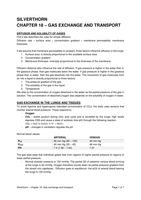
SILVERTHORN
CHAPTER 18 – GAS EXCHANGE AND TRANSPORT
DIFFUSION AND SOLUBILITY OF GASES
Fick’s law describes the rules for simple diffusion:
Diffusion rate surface area concentration gradient membrane permeability/ membrane
thickness
If we assume that membrane permeability is constant, three factors influence diffusion in the lungs:
1. Surface area: is directly proportional to the available surface area
2. Concentration gradient
3. Membrane thickness: inversely proportional to the thickness of the membrane
Diffusion distance also influence the rate of diffusion. If gas pressure is higher in the water than in
the gaseous phase, than gas molecules leave the water. If gas pressure is higher in the gaseous
phase than in water, then the gas dissolves into the water. The movement of gas molecules from
air into a liquid is directly proportional to three factors:
1. The pressure gradient of the gas
2. The solubility of the gas in the liquid
3. Temperature
We refer to the concentration of oxygen dissolved in the water as the partial pressure of the gas in
solution. The concentration of dissolved oxygen also depends on the solubility of oxygen in water.
GAS EXCHANGE IN THE LUNGS AND TISSUES
To avoid hypoxia and hypercapnia (elevated concentration of CO2), the body uses sensors that
monitor arterial blood pressure. These respond to:
– Oxygen
– CO2 – waste product during citric acid cycle and is excreted by the lungs: high levels
depress CNS and cause a state of acidosis (low pH) through the following reaction:
CO2 + H2O H2CO3 H+ + HCO-3
– pH – changes in ventilation regulate the pH
Normal blood values:
ARTERIAL VENOUS
PO2 95 mm Hg (85 – 100) 40 mm Hg
PCO2 40 mm Hg (35 – 45) 46 mm Hg
PH 7.4 (7.38 – 7.42) 7.37
The gas laws state that individual gases flow from regions of higher partial pressure to regions of
lower partial pressure.
– Normal alveolar pressure is 100 mmHg. The partial O2 of systemic venous blood arriving
at the lungs is 40 mmHg. Oxygen therefore moves down its partial pressure gradient from
the alveoli into capillaries. Diffusion goes to equilibrium: the pO2 of arterial blood leaving
the lungs is 100 mmHg.
Silverthorn – chapter 18: Gas exchange and transport Page 1 of 7
CHAPTER 18 – GAS EXCHANGE AND TRANSPORT
DIFFUSION AND SOLUBILITY OF GASES
Fick’s law describes the rules for simple diffusion:
Diffusion rate surface area concentration gradient membrane permeability/ membrane
thickness
If we assume that membrane permeability is constant, three factors influence diffusion in the lungs:
1. Surface area: is directly proportional to the available surface area
2. Concentration gradient
3. Membrane thickness: inversely proportional to the thickness of the membrane
Diffusion distance also influence the rate of diffusion. If gas pressure is higher in the water than in
the gaseous phase, than gas molecules leave the water. If gas pressure is higher in the gaseous
phase than in water, then the gas dissolves into the water. The movement of gas molecules from
air into a liquid is directly proportional to three factors:
1. The pressure gradient of the gas
2. The solubility of the gas in the liquid
3. Temperature
We refer to the concentration of oxygen dissolved in the water as the partial pressure of the gas in
solution. The concentration of dissolved oxygen also depends on the solubility of oxygen in water.
GAS EXCHANGE IN THE LUNGS AND TISSUES
To avoid hypoxia and hypercapnia (elevated concentration of CO2), the body uses sensors that
monitor arterial blood pressure. These respond to:
– Oxygen
– CO2 – waste product during citric acid cycle and is excreted by the lungs: high levels
depress CNS and cause a state of acidosis (low pH) through the following reaction:
CO2 + H2O H2CO3 H+ + HCO-3
– pH – changes in ventilation regulate the pH
Normal blood values:
ARTERIAL VENOUS
PO2 95 mm Hg (85 – 100) 40 mm Hg
PCO2 40 mm Hg (35 – 45) 46 mm Hg
PH 7.4 (7.38 – 7.42) 7.37
The gas laws state that individual gases flow from regions of higher partial pressure to regions of
lower partial pressure.
– Normal alveolar pressure is 100 mmHg. The partial O2 of systemic venous blood arriving
at the lungs is 40 mmHg. Oxygen therefore moves down its partial pressure gradient from
the alveoli into capillaries. Diffusion goes to equilibrium: the pO2 of arterial blood leaving
the lungs is 100 mmHg.
Silverthorn – chapter 18: Gas exchange and transport Page 1 of 7