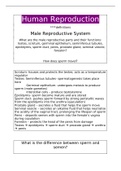
Human Reproduction
****definitions
Male Reproductive System
What are the male reproductive parts and their functions:
testes, scrotum, germinal epithelium, seminiferous tubules,
epididymis, sperm duct, penis, prostate gland, seminal vesicle,
foreskin?
How does sperm travel?
Scrotum- houses and protects the testes, acts as a temperature
regulator
Testes: Seminiferous tubules- spermatogenesis takes place
here
Germinal epithelium- undergoes meiosis to produce
sperm (male gametes)
Interstitial cells – produce testosterone
Epididymis- sperm become mature and are stored
Sperm duct- pushes sperm forward by strong peristaltic waves
from the epididymis into the urethra (ejaculation)
Prostate gland – secretes a fluid that helps the sperm move
Seminal vesicle – secretes an alkaline fluid that helps neutralise
the acidity of the vaginal tract, prolonging the lifespan of sperm
Penis – deposits semen with sperm into the female’s vagina
during copulation
Foreskin – protects the head of the penis from damage
Testes epididymis sperm duct prostate gland urethra
penis
What is the difference between sperm and
semen?
, What is the difference between erection and
ejaculation?
- Sperm are the male gametes that contain the male
genetic material
- Semen consists of sperm and fluids from the sperm duct,
prostate gland, and seminal vesicle
- An erection is the stiffening of the penis
- Ejaculation is the expulsion of semen
Female Reproductive System
What are the female reproductive parts and their functions:
ovary including follicles and corpus luteum, oviduct, uterus,
endometrium, cervix, vagina, and clitoris.
Ovary: Almond-shaped organ – Forms and releases an egg,
produces oestrogen and progesterone.
Follicles: primary + mature (Graafian) – contains immature
eggs. Releases mature eggs (ovulation) and secrete oestrogen.
Corpus Luteum: develops from a mature follicle- secretes
oestrogen and progesterone.
Oviduct (fallopian tubes): stretch from ovary to uterus- pathway
between uterus and ovary for eggs, sperm and zygote, site for
fertilisation and initial cell division of the zygote.
Uterus: Hollow muscular organ – the organ in which embryo
(blastocyst) is implanted, the embryo grows and develops into
a foetus.
Endometrium: vascular (many blood vessels) lining of the
uterus- forms part of the placenta that serves to nourish the
foetus.
Cervix: lower part of the uterus that projects into the vagina-
sphincter muscle keeps uterus closed during pregnancy.
****definitions
Male Reproductive System
What are the male reproductive parts and their functions:
testes, scrotum, germinal epithelium, seminiferous tubules,
epididymis, sperm duct, penis, prostate gland, seminal vesicle,
foreskin?
How does sperm travel?
Scrotum- houses and protects the testes, acts as a temperature
regulator
Testes: Seminiferous tubules- spermatogenesis takes place
here
Germinal epithelium- undergoes meiosis to produce
sperm (male gametes)
Interstitial cells – produce testosterone
Epididymis- sperm become mature and are stored
Sperm duct- pushes sperm forward by strong peristaltic waves
from the epididymis into the urethra (ejaculation)
Prostate gland – secretes a fluid that helps the sperm move
Seminal vesicle – secretes an alkaline fluid that helps neutralise
the acidity of the vaginal tract, prolonging the lifespan of sperm
Penis – deposits semen with sperm into the female’s vagina
during copulation
Foreskin – protects the head of the penis from damage
Testes epididymis sperm duct prostate gland urethra
penis
What is the difference between sperm and
semen?
, What is the difference between erection and
ejaculation?
- Sperm are the male gametes that contain the male
genetic material
- Semen consists of sperm and fluids from the sperm duct,
prostate gland, and seminal vesicle
- An erection is the stiffening of the penis
- Ejaculation is the expulsion of semen
Female Reproductive System
What are the female reproductive parts and their functions:
ovary including follicles and corpus luteum, oviduct, uterus,
endometrium, cervix, vagina, and clitoris.
Ovary: Almond-shaped organ – Forms and releases an egg,
produces oestrogen and progesterone.
Follicles: primary + mature (Graafian) – contains immature
eggs. Releases mature eggs (ovulation) and secrete oestrogen.
Corpus Luteum: develops from a mature follicle- secretes
oestrogen and progesterone.
Oviduct (fallopian tubes): stretch from ovary to uterus- pathway
between uterus and ovary for eggs, sperm and zygote, site for
fertilisation and initial cell division of the zygote.
Uterus: Hollow muscular organ – the organ in which embryo
(blastocyst) is implanted, the embryo grows and develops into
a foetus.
Endometrium: vascular (many blood vessels) lining of the
uterus- forms part of the placenta that serves to nourish the
foetus.
Cervix: lower part of the uterus that projects into the vagina-
sphincter muscle keeps uterus closed during pregnancy.