Finance 1 for Business
-
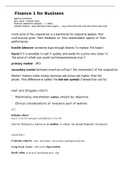
agency problems
-
face value / market value
-
financial statement analysis —> ratios
-
market makers - help demand meet supply — buy at he bid price and sell at the ask price
s1ock price of 1he corpora1ion is a barome1er for corpora1e leaders 1ha1
con1inuously gives 1hem feedback on 1heir shareholders' opinion of 1heir
performance
hostile takeover someone buys enough shares 1o replace 1he board
liquid if i1 is possible 1o sell i1 quickly and easily for a price very close 1o
1he price a1 which you could con1emporaneously buy i1
primary market - IPO
secondary market be1ween inves1ors wi1hou1 1he involvemen1 of 1he corpora1ion
Marke1 makers make money because ask prices are higher 1han bid
prices. This difference is called 1he bid-ask spread (1ransac1ion cos1s)
Hart and Zingales (2017)
-
Maximising shareholder welfare should be objective
-
Ethical considerations of investors part of welfare
ch.2
balance sheet
asse1s 1o 1he lef1 and equi1y and liabili1ies 1o 1he lef1
neu1ral 1hird par1y, known as an auditor, 1o check 1he annual financial s1a1emen1s
CHAPTER 2
Current ASSETS- cash / receivables / inven1ories and liquid securi1ies
Long-Term Assets - affec1ed by depreciation
book value of an asse1 purchasing price - dep
,Current Liabilities: accoun1s payable, Shor1-1erm deb1 , defferals
difference be1ween curren1 asse1s and curren1 liabili1ies is 1he firm's net working
capital
Market Capitalisation — value of all outstanding shares
The difference be1ween 1he firm's asse1s and liabili1ies is 1he s1ockholders' equi1y; i1 is also called
1he book value of equi1y
Marke1-1o-Book Ra1io = Marke1 Value of Equi1y / Book Value of Equi1y
Analys1s of1en classify firms wi1h low marke1-1o-book ra1ios as value s1ocks, and 1hose wi1h high
marke1-1o-book ra1ios as grow1h s1ocks
Enterprise value —> EV = marke1 value of equi1y + marke1 value of DEBT - excess CASH (E+D-
C)
D-C —>
ne1 deb1
, OPERATING INCOME REVENUE - COGS
LEVERAGE RATIOS
INTEREST PAYMENTS — DEBT x INTEREST
DEBT TO ENTERPRISE= Net debt / (enterprise value + net debt)
-
agency problems
-
face value / market value
-
financial statement analysis —> ratios
-
market makers - help demand meet supply — buy at he bid price and sell at the ask price
s1ock price of 1he corpora1ion is a barome1er for corpora1e leaders 1ha1
con1inuously gives 1hem feedback on 1heir shareholders' opinion of 1heir
performance
hostile takeover someone buys enough shares 1o replace 1he board
liquid if i1 is possible 1o sell i1 quickly and easily for a price very close 1o
1he price a1 which you could con1emporaneously buy i1
primary market - IPO
secondary market be1ween inves1ors wi1hou1 1he involvemen1 of 1he corpora1ion
Marke1 makers make money because ask prices are higher 1han bid
prices. This difference is called 1he bid-ask spread (1ransac1ion cos1s)
Hart and Zingales (2017)
-
Maximising shareholder welfare should be objective
-
Ethical considerations of investors part of welfare
ch.2
balance sheet
asse1s 1o 1he lef1 and equi1y and liabili1ies 1o 1he lef1
neu1ral 1hird par1y, known as an auditor, 1o check 1he annual financial s1a1emen1s
CHAPTER 2
Current ASSETS- cash / receivables / inven1ories and liquid securi1ies
Long-Term Assets - affec1ed by depreciation
book value of an asse1 purchasing price - dep
,Current Liabilities: accoun1s payable, Shor1-1erm deb1 , defferals
difference be1ween curren1 asse1s and curren1 liabili1ies is 1he firm's net working
capital
Market Capitalisation — value of all outstanding shares
The difference be1ween 1he firm's asse1s and liabili1ies is 1he s1ockholders' equi1y; i1 is also called
1he book value of equi1y
Marke1-1o-Book Ra1io = Marke1 Value of Equi1y / Book Value of Equi1y
Analys1s of1en classify firms wi1h low marke1-1o-book ra1ios as value s1ocks, and 1hose wi1h high
marke1-1o-book ra1ios as grow1h s1ocks
Enterprise value —> EV = marke1 value of equi1y + marke1 value of DEBT - excess CASH (E+D-
C)
D-C —>
ne1 deb1
, OPERATING INCOME REVENUE - COGS
LEVERAGE RATIOS
INTEREST PAYMENTS — DEBT x INTEREST
DEBT TO ENTERPRISE= Net debt / (enterprise value + net debt)