Nursing 206 Case Study Cardiac Tamponade
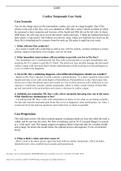
Cardiac Tamponade Case Study Case Scenario You are the charge nurse on the intermediate cardiac care unit in a large hospital. One of the clients on the unit is Mr. Roy, who was admitted at 1300 after a motor vehicle accident in which he sustained a chest contusion and fractures of the fourth and fifth ribs on his left side. At about 2000 hours, his wife runs up to you at the nurses' station and says, "I think my husband just had a heart attack. Come quick!" She follows you into his room, where you find him face down on the floor. He is breathing and is cyanotic from the neck up. His pulse is rapid but very weak. 1. What will your first action be? - As a nurse I would call a code blue as well as stay with the patient, continue attempts to arouse patient, support respirations with oxygen, and call for help. 2. What immediate interventions will you initiate to provide care for to Mr. Roy? - The immediate care I would provide Mr. Roy with is placing him on oxygen immediately and ensuring the IV is patent to provide IV fluids. The physician may initially manage the decreased cardiac output with increased fluid volume administration while awaiting an echocardiogram or x-ray to confirm the diagnosis. 3. Given Mr. Roy's admitting diagnosis, what differential diagnoses should you consider? - Based on Mr. Roy’s injuries I would consider a pneumothorax. It is often caused by blunt chest trauma and may occur with some degree of hemothorax. Pneumothorax is any chest injury that allows air to enter the pleural space and results in a rise in chest pressure and a reduction in vial capacity. I would also consider cardiac tamponade, which is when a small volume of fluid fills up and surrounds in the pericardium and causes a decrease in cardiac output. 4. Suddenly you remember Mr. Roy's wife, who is anxiously hovering over you in the room. What should you communicate to her? - I would provide Mr. Roy’s wife with information we know so far, what we are doing currently for him and what the treatment plan looks like as far as diagnostic tests, medications, etc. Also, I would ask her if she had any questions and comfort her as much as possible. Case Progressions S The code team arrives. Mr. Roy's trauma surgeon is making rounds on your unit when the code is called, and he runs into the room. Mr. Roy is intubated, and an IV of Lactated Ringer's is started at a "wide open" rate. The trauma surgeon recognizes Beck's triad and calls for a cardiac needle and syringe. He inserts the needle below the xiphoid process and aspirates 75 mL of unclotted blood. 5. What is Beck's triad, and what causes it? - Beck’s triad is the three classic signs that help indicate cardiac tamponade, which includes, distended neck veins, muffled heart sounds and hypotension.
Document information
- Uploaded on
- January 13, 2022
- Number of pages
- 3
- Written in
- 2021/2022
- Type
- Exam (elaborations)
- Contains
- Questions & answers