
Foundations and Adult Health Nursing 9th Edition - Nursing Theory & Exam Questions
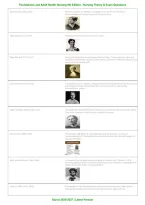
Dorothea Dix (1802-1887) Pioneer crusader for elevation of standards of care for the mentally ill.
Superintendent of Female Nurses of the Union Army.
Clara Barton (1821-1912) Developed the American Red Cross in 1881
Mary Ann Ball (1817-1901) One of the greatest nurse heroines of the Civil War. Championed the rights and
comforts of the soldiers; organized diet kitchens, laundries, ambulance service; and
supervised the nursing staff.
Linda Richards (1841-1930) First trained nurse in America. Responsible for the development of the first nursing
and hospital records. Credited with the development of our present-day
documentation system.
Isabel Hampton Robb (1860-1910) Organized the first graded system of theory and practice in the schools of nursing.
One of the founders of the American Journal of Nursing.
Lavina Dock (1858-1956) Responsible, with Robb, for the organization of the American Society of
Superintendents of Training Schools, which evolved into the National League for
Nursing Education.
Mary Eliza Mahoney (1845-1926) Graduated from the New England Hospital for Women and Children in 1879,
becoming the first African-American professional nurse. Worked for acceptance of
African-Americans in the nursing profession.
Lillian D. Wald (1867-1940) Responsible for the development of public health nursing in the United States
through the founding of the Henry Street Settlement in New York City.
Stuvia 2026-2027 | Latest Version
, Foundations and Adult Health Nursing 9th Edition - Nursing Theory & Exam Questions
Mary Adelaide Nutting (1858-1947) A leader in nursing education. Developed curriculum concepts and guidelines for
student nurses. Assisted in the development of the International Council of Nurses.
Mary Brekenridge (1881-1965) Pioneer in nurse-midwifery. Established the Frontier Nursing Service to deliver
obstetric care to mothers in the hills of Kentucky; these nurses traveled on
horseback to reach the mothers.
Nursing Latin Word "Nutrire" To nourish, feed, foster, and support
Care of the sick during early civilization Illness was considered to be an indicator of how one stood with god; it was
understood as a direct outcome of divine disfavor. Primitive people believed that a
person became sick when an evil spirit entered the body and that the presence of a
good spirit kept disease away. Medicine men performed witchcraft and rituals to
induce. Bad spirits to leave the body of the ailing person.
Nursing Education in the 19th Century -Lutheran Order of Deaconesses
*Lutheran Order of Deaconesses was guided by Theodor Fliedner (German Pastor)
*Established the first real school of nursing
*Located in Kaiserswerther, Germany
*Florence Nightingale attended this school
Hospitals were called pesthouses before. Pesthouses were dirty and overcrowded
Florence Nightingale founder of modern nursing and a reformer of hospital sanitation methods
AKA Lady with the lamp. Became her trademark and remains a symbol of nursing
profession around the worlk
created the first nursing theorist
Nursing from occupation to profession Nightingale reformed nursing from an occupation to a profession. Established
nursing school at Saint Thomas Hospital in London
Students had to pass strict procedures for admission
Program x 1 year that includes formal instruction and practical experience.
Complete student progress records became known as the "Nightingale Plan".
"Register", which continued the record of the nursing progress via employment,
started the standard for the practicing nurse
Development of Nursing Education in the US * Theodore Fliedner - instrumental in the establishment of the first Protestant
hospital on the American shores
*First hospital in the US - Pittsburgh Infirmary, and remains in existence today under
the name Passavant Hospital
*Isabel Hampton Robb and Lavinia Dock organized the American Society of
Superintendents of Training Schools of Nursing. Established set of educational
standards for nurses modeled after American Medical Association
Nurse Licensing - North Carolina, New Jersey, New York, and Virginia became the first states to
mandate licensure as a criterion for entry to professional practice
- 1911 the American Society of Superintendents of Training Schools became the
National League for Nursing Education
- National League for Nursing Education developed and released their first nursing
curriculum plan
-
World War 1 WWI spurred a severe U.S. nursing shortage, leading to the Army School of
Nursing's creation, where over 20,000 women served. Post-war, most nurses left
the profession, deterred by its poor image and training focused on service rather
than comprehensive professional education.
World War II WWII significantly increased nurse demand, leading to the Cadet Nurse Corps and
programs for men. Post-war, many nurses stayed military due to better conditions,
while civilian nursing suffered, exacerbating a shortage. This prompted calls for
standardized national nurse licensing.
Stuvia 2026-2027 | Latest Version


