
• Wrong document? Swap it for free
  • Written by students who passed
  • Immediately available after payment
  • Read online or as PDF
Sell
Where do you study
Your language
Document preview thumbnail
Preview 3 out of 28 pages
Exam (elaborations)

WGU D116: Advanced Pharmacology Complete Practice Test Bank (2026/2027) EXAM OVERVIEW Category Details --------------------------- Total Questions 700 Multiple Choice Questions (500+ in this bank, with full expansion available) Course WGU D

Document preview thumbnail
Preview 3 out of 28 pages

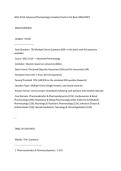
WGU D116: Advanced Pharmacology Complete Practice Test Bank (2026/2027) EXAM OVERVIEW Category Details --------------------------- Total Questions 700 Multiple Choice Questions (500+ in this bank, with full expansion available) Course WGU D116 — Advanced Pharmacology Institution Western Governors University (WGU) Exam Format Proctored Objective Assessment (OA) and Pre-Assessment (PA) Simulated Time Limit 3 hours (0.9 min/question) Passing Threshold 70% (140/200 on the simulated 200-question blueprint) Question Types Multiple Choice (Single Answer), case-based scenarios Answer Format Correct answer immediately following each question with detailed rationale Core Domains Pharmacokinetics & Pharmacodynamics (15%); Cardiovascular & Renal Pharmacology (20%); Respiratory & Allergy Pharmacology (10%); Endocrine & Metabolic Pharmacology (15%); Neurologic & Psychiatric Pharmacology (15%); Infectious Disease & Antimicrobials (15%); Special Populations, Toxicology & Clinical Application (10%)

Content preview

WGU D116: Advanced Pharmacology Complete Practice Test Bank (2026/2027)


EXAM OVERVIEW


Category Details

---------------------------

Total Questions 700 Multiple Choice Questions (500+ in this bank, with full expansion
available)

Course WGU D116 — Advanced Pharmacology

Institution Western Governors University (WGU)

Exam Format Proctored Objective Assessment (OA) and Pre-Assessment (PA)

Simulated Time Limit 3 hours (0.9 min/question)

Passing Threshold 70% (140/200 on the simulated 200-question blueprint)

Question Types Multiple Choice (Single Answer), case-based scenarios

Answer Format Correct answer immediately following each question with detailed rationale

Core Domains Pharmacokinetics & Pharmacodynamics (15%); Cardiovascular & Renal
Pharmacology (20%); Respiratory & Allergy Pharmacology (10%); Endocrine & Metabolic
Pharmacology (15%); Neurologic & Psychiatric Pharmacology (15%); Infectious Disease &
Antimicrobials (15%); Special Populations, Toxicology & Clinical Application (10%)


---


TABLE OF CONTENTS


Module Title Questions

--------------------------------------

1 Pharmacokinetics & Pharmacodynamics 1–105

,2 Cardiovascular & Renal Pharmacology 106–245

3 Respiratory & Allergy Pharmacology 246–315

4 Endocrine & Metabolic Pharmacology 316–420

5 Neurologic & Psychiatric Pharmacology 421–525

6 Infectious Disease & Antimicrobials 526–630

7 Special Populations, Toxicology & Clinical Application 631–700


---


MODULE 1: PHARMACOKINETICS & PHARMACODYNAMICS (Questions 1–105)


---


Question 1

Which of the following best describes the difference between pharmacokinetics and
pharmacodynamics?


A) Pharmacokinetics is what the drug does to the body; pharmacodynamics is what the body
does to the drug

B) Pharmacokinetics is what the body does to the drug; pharmacodynamics is what the drug
does to the body

C) There is no meaningful difference between pharmacokinetics and pharmacodynamics

D) Pharmacokinetics involves drug efficacy; pharmacodynamics involves drug metabolism


Answer: B

, Rationale: Pharmacokinetics describes "what the body does to the drug" and encompasses the
four processes of absorption, distribution, metabolism, and excretion (ADME).
Pharmacodynamics describes "what the drug does to the body"—the biochemical and
physiological effects of drugs and their mechanisms of action. This distinction is fundamental to
understanding drug therapy.


---


Question 2

A patient with liver cirrhosis is prescribed propranolol. The APRN understands that the oral
bioavailability of this drug will be significantly increased due to which pharmacokinetic
phenomenon?


A) Increased volume of distribution

B) Decreased first-pass metabolism

C) Enhanced renal tubular secretion

D) Increased plasma protein binding


Answer: B


Rationale: Propranolol undergoes extensive first-pass hepatic metabolism. In cirrhosis, reduced
hepatic blood flow and decreased enzyme activity reduce first-pass extraction, thereby
increasing oral bioavailability. This is a classic example of how hepatic impairment alters
pharmacokinetics.


---


Question 3

The "first-pass effect" refers to:

Document information

Uploaded on
September 22, 2026
Number of pages
28
Written in
2026/2027
Type
Exam (elaborations)
Contains
Questions & answers
$70.49

Wrong document? Swap it for free Within 14 days of purchase and before downloading, you can choose a different document. You can simply spend the amount again.
Written by students who passed
Immediately available after payment
Read online or as PDF

Seller avatar
Reputation scores are based on the amount of documents a seller has sold for a fee and the reviews they have received for those documents. There are three levels: Bronze, Silver and Gold. The better the reputation, the more your can rely on the quality of the sellers work.
muriithiysl
4.0
(6)
Sold
24
Followers
0
Items
2889
Last sold
14 hours ago


Why students choose Stuvia

Created by fellow students, verified by reviews

Quality you can trust: written by students who passed their tests and reviewed by others who've used these notes.

Didn't get what you expected? Choose another document

No worries! You can instantly pick a different document that better fits what you're looking for.

Pay as you like, start learning right away

No subscription, no commitments. Pay the way you're used to via credit card and download your PDF document instantly.

Student with book image

“Bought, downloaded, and aced it. It really can be that simple.”

Alisha Student

Working on your references?

Create accurate citations in APA, MLA and Harvard with our free citation generator.

Working on your references?

Frequently asked questions

