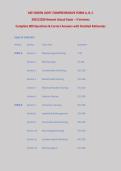
VATI GREEN LIGHT COMPREHENSIVE FORM A, B, C
2025/2026 Newest Actual Exam – 3 Versions
Complete 900 Questions & Correct Answers with Detailed Rationales
TABLE OF CONTENTS
Version Section Topic Area Questions
FORM A Section 1 Medical-Surgical Nursing 1-50
Section 2 Pharmacology 51-100
Section 3 Fundamentals of Nursing 101-150
Section 4 Mental Health Nursing 151-200
Section 5 Maternal-Newborn Nursing 201-250
Section 6 Pediatric Nursing 251-300
FORM B Section 7 Critical Care Nursing 301-350
Section 8 Leadership & Management 351-400
Section 9 Community Health Nursing 401-450
Section 10 Gerontological Nursing 451-500
Section 11 Complex Health Alterations 501-550
Section 12 Pharmacology II 551-600
,Version Section Topic Area Questions
FORM C Section 13 Emergency Nursing 601-650
Section 14 Prioritization & Delegation 651-700
Section 15 Professional Issues & Ethics 701-750
Section 16 Infection Control & Safety 751-800
Section 17 Nutrition & Metabolic Disorders 801-850
Section 18 Comprehensive Review 851-900
FORM A
Section 1: Medical-Surgical Nursing (Questions 1-50)
Question 1
A nurse is admitting a client who has antisocial personality disorder. Which of the following
client behaviors should the nurse identify as consistent with this disorder?
A. Compulsive attention to details
B. Avoids interacting with others
C. Uses others for personal gain
D. Socially awkward in group situations
Correct Answer: C. Uses others for personal gain
Rationale: Individuals with antisocial personality disorder often exhibit manipulative behaviors,
which involve using others to achieve personal goals or benefits. This behavior is a hallmark of
the disorder. Option A describes obsessive-compulsive traits, Option B describes avoidant or
schizoid traits, and Option D describes social anxiety or autism spectrum traits.
Question 2
A nurse is caring for a client with heart failure who reports shortness of breath at rest. Which
assessment finding requires immediate action?
A. Weight gain of 1 lb in 24 hours
,B. Crackles in bilateral lung bases
C. Oxygen saturation of 88% on room air
D. Peripheral edema in lower extremities
Correct Answer: C. Oxygen saturation of 88% on room air
Rationale: An oxygen saturation of 88% indicates hypoxemia and requires immediate
intervention to prevent respiratory compromise. While weight gain, crackles, and peripheral
edema are concerning findings in heart failure, they do not represent the immediate life-
threatening priority that hypoxemia does.
Question 3
A client with diabetes mellitus is scheduled for surgery and is NPO. Which action should the
nurse take regarding insulin administration?
A. Hold all insulin
B. Administer the full prescribed dose
C. Administer sliding-scale insulin only
D. Clarify prescriptions with the provider
Correct Answer: D. Clarify prescriptions with the provider
Rationale: Insulin needs may change when a client is NPO. The nurse should clarify orders with
the provider to prevent hypo- or hyperglycemia during the perioperative period. Holding all
insulin could lead to hyperglycemia, while administering the full dose could cause
hypoglycemia.
Question 4
A nurse is teaching a client about warfarin therapy. Which statement indicates understanding?
A. "I will increase foods high in vitamin K."
B. "I should report signs of bleeding immediately."
C. "I can take aspirin for headaches."
D. "I no longer need blood tests."
Correct Answer: B. "I should report signs of bleeding immediately."
Rationale: Warfarin increases bleeding risk, and clients must promptly report any signs of
bleeding (e.g., bruising, hematuria, gum bleeding). Vitamin K intake should remain consistent,
as fluctuations can affect INR. Aspirin should be avoided due to increased bleeding risk, and
regular blood tests (INR) are necessary to monitor therapy.
, Question 5
A client with COPD is prescribed oxygen at 2 L/min via nasal cannula. Which finding indicates
the therapy is effective?
A. Respiratory rate of 10/min
B. Oxygen saturation of 92%
C. Decreased PaCO₂ below normal
D. Absence of wheezing
Correct Answer: B. Oxygen saturation of 92%
Rationale: Target oxygen saturation for COPD clients is typically 88-92%, indicating adequate
oxygenation without suppressing the respiratory drive. A respiratory rate of 10/min is
bradypneic and may indicate respiratory depression.
Question 6
A postoperative client reports calf pain and warmth. Which action should the nurse take first?
A. Encourage ambulation
B. Apply heat
C. Notify the provider
D. Massage the area
Correct Answer: C. Notify the provider
Rationale: These findings suggest possible deep vein thrombosis (DVT). Massaging the area
could dislodge a clot, and ambulation could worsen the condition. The provider should be
notified immediately for further evaluation and orders.
Question 7
A nurse is caring for a client receiving IV potassium chloride. Which action is appropriate?
A. Administer IV push
B. Dilute and infuse slowly
C. Mix with dextrose only
D. Give via central line only
Correct Answer: B. Dilute and infuse slowly
Rationale: Potassium chloride must always be diluted and infused slowly (maximum 10
mEq/hour) to prevent cardiac dysrhythmias and hyperkalemia. IV push potassium is
contraindicated and can be fatal.