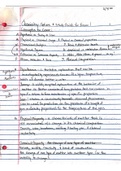
Empiricism: Meaning and Key Concepts
Empiricism is a philosophical doctrine that holds the view that knowledge is derived
from experience. Hence, for the empiricists, all knowledge begins with experience and
that the mind is like a “blank sheet” (Tabula rasa) that the human person fills with ideas
as she experiences the world through her five external senses. The empiricists,
therefore, deny the contention of the rationalists that ideas are innate, that is, humans
are born with imprinted ideas, knowledge, and principles.
It must be noted that there are many types of experience. For example, we may talk of
“inner” experience, such as dreaming, imagining, and fantasizing. However, this type of
experience is not the one dealt with in empiricism. This is because when we talk of
experience in philosophy, particularly in empiricism, we are specifically and exclusively
referring to “sensory experience”.
In particular, the adherents of empiricism are interested in explaining the origin of
knowledge, with emphasis on how the human mind acquires knowledge and conceptual
understanding. In fact, John Locke, a 17th century British philosopher, devoted Book II of
his seminal work titled An Essay Concerning Human Understanding to explaining the
origin and development of knowledge. Locke says that first, there is the relationship
between the subject (knower) and object (the thing known). The subject then perceives
the object through the five external senses. According to Locke, through this process of
sensation, the human mind forms simple ideas, such as the idea of a “table” or a “book”.
When we put together simple ideas, as Locke contends, we form complex ideas through
the process of reflection. Locke understands reflection as the “perception of the
operations of our own mind within us, as it is employed about the ideas it has got”.
Empiricism is a philosophical doctrine that holds the view that knowledge is derived
from experience. Hence, for the empiricists, all knowledge begins with experience and
that the mind is like a “blank sheet” (Tabula rasa) that the human person fills with ideas
as she experiences the world through her five external senses. The empiricists,
therefore, deny the contention of the rationalists that ideas are innate, that is, humans
are born with imprinted ideas, knowledge, and principles.
It must be noted that there are many types of experience. For example, we may talk of
“inner” experience, such as dreaming, imagining, and fantasizing. However, this type of
experience is not the one dealt with in empiricism. This is because when we talk of
experience in philosophy, particularly in empiricism, we are specifically and exclusively
referring to “sensory experience”.
In particular, the adherents of empiricism are interested in explaining the origin of
knowledge, with emphasis on how the human mind acquires knowledge and conceptual
understanding. In fact, John Locke, a 17th century British philosopher, devoted Book II of
his seminal work titled An Essay Concerning Human Understanding to explaining the
origin and development of knowledge. Locke says that first, there is the relationship
between the subject (knower) and object (the thing known). The subject then perceives
the object through the five external senses. According to Locke, through this process of
sensation, the human mind forms simple ideas, such as the idea of a “table” or a “book”.
When we put together simple ideas, as Locke contends, we form complex ideas through
the process of reflection. Locke understands reflection as the “perception of the
operations of our own mind within us, as it is employed about the ideas it has got”.