Nsg6320 Agnp Board Exam Respiratory Assessment (51 Questions)|Agnp Board Exam Respiratory Assessment (2020)
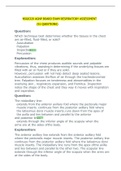
NSG6320 AGNP BOARD EXAM RESPIRATORY ASSESSMENT (51 QUESTIONS) Question: Which technique best determines whether the tissues in the chest are air-filled, fluid- filled, or solid? Auscultation Palpation Inspection Percussion Explanation: Percussion of the chest produces audible sounds and palpable vibrations, thus, assisting in determining if the underlying tissues are filled with air or fluid or if they are solid. However, percussion will not help detect deep seated lesions. Auscultation assesses the flow of air through the tracheobronchial tree. Palpation focuses on tenderness and abnormalities in the overlying skin , respiratory expansion, and fremitus. Inspection notes the shape of the chest and they way it moves with inspiration and expiration. Question: The midaxillary line: extends from the anterior axillary fold where the pectoralis major muscle inserts. continues from the posterior axillary fold where the latissimus dorsi muscle inserts. runs down from the apex of the axilla and lies between and parallel to the anterior and posterior lines. extends through the inferior angle of the scapula when the arms are at the sides of the body. Explanation: The anterior axillary line extends from the anterior axillary fold where the pectoralis major muscle inserts. The posterior axillary line continues from the posterior axillary fold where the latissimus dorsi muscle inserts. The midaxillary line runs from the apex of the axilla and lies between and parallel to the other two. The scapular line extends through the inferior angle of the scapula when the arms are at the sides of the body. Correct Question: When percussing the lower posterior chest, begin by: standing on the side rather than directly behind the patient. Correct having the patient lie supine on the examining table. carefully palpating any area the patient has reported pain. using the ball or the ulnar surface of the hand. Explanation: When percussing the lower posterior chest, stand on the side rather than directly behind the patient. This position allows the ability to place the pleximeter finger more firmly on the chest and the plexor is more effective in making a better percussion note. If the patient is lying supine, the posterior chest will not be able to be percussed. Palpating painful areas is not percussion, so is not correct. Using the bony part of the palm at the base of the fingers or the ulnar surface is a technique used to detect tactile fremitus. Question: A 65-year-old obese man with a past medical history of hypertension complains of increased fatigue during the day. The practitioner orders a polysomnogram to test for: congestive heart failure (CHF). gastroesophageal reflux disease (GERD). obstructive sleep apnea (OSA). Correct chronic obstructive pulmonary disease (COPD). Explanation: A polysomnography is a standard diagnostic test for the diagnosis of obstructive sleep apnea (OSH) through sleep evaluation. OSH is also referred to as obstructive sleep apnea-hypopnea. This disorder involves cessation or a significant decrease in airflow in the presence of breathing effort and is characterized by recurrent episodes of upper airway collapse during sleep. It is also associated with excessive daytime sleepiness. Question: Pain from pleurisy may be referred to the: right shoulder. retrosternal area. epigastric area. Correct back. Explanation: Referred pain is defined as pain that is felt in more distal sites than the initial pain site. Pain from pleurisy or inferior wall myocardial infarction may be referred to the epigastric area. Referred pain from the biliary tree may be perceived in the right shoulder or the right posterior chest. Referred pain of duodenal or pancreatic origin may be referred to the back. Heartburn may be associated with retrosternal burning pain. Question: An acute viral illness that presents with a burning retrosternal discomfort and a dry cough is suggestive of: tracheobronchitis. Correct chronic bronchitis. bronchiectasis. laryngitis. Explanation: An acute viral illness that presents with a burning retrosternal discomfort and a dry cough is tracheobronchitis. An acute, mild illness associated with viral nasopharyngitis and hoarseness is laryngitis. The initial cough is dry and nonproductive but may become productive over time. A chronic bronchitis cough is characteristically productive with mucoid to purulent sputum and may be blood tinged. Bronchiectasis produces a chronic cough with sputum that is copious and foul-smelling. It may be blood tinged or bloody. Question: When examining a patient for chest expansion, begin by: hyperextending the examiner's middle finger of the left hand (pleximeter finger) and pressing its distal interphalangeal joint firmly on the surface to be examined
Document information
- Uploaded on
- July 7, 2021
- Number of pages
- 31
- Written in
- 2020/2021
- Type
- Exam (elaborations)
- Contains
- Questions & answers