
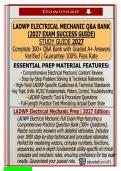
Ace your LADWP Electrical Mechanic and Test Technician exam with confidence using this comprehensive 300+ question Q&A bank, fully updated for the 2027 Los Angeles Department of Water and Power certification cycle! This all-in-one resource is meticulously aligned with the official LADWP Civil Service examination blueprint and covers the full spectrum of content required for the Electrical Mechanic and Test Technician classification — including electrical theory and fundamentals (Ohm's Law, series and parallel circuits, power calculations), AC/DC theory and circuits, transformer calculations, motors and generators, circuit breakers and disconnects, mechanical aptitude, high-voltage substation equipment maintenance, safety protocols (lockout/tagout, clearance procedures, PPE), and critical decision-making skills for utility operations. Featuring exam-style multiple-choice questions with verified correct answers and detailed rationales that explain both the correct choice and why the distractors are incorrect, this resource mirrors the actual LADWP Civil Service exam format. Perfect for aspiring electrical mechanics, test technicians, electric station operators, and utility workers seeking self-assessment, targeted review, and exam-day success. Instant Download available.
KEYWORDS
LADWP Electrical Mechanic Exam, LADWP Test Technician Exam, Los Angeles Department of Water and Power, LADWP Civil Service Exam, Electrical Mechanic Q&A Bank, 2027 study guide, electrical theory, Ohm's Law, AC/DC circuits, transformer calculations, motors and generators, circuit breakers, disconnects, electrical safety, lockout/tagout, high-voltage substation, utility operations, mechanical aptitude, power systems, electrical maintenance, LADWP exam prep, verified answers, detailed rationales, practice questions, pass guarantee.
QUICK REFERENCE: KEY EXAM TOPICS
Topic Area Key Concepts
Electrical Theory Ohm's Law, Kirchhoff's Laws, series/parallel circuits, power calculations, impedance
AC/DC Circuits Alternating current fundamentals, direct current systems, rectifiers, inverters
Transformers Transformer calculations, cooling systems, tap changers, protection
Motors & Generators Motor theory, generator operation, maintenance, troubleshooting
Circuit Breakers Vacuum vs. SF6 breakers, trip/close coils, interrupting ratings
Disconnects & Switchgear Isolators, air-break switches, grounding switches, load-break switches
Safety Protocols Lockout/tagout (LOTO), clearance procedures, PPE, G.O. 95 rules
Mechanical Aptitude Tools, equipment, mechanical systems, troubleshooting
Substation Equipment High-voltage maintenance, vertical clearances, pole riser placement
️ Disclaimer: This resource is intended for educational and study purposes only to support exam preparation. It is not a substitute for official LADWP materials, exam announcements, or institutional guidelines. The LADWP Civil Service examination process is administered by the City of Los Angeles Personnel Department. Always refer to the official LADWP Careers website (
Content preview
,LADWP Electrical Mechanic Q&A Bank 2027 Exam Success
Guide | Graded A+
1. Which AWG wire is capable of carrying the largest amount of current?
8
10
12
14
2. What is the primary cooling method used in a dry type transformer?
Water
Air
Oil
Gas
3. Describe the characteristics of a Type UF conductor and its typical
applications.
Type UF conductor is only used in residential applications without
moisture exposure.
Type UF conductor is designed for wet locations and is suitable for
underground installations.
Type UF conductor has a rigid structure and is used for high-voltage
applications.
Type UF conductor is primarily used for indoor wiring in dry locations.
4. If an electrician discovers a splice in a buried conduit during an inspection,
what should be their immediate course of action according to NEC
, guidelines?
The electrician should report the violation and recommend
corrective measures to remove the splice.
The electrician should replace the entire conduit system.
The electrician should leave the splice as is if it appears functional.
The electrician should cover the splice with additional insulation.
5. Watt is a What? Oops, sorry... I meant to ask, "What is a Watt?".
A unit of energy.
A unit of power.
That was a terrible joke.
A unit of kinetic energy.
6. Describe how a transformer operates in relation to voltage levels in an
electrical circuit.
A transformer uses mechanical components to adjust voltage levels.
A transformer operates by using electromagnetic induction to
increase or decrease voltage levels in an electrical circuit.
A transformer isolates circuits to prevent electrical interference.
A transformer converts electrical energy into heat to manage voltage
levels.
7. If you attempt to measure resistance in a live circuit with an ohmmeter, what
potential hazards could arise?
You could damage the ohmmeter and create a shock hazard.
You would obtain an accurate resistance reading.
, You would improve the circuit's performance.
You would not encounter any issues.
8. In a scenario where a power plant generates electricity at 20,000 volts, which
device would be essential to reduce this voltage for safe distribution to
homes?
Transformer
Circuit breaker
Voltage regulator
Fuse
9. A dry-type transformer uses to dissipate excess heat that is generated by
current passing through the windings.
cores
deflection
air
oil
10. An open circuit can be caused by a(n)
broken wire
lose terminal/wire
blown fuse
All of the above
11. As the gauge number of the wire increases, its current carrying capacity?
Decreases

