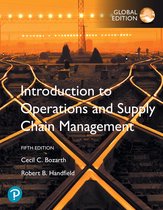
Supply chain book
- Chapter 1
- Chapter 2
- Chapter 7
- Chapter 8
- Chapter 11
- Chapter 12S
,Chapter 1
Why study operations and supply chain management?
- Every organization must make product or provide a service that someone values
- Organizations function as part of larger supply chains
- Organizations must carefully manage their operations and supply chains in order to
prosper and indeed survive
Operations function (operations)
The collection of people, technology and systems within an organization that has primary
responsibility for providing the organization’s products or services.
Supply chain
A network of manufacturers and service providers that work together to create products or
services needed by end users. These manufacturers and service providers are linked
together through physical flows, information flows and monetary flows.
Supply chain operations reference (SCOR) model
A framework developed and supported by the supply chain council that seeks to provide
standard descriptions of the processes, relationships and metric that define supply chain
management.
According to the SCOR model, supply chain management covers 5 broad areas:
- Planning activities
- Sourcing activities
- “make” or production activities
- Delivery activities
- Return activities
Agility
The ability to recalculate plans in the face of market demand and supply volatility and deliver
the same or comparable cost, quality and customer service.
Electronic commerce (e-commerce)
The use of computer and telecommunication technologies to conduct business via electronic
transfer of data and documents.
3 enduring trends that will continue to attract attention of operations and supply chain
management professionals for the foreseeable future:
- Agility
- Information technologies
- People
Relationship management is the most difficult.
, Critical thinking
Involves purposeful and goal-directed thinking used to define and solve problems, make
decisions or form judgements related to a particular situation or set of circumstances.
Knowledge application and analysis
The ability to learn a concept and then apply that knowledge in another setting to achieve a
higher level of understanding.
Information technology application and computing skills
The ability to select and use appropriate technology to accomplish a given task.
Major operations and supply chain activities
Operations and Purpose Key interfunctional Key
supply chain activity participants interorganizational
participants
Process selection Design and Engineering Customers
implement the Marketing
transformation Finance
processes that best Human resources
meet the needs of It
the customer and
the firm
Forecasting Develop the Marketing Suppliers
planning numbers Finance Customers
needed for effective Accounting
decision making
Capacity planning Establish strategic Finance Suppliers
capacity levels Accounting Customers
Marketing
Human resources
Inventory Manage the amount Finance Suppliers
management and placement of IT Customers
inventory within the
company and the
supply chain
Planning and control Schedule and Marketing Suppliers
manage the flow of IT Customers
work through an
organization and the
supply chain; match
customer demand to
supply chain
activities
Purchasing Identify and qualify Engineering Suppliers
- Chapter 1
- Chapter 2
- Chapter 7
- Chapter 8
- Chapter 11
- Chapter 12S
,Chapter 1
Why study operations and supply chain management?
- Every organization must make product or provide a service that someone values
- Organizations function as part of larger supply chains
- Organizations must carefully manage their operations and supply chains in order to
prosper and indeed survive
Operations function (operations)
The collection of people, technology and systems within an organization that has primary
responsibility for providing the organization’s products or services.
Supply chain
A network of manufacturers and service providers that work together to create products or
services needed by end users. These manufacturers and service providers are linked
together through physical flows, information flows and monetary flows.
Supply chain operations reference (SCOR) model
A framework developed and supported by the supply chain council that seeks to provide
standard descriptions of the processes, relationships and metric that define supply chain
management.
According to the SCOR model, supply chain management covers 5 broad areas:
- Planning activities
- Sourcing activities
- “make” or production activities
- Delivery activities
- Return activities
Agility
The ability to recalculate plans in the face of market demand and supply volatility and deliver
the same or comparable cost, quality and customer service.
Electronic commerce (e-commerce)
The use of computer and telecommunication technologies to conduct business via electronic
transfer of data and documents.
3 enduring trends that will continue to attract attention of operations and supply chain
management professionals for the foreseeable future:
- Agility
- Information technologies
- People
Relationship management is the most difficult.
, Critical thinking
Involves purposeful and goal-directed thinking used to define and solve problems, make
decisions or form judgements related to a particular situation or set of circumstances.
Knowledge application and analysis
The ability to learn a concept and then apply that knowledge in another setting to achieve a
higher level of understanding.
Information technology application and computing skills
The ability to select and use appropriate technology to accomplish a given task.
Major operations and supply chain activities
Operations and Purpose Key interfunctional Key
supply chain activity participants interorganizational
participants
Process selection Design and Engineering Customers
implement the Marketing
transformation Finance
processes that best Human resources
meet the needs of It
the customer and
the firm
Forecasting Develop the Marketing Suppliers
planning numbers Finance Customers
needed for effective Accounting
decision making
Capacity planning Establish strategic Finance Suppliers
capacity levels Accounting Customers
Marketing
Human resources
Inventory Manage the amount Finance Suppliers
management and placement of IT Customers
inventory within the
company and the
supply chain
Planning and control Schedule and Marketing Suppliers
manage the flow of IT Customers
work through an
organization and the
supply chain; match
customer demand to
supply chain
activities
Purchasing Identify and qualify Engineering Suppliers