UTSA MEDICAL NOTES ANTOMY
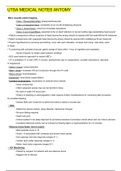
UTSA MEDICAL NOTES ANTOMY Mass casualty patient tagging: ‣ Class 1 Resuscitation/Red: airway/cardiovascular ‣ Class 2 Emergent/Yellow: immediate tx but not life threatening (fracture) ‣ Class 3 Urgent/Green: minor/not immediate (laceration) ‣ Class 4 Less Urgent/Black: expected to die so divert attention to red and yellow tags (penetrating head wound • Patient unresponsive without suspicion of head trauma the airway should be opened with the head-tilt/chin-lift maneuver • Patient unresponsive with suspected head trauma the airway should be opened with modified jaw thrust maneuver • Prevent hypothermia by removing wet clothing, cover with warm blankets, increase room temp, heat lamp, warm IV fluids • Tx poisoning with activated charcoal, gastric lavage (if done within 1 hour of ingestion),and aspiration ‣ Syrup of ipecac no longer used (induces vomiting) • BLS uses hands-on approach to restore ABC’s • VF or pulseless VT tx with CPR, IV access, dysrhythmics (epi or vasopressin), consider amiodarone, lidocaine, or magnesium • Alpha-1 drugs= vasoconstriction • Beta-1 drugs= increases HR and conduction through the AV node • Beta-2 drugs= bronchodilation • Dopamine= renal blood vessel dilation • Cerebral angiography: visualization of cerebral blood vessels ‣ Uses contrast dye ‣ Inform pregnant women dye can be harmful to fetus ‣ No food or water 4-6 hours prior ‣ History or bleeding or anticoagulation meds requires further considerations for monitoring after procedure for possible bleeding ‣ Assess BUN and Creatinine to determine kidney’s ability to excrete dye • EEG: ‣ Determine seizure activity, sleep disorder, behavioral changes ‣ No prior fasting required ‣ Wash hair prior ‣ Instruct patient to be sleep deprived for procedure because it promotes cranial stress and can induce seizures ‣ Increased electrical activity can be induced by flashing lights or hyperventilation for 3-4 minutes • Glascow Coma Scale: (not on exam) ‣ Best possible score is 15 ‣ Score 8 associated with comatose and severe head injuries ‣ Eye opening: best eye response (ranges 4-1) ‣ Verbal: best verbal response (ranges 5-1) ‣ Motor: best motor response (ranges 6-1) • ICP Monitoring: ‣ Placed by surgeon for patients with low Glascow Score ‣ Biggest risk is infection ‣ Intraventricular catheter aka ventriculostomy ‣ Subarachnoid screw or bolt ‣ Epidural or subdural sensor ‣ Increased ICP S/S: severe headache, decreased LOC, irritability, dilated/pinpoint pupils, Cheyne-Stokes respirations, abnormal posturing (decerebrate,decorticate, flaccidity) ‣ Normal ICP= 10-15 • Lumbar puncture: ‣ Tests for MS, Meningitis, Syphilis ‣ Patient should void prior to procedure ‣ Patient should be in cannon ball position while on side or stretched over an overbed table ‣ Patient should remain lying flat for several hours after procedure to ensure clotsand to decrease risk of headache ‣ Increase fluids after procedure • PET scan determines tumor activity and response to tx • Somatic pain occurs in bones, joints, muscles, skin, or connective tissues • Visceral pain occurs in organs • NSAIDs/Acetaminophen: ‣ Patients with healthy liver should take no more than 4g/day ‣ Monitor for salicylism (tinnitus, vertigo, decreased hearing acuity) ‣ Prevent GI upset by taking them with food or antacids ‣ Monitor for bleeding with long-term use • Opioid A/E: constipation, orthostatic hypotension, retention, nausea, vomiting,sedation, respiratory depression • Meningitis: ‣ Prevention: Haemophilus Influenzae Type B vaccine and Meningococcal vaccine ‣ Viral Meningitis: no vaccine ‣ S/S: excruciating constant headache, nuchal rigidity (neck stiffness),photophobia, fever, chills, N/V, altered LOC, positive Kernig’s and Brudzinski's Signs, hyperactive deep tendon reflexes, tachycardia, seizures, red macular rash ‣ Kernig’s Sign: resistance and pain with extension of leg from flexed position(think Kernig’s=Knee) ‣ Brudzinski’s Sign: flexion of knees and hips occurring with deliberate flexion of the patient's neck ‣ Cloudy CSF= bacterial meningitis ‣ Clear CSF= viral meningitis ‣ Labs: Elevated WBC and elevated protein; Decreased Glucose (bacterial) ‣ Isolate patient as soon as Meningitis is suspected (contact precautions until antibiotics have been administered for 24 hours and oral/nasal secretions are no longer infectious. Patients with bacterial meningitis might need to remain on droplet precautions continuously ..................................................CONTINUED.....................................................
Document information
- Uploaded on
- March 20, 2021
- Number of pages
- 46
- Written in
- 2020/2021
- Type
- Other
- Person
- Unknown