
Brainstorm - Study guides, Revision notes & Summaries
Looking for the best study guides, study notes and summaries about Brainstorm? On this page you'll find 18 study documents about Brainstorm.
Popular textbooks 'Brainstorm'

Lecture notes
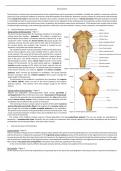
Neuroanatomy of the brainstem
Each concept is accompanied by vivid diagrams and illustrations, making it easier to visualize and understand the brain's intricate structures. Complex topics are broken down into digestible segments, making it easier to grasp difficult concepts and retain information longer. Organized logically, with a focus on flow and readability, these notes allow for quick revision and reference.
 martapokotylo
Lecture notes
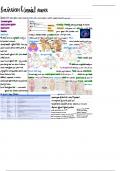
Brainstem & Cranial Nerves Lecture Notes
PopularThese notes are written on a lecture about the brainstem and the cranial nerves. The pictures and notes are quoted from slides by Dr Paul Strutton.
 ankitamenon

Essay
Essay- "Brainstorm" by Nemerov (Unseen Poetry)
Read “Brainstorm” by Howard Nemerov. In this poem, the speaker considers a storm outside. Analyse the poetic methods used by Nemerov to explore the thoughts and feelings of the speaker. This is an A grade essay for Unseen Poetry for English Literature. I have included an essay and an essay plan. Happy studying!
anon555
Package deal
EC1100 Skills for Economics Macroeconomic report package
The package includes drafts to show what and how I was going about with the project from the outline to the final report. Brainstorm and linked resources to see what I was referring to. The 1st year paper resulted in a 2nd class honours grade. This module was to teach on how to go about our research for the macroeconomic activity in a given country
 R1neza
Summary
summary slides covering the whole BMD163 functional neuroanatomy module
Newsummary slides for BMD163- functional neuroanatomy used using a student's notes that got a 1st in their degree
 riagore
Summary
Brainstem syndromes, etiology and ocular manifestations
Aetiology and Affected Areas in brain stem syndromes, including saccades and smooth pursuit. Conditions include fovilles syndrome, webers, encephalopathy and more. - **Vascular causes**: Infarcts due to occlusion of small penetrating arteries (e.g., lateral medullary syndrome, also called Wallenberg syndrome), or larger artery strokes like basilar artery occlusion. - **Demyelinating diseases**: In conditions such as multiple sclerosis, plaques may form within brainstem white matter, leading...
 halilish
Summary
Embryology – CNS Development
Embryology – CNS Development summary in detail
 samyberya
Lecture notes
Final Project - Max for Live Experiment
The study notes cover a series of steps and considerations to facilitate the development of a unique and creative final project, including: Project Conceptualization: Encouraging participants to brainstorm and define the creative direction of their project. Identifying the experimental aspect or unique feature that sets the project apart. Research and Inspiration: Exploring existing experimental music and technology projects for inspiration. Investigating avant-garde approaches and b...
 lucycates
Summary
Pediatrics Final Exam Study Guide easy effective study (maternal newborn)
Pediatrics Final Exam Study Guide easy well written and thorough preparation on key exam topics for easy and effective study.
 nancymacheria
Lecture notes
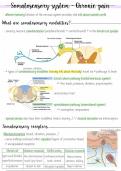
NEU 7a: Somatosensory system - chronic pain
Lecture notes from Imperial College London, Medical Biosciences BSc, 2nd year, Neuroscience (NEU) module. The afferent (sensory) and efferent (motor) divisions of the nervous system provide vital information about our outside world and allow us to implement an appropriate behaviour. We will look at the sensory system in the first part of this module (a). learning outcomes: LO1: List and define the major somatosensory modalities. LO2: Explain the neurophysiological terms: receptor, st...
lisaribau
Lecture notes
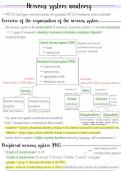
NEU 1: Nervous system anatomy
Lecture notes from Imperial College London, Medical Biosciences BSc, 2nd year, Neuroscience (NEU) module. learning objectives: LO1: Recall the gross organisation of the human central and peripheral nervous systems LO2: Illustrate the structure and functions of the spinal and cranial nerves LO3: Identify the main CNS structures and summarise their functions: spinal cord, brainstem, diencephalon, basal ganglia, cerebral cortex and cerebellum. LO4: Explain the structure and function of: c...
lisaribau

Other
MGMT 404 Week 4 Course Project Part 2 (Includes Sections C and D); The Getta Byte – New Billing System Project
The Course Project is divided into four parts. • Part 1 includes Sections A and B. This deliverable is due in Week 2. • Part 2 includes Sections C and D. This deliverable is due in Week 4. • Part 3 includes Sections E and F. This deliverable is due in Week 6. • Part 4 includes Section G and the compilation of Sections A through G. This deliverable is due in Week 8 and must be compiled into a single Word document. Your introduction is a one-page summary of all the main aspects of...
Milestonee
Exam (elaborations)
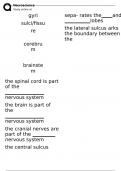
Neuroscience Exploring the Brain 4th edition Test Bank
gyri sulci/fissure cerebrum brainstem the spinal cord is part of the nervous system the brain is part of the nervous system the cranial nerves are part of the nervous system the central sulcus sepa- rates the and lobes the lateral sulcus arks the boundary between the convolutions depressions two hemispheres each containing the cerebral cortex and diencephalon mid brain, pons, medulla oblongata central central peripheral frontal, parietal frontal, temporal ...
 YOURVERIFIEDEXAMPLUG
Lecture notes
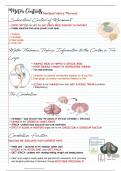
Subcortical Control of Movement
An introduction to parts of the brain that are in control of the process of movement. It gives a brief overview of the parts of the brain involved, before going into more detail about the function and explanation of the receptors, tissues, etc. involved in that area of the brain. It also includes information about the different types of pathways that areas of the brain used for signalling, as well as discussing some diseases that can have an affect on the pathway of the brain, which then impact ...
kathrynray
Summary
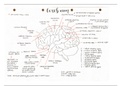
Neuroanatomy - Cerebrum and brainstem
This documents highlights the key features on the spinal cord, medulla, pons, midbrain, medial and lateral cerebral hemispheress. It covers: - lobes, gyri and sulk of the cerebrum - cranial nerve nuclei of the brainstem - ascending and descending pathways of the brainstem - ventricles of the brainstem
Lakshe
Summary
Unconsciousness Lecture
unconsciousness notes summary
 soniakhan
Summary
Anatomy of the Nervous System
All major lobes and sections of the brain discussed in relation to their functions
soniakhan
Summary
Semester 3 anatomy
Breakdown of each case for Semester 3 anatomy at manchester medical school. Each case is presented as questions and answers so can be converted into flashcards with whatever flashcard software used. Disclaimer - This does not replace any official teaching and resources provided by the university and may not reflect current content. This is only a revision resource so any university resources should have priority during learning.
 sophiemitchell1