100% satisfaction guarantee Immediately available after payment Both online and in PDF No strings attached 4.2 TrustPilot
logo-home
Exam (elaborations)

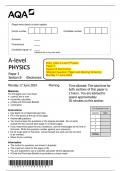
2024_AQA A-Level Physics Paper 3 Section B Electronics (Merged Question Paper and Marking Scheme) Monday 17 June 2024

Rating
-
Sold
-
Pages
38
Grade
A+
Uploaded on
04-02-2025
Written in
2024/2025

2024_AQA A-Level Physics Paper 3 Section B Electronics (Merged Question Paper and Marking Scheme) Monday 17 June 2024 Monday 17 June 2024 Materials For this paper you must have:  a pencil and a ruler  a scientific calculator  a Data and Formulae Booklet  a protractor. Instructions Morning Time allowed: The total time for both sections of this paper is 2 hours. You are advised to spend approximately 50 minutes on this section.  Use black ink or black ball-point pen.  Fill in the boxes at the top of this page.  Answer all questions.  You must answer the questions in the spaces provided. Do not write outside the box around each page or on blank pages.  If you need extra space for your answer(s), use the lined pages at the end of this book. Write the question number against your answer(s).  Do all rough work in this book. Cross through any work you do not want to be marked.  Show all your working. Information  The marks for questions are shown in brackets.  The maximum mark for this paper is 35.  You are expected to use a scientific calculator where appropriate.  A Data and Formulae Booklet is provided as a loose insert. For Examiner’s Use Question Mark 1 2 3 4 5 TOTAL IB/M/Jun24/E8 A-Level Physics: Paper 3 Section B – Electronics: Exam Review Question Section B of Paper 3 focuses on Electronics, which covers the application of physics in the design and functioning of electronic circuits and devices. It includes components such as diodes, transistors, capacitors, and their use in amplification, rectification, and digital systems. 1. Semiconductor Physics:  Semiconductors: Understand the properties of semiconductors (like silicon and germanium) and how they are used to control the flow of electrical current. Review the difference between conductors, insulators, and semiconductors.  Intrinsic and Extrinsic Semiconductors: Learn about intrinsic semiconductors (pure materials) and extrinsic semiconductors (doped materials), and how doping adds n-type (negative) or p-type (positive) carriers to the semiconductor.  Energy Bands: Study the concept of energy bands in solids, particularly the valence band and conduction band, and the role of the band gap in determining whether a material is a conductor, semiconductor, or insulator. 2. Diodes and Rectification:  Diodes: Understand the function of a diode in electronic circuits. A diode allows current to flow in one direction only, acting as a rectifier.  Forward and Reverse Bias: Learn the behavior of diodes under forward bias (current flows) and reverse bias (no current flow).  Rectification: Study how diodes are used in rectifier circuits to convert alternating current (AC) to direct current (DC). 3. Transistors and Amplification: 4. Capacitors in Electronics:  Capacitors: Understand the function of capacitors, which store electrical energy in an electric field. Learn how they are used in circuits to smooth out voltage fluctuations (in power supplies) and in timing applications (e.g., RC circuits).  Capacitance: 5. Key Concepts to Revise:  Semiconductor Behavior: Understand doping, energy bands, and the properties of n-type and p-type semiconductors.  Diodes and Rectification: Review how diodes work in rectifier circuits and how rectification transforms AC into DC.  Transistors: Focus on the operation of BJTs and FETs, and how they are used in amplification and switching. o Capacitors: Understand the role of capacitors in smoothing voltages and timing applications, and be familiar with RC circuits. o Digital Logic: Be able to analyze and simplify logic circuits, and understand the use of logic gates in digital electronics. o Power Supply Circuits: Review the conversion of AC to DC power, including rectifiers, filters, and regulators. 7408/3BE 2 Do not write outside the box Section B IB/M/Jun24/7408/3BE Answer all questions in this section. 0 1 A toy manufacturer is designing a two-tone siren for use in small battery-operated cars. Figure 1 shows design Option 1. Option 1 uses three separate signal generators feeding into a logic sub-system. The signal generators produce logic-compatible 9 V square waves of frequencies 1024 Hz, 1 Hz and 512 Hz. Figure 1 The waveforms shown are not to scale. 0 1 . 1 Explain how the logic level applied at B in Figure 1 determines the output frequency at Q. [2 marks] 0 1 . 2 Write the Boolean algebra expression for output Q in terms of the inputs A, B and C. Use only the logic operations shown in Figure 1. [2 marks] Q = 3 Do not write outside the box IB/M/Jun24/7408/3BE 0 1 . 3 Option 1 is tested by replacing the 1 Hz signal generator with a manual input. The manual input is provided by the combination of a push-to-make switch and a 10 kΩ resistor. The combination produces the following voltages at its output:  0 V when the switch is not pressed  9 V when the switch is pressed. Figure 2 shows the symbol for the push-to-make switch. Figure 2 Complete Figure 3 to show how this switch and the 10 kΩ resistor are connected. Label the output Vout. You do not need to add details taken from Figure 1. [1 mark] Figure 3 Question 1 continues on the next page Turn over ► 4 Do not write outside the box IB/M/Jun24/7408/3BE 0 1 . 4 Figure 4 shows a generalised layout of an integrated circuit (IC) for an N-bit binary counter. Q0 is the output that provides the least significant bit. Figure 4 A signal generator feeds a square wave of frequency 1024 Hz into the clock of the IC. The N-bit binary counter generates the 512 Hz signal and the 1 Hz signal from separate outputs. Deduce which of the outputs Q0 to QN will provide the 1 Hz signal. [1 mark] 5 Do not write outside the box IB/M/Jun24/7408/3BE 0 1 . 5 To make the two-tone siren, the manufacturer decides to use a new design, Option 2. Option 2 contains:  one 1024 Hz signal generator  one N-bit binary counter  a new logic sub-system as shown in Figure 5. Figure 5 Assume that:  each type of logic gate has its own dedicated IC chip  each separate signal generator is based upon its own IC chip. Compare the number of ICs used in Option 1 with the number used in Option 2. Go on to explain one advantage of the manufacturer’s decision. [2 marks] Turn over ► 8 6 Do not write outside the box IB/M/Jun24/7408/3BE 0 2 The short message service (SMS) on a mobile phone can send a maximum of 160 characters per message. Each character is represented by its own seven-bit binary code as it is converted to digital data. 0 2 . 1 The mobile phone transmits digital data at a rate of 8 kilobytes per second (kB s−1) when using the SMS function. Determine the minimum time required to send 160 characters. [2 marks] time = s Electrical noise can affect communication systems. 0 2 . 2 Describe one origin of electrical noise in a communication system. [1 mark] 0 2 . 3 Describe the effect that electrical noise can have:  on the signal and  on the communication system. [2 marks] 7 Do not write outside the box IB/M/Jun24/7408/3BE Turn over ► Figure 6 shows a noisy digital signal Vin which is applied to a circuit. The circuit output Vout switches to:  5 V when the input voltage Vin falls below 1.8 V  0 V when the input voltage Vin rises above 3.2 V. 0 2 . 4 Draw, on Figure 7, the output signal Vout from the circuit. Assume that Vout is initially at 5 V. [2 marks] 7 8 Do not write outside the box IB/M/Jun24/7408/3BE 0 3 Figure 8 shows an LC circuit that produces electrical oscillations when the switch is moved from position A to position B. Figure 8 0 3 . 1 Which quantity in the LC circuit is analogous to the mass in a mass–spring system? Tick () one box. [1 mark] C 1 C L 1 L 9 Do not write outside the box IB/M/Jun24/7408/3BE 0 3 . 2 A radio receiver uses a parallel LC tuned circuit to select a radio station. Figure 9 shows the response of the tuned circuit. Figure 9 Calculate the quality factor Q of the tuned circuit. [3 marks] Q = Question 3 continues on the next page Turn over ► 10 Do not write outside the box IB/M/Jun24/7408/3BE Another radio receiver is used to detect frequency-modulated (FM) radio waves. Figure 10 shows the variation of amplitude with time for a carrier wave and an information signal. Figure 10 0 3 . 3 Sketch, on Figure 10, the graph that represents the frequency-modulated (FM) signal. [2 marks] 0 3 . 4 An audio signal is transmitted on an FM music station. The transmission has a bandwidth of 186 kHz. The carrier wave has a maximum frequency deviation of 75 kHz. Calculate the maximum frequency in the information signal. [1 mark] maximum frequency = kHz 7 11 0 4 . 1 Figure 11 shows the response of a photodiode for different values of reverse-bias voltage VR. Figure 11 The photodiode is used as the input for a light-intensity meter. The light intensity changes from 100 W m−2 to 400 W m−2. Explain which value of VR in Figure 11 should be used for this application. Go on to deduce the change in photocurrent for this change in light intensity. [2 marks] change in photocurrent = Question 4 continues on the next page A IB/M/Jun24/7408/3BE Do not write outside the box Turn over ► 12 Do not write outside the box IB/M/Jun24/7408/3BE 0 4 . 2 Describe how a photodiode is used in a particle detector to detect sub-atomic particles. [2 marks] 13 Do not write outside the box IB/M/Jun24/7408/3BE 7 0 4 . 3 The particle detector produces an analogue signal that is the input voltage Vin to an amplifier circuit. Vin is amplified by a factor of +10 Draw, on Figure 12, a circuit that uses a single operational amplifier to produce an amplification of +10 Use resistors with resistance values in the range 10 kΩ to 1 MΩ in the circuit. On your diagram you should label:  the value of the resistors  the output of the circuit as Vout. Do not show the power supplies for the operational amplifier. [3 marks] Figure 12 Turn over for the next question Turn over ► 14 Do not write outside the box IB/M/Jun24/7408/3BE 0 5 Several telephone conversations need to be transmitted simultaneously between two locations. Describe the process that allows these conversations to be carried by the same optical fibre. In your answer you should explain:  the importance of the sampling rate in the analogue-to-digital conversion  the effect of resolution in this conversion  the technique that is used to enable several conversations to be transmitted simultaneously. You may use diagrams to help with your explanation. [6 marks] 15 Do not write outside the box IB/M/Jun24/7408/3BE 6 END OF QUESTIONS 16 Do not write outside the box There are no questions printed on this page IB/M/Jun24/7408/3BE DO NOT WRITE ON THIS PAGE ANSWER IN THE SPACES PROVIDED 17 Question number Additional page, if required. Write the question numbers in the left-hand margin. IB/M/Jun24/7408/3BE Do not write outside the box 18 Question number Additional page, if required. Write the question numbers in the left-hand margin. IB/M/Jun24/7408/3BE Do not write outside the box 19 Question number Additional page, if required. Write the question numbers in the left-hand margin. IB/M/Jun24/7408/3BE Do not write outside the box 20 Do not write outside the IB/M/Jun24/7408/3BE There are no questions printed on this page DO NOT WRITE ON THIS PAGE ANSWER IN THE SPACES PROVIDED box Copyright information For confidentiality purposes, all acknowledgements of third-party copyright material are published in a separate booklet. This booklet is published after each live examination series and is available for free download from Permission to reproduce all copyright material has been applied for. In some cases, efforts to contact copyright-holders may have been unsuccessful and AQA will be happy to rectify any omissions of acknowledgements. If you have any queries please contact the Copyright Team. Copyright © 2024 AQA and its licensors. All rights reserved. A-level PHYSICS 7408/3BE Paper 3 Section B Electronics Mark scheme June 2024 Version: 1.0 Final MARK SCHEME – A-LEVEL PHYSICS – 7408/3BE – JUNE 2024 Mark schemes are prepared by the Lead Assessment Writer and considered, together with the relevant questions, by a panel of subject teachers. This mark scheme includes any amendments made at the standardisation events which all associates participate in and is the scheme which was used by them in this examination. The standardisation process ensures that the mark scheme covers the students’ responses to questions and that every associate understands and applies it in the same correct way. As preparation for standardisation each associate analyses a number of students’ scripts. Alternative answers not already covered by the mark scheme are discussed and legislated for. If, after the standardisation process, associates encounter unusual answers which have not been raised they are required to refer these to the Lead Examiner. It must be stressed that a mark scheme is a working document, in many cases further developed and expanded on the basis of students’ reactions to a particular paper. Assumptions about future mark schemes on the basis of one year’s document should be avoided; whilst the guiding principles of assessment remain constant, details will change, depending on the content of a particular examination paper. No student should be disadvantaged on the basis of their gender identity and/or how they refer to the gender identity of others in their exam responses. A consistent use of ‘they/them’ as a singular and pronouns beyond ‘she/her’ or ‘he/him’ will be credited in exam responses in line with existing mark scheme criteria. Further copies of this mark scheme are available from Copyright information AQA retains the copyright on all its publications. However, registered schools/colleges for AQA are permitted to copy material from this booklet for their own internal use, with the following important exception: AQA cannot give permission to schools/colleges to photocopy any material that is acknowledged to a third party even for internal use within the centre. Copyright © 2024 AQA and its licensors. All rights reserved. 2 MARK SCHEME – A-LEVEL PHYSICS – 7408/3BE – JUNE 2024 Physics - Mark scheme instructions to examiners 1. General The mark scheme for each question shows:  the marks available for each part of the question  the total marks available for the question  the typical answer or answers which are expected  extra information to help the Examiner make his or her judgement and help to delineate what is acceptable or not worthy of credit or, in discursive answers, to give an overview of the area in which a mark or marks may be awarded. The extra information is aligned to the appropriate answer in the left-hand part of the mark scheme and should only be applied to that item in the mark scheme. At the beginning of a part of a question a reminder may be given, for example: where consequential marking needs to be considered in a calculation; or the answer may be on the diagram or at a different place on the script. In general the right-hand side of the mark scheme is there to provide those extra details which confuse the main part of the mark scheme yet may be helpful in ensuring that marking is straightforward and consistent. 2. Emboldening 2.1 In a list of acceptable answers where more than one mark is available ‘any two from’ is used, with the number of marks emboldened. Each of the following bullet points is a potential mark. 2.2 A bold and is used to indicate that both parts of the answer are required to award the mark. 2.3 Alternative answers acceptable for a mark are indicated by the use of or. Different terms in the mark scheme are shown by a / ; eg allow smooth / free movement. 3. Marking points 3.1 Marking of lists This applies to questions requiring a set number of responses, but for which candidates have provided extra responses. The general principle to be followed in such a situation is that ‘right + wrong = wrong’. Each error / contradiction negates each correct response. So, if the number of errors / contradictions equals or exceeds the number of marks available for the question, no marks can be awarded. However, responses considered to be neutral (often prefaced by ‘Ignore’ in the mark scheme) are not penalised. 3.2 Marking procedure for calculations Full marks can usually be given for a correct numerical answer without working shown unless the question states ‘Show your working’. However, if a correct numerical answer can be evaluated from incorrect physics then working will be required. The mark scheme will indicate both this and the credit (if any) that can be allowed for the incorrect approach. 3 MARK SCHEME – A-LEVEL PHYSICS – 7408/3BE – JUNE 2024 However, if the answer is incorrect, mark(s) can usually be gained by correct substitution / working and this is shown in the ‘extra information’ column or by each stage of a longer calculation. A calculation must be followed through to answer in decimal form. An answer in surd form is never acceptable for the final (evaluation) mark in a calculation and will therefore generally be denied one mark. 3.3 Interpretation of ‘it’ Answers using the word ‘it’ should be given credit only if it is clear that the ‘it’ refers to the correct subject. 3.4 Errors carried forward, consequential marking and arithmetic errors Allowances for errors carried forward are likely to be restricted to calculation questions and should be shown by the abbreviation ECF or conseq in the marking scheme. An arithmetic error should be penalised for one mark only unless otherwise amplified in the marking scheme. Arithmetic errors may arise from a slip in a calculation or from an incorrect transfer of a numerical value from data given in a question. 3.5 Phonetic spelling The phonetic spelling of correct scientific terminology should be credited (eg fizix) unless there is a possible confusion (eg defraction/refraction) with another technical term. 3.6 Brackets (…..) are used to indicate information which is not essential for the mark to be awarded but is included to help the examiner identify the sense of the answer required. 3.7 Ignore / Insufficient / Do not allow ‘Ignore’ or ‘insufficient’ is used when the information given is irrelevant to the question or not enough to gain the marking point. Any further correct amplification could gain the marking point. ‘Do not allow’ means that this is a wrong answer which, even if the correct answer is given, will still mean that the mark is not awarded. 3.8 Significant figure penalties Answers to questions in the practical sections (7407/2 – Section A and 7408/3A) should display an appropriate number of significant figures. For non-practical sections, an A-level paper may contain up to 2 marks (1 mark for AS) that are contingent on the candidate quoting the final answer in a calculation to a specified number of significant figures (sf). This will generally be assessed to be the number of sf of the datum with the least number of sf from which the answer is determined. The mark scheme will give the range of sf that are acceptable but this will normally be the sf of the datum (or this sf -1). An answer in surd form cannot gain the sf mark. An incorrect calculation following some working can gain the sf mark. For a question beginning with the command word ‘Show that…’, the answer should be quoted to one more sf than the sf quoted in the question eg ‘Show that X is equal to about 2.1 cm’ – 4 MARK SCHEME – A-LEVEL PHYSICS – 7408/3BE – JUNE 2024 answer should be quoted to 3 sf. An answer to 1 sf will not normally be acceptable, unless the answer is an integer eg a number of objects. In non-practical sections, the need for a consideration will be indicated in the question by the use of ‘Give your answer to an appropriate number of significant figures’. 3.9 Unit penalties An A-level paper may contain up to 2 marks (1 mark for AS) that are contingent on the candidate quoting the correct unit for the answer to a calculation. The need for a unit to be quoted will be indicated in the question by the use of ‘State an appropriate SI unit for your answer’. Unit answers will be expected to appear in the most commonly agreed form for the calculation concerned; strings of fundamental (base) units would not. For example, 1 tesla and 1 Wb m–2 would both be acceptable units for magnetic flux density but 1 kg m2 s–2 A–1 would not. 3.10 Level of response marking instructions Level of response mark schemes are broken down into three levels, each of which has a descriptor. The descriptor for the level shows the average performance for the level. There are two marks in each level. Before you apply the mark scheme to a student’s answer read through the answer and annotate it (as instructed) to show the qualities that are being looked for. You can then apply the mark scheme. Determining a level Start at the lowest level of the mark scheme and use it as a ladder to see whether the answer meets the descriptor for that level. The descriptor for the level indicates the different qualities that might be seen in the student’s answer for that level. If it meets the lowest level then go to the next one and decide if it meets this level, and so on, until you have a match between the level descriptor and the answer. With practice and familiarity you will find that for better answers you will be able to quickly skip through the lower levels of the mark scheme. When assigning a level you should look at the overall quality of the answer and not look to pick holes in small and specific parts of the answer where the student has not performed quite as well as the rest. If the answer covers different aspects of different levels of the mark scheme you should use a best fit approach for defining the level and then use the variability

Show more Read less
Institution
2024_AQA A-Level Physics Paper 3 Section B Ele
Module
2024_AQA A-Level Physics Paper 3 Section B Ele


Whoops! We can’t load your doc right now. Try again or contact support.

Written for

Institution
2024_AQA A-Level Physics Paper 3 Section B Ele
Module
2024_AQA A-Level Physics Paper 3 Section B Ele

Document information

Uploaded on
February 4, 2025
Number of pages
38
Written in
2024/2025
Type
Exam (elaborations)
Contains
Questions & answers

Subjects

Content preview

Please write clearly in block capitals.

Centre number Candidate number


Surname

Forename(s)

Candidate signatu re
I declare this is my own work.


A-level 2024_AQA A-Level Physics

PHYSICS Paper 3
Section B Electronics
(Merged Question Paper and Marking Scheme)
Paper 3 Monday 17 June 2024
Section B Electronics

Monday 17 June 2024 Morning Time allowed: The total time for
Materials
both sections of this paper is
For this paper you must have: 2 hours. You are advised to
 a pencil and a ruler spend approximately
 a scientific calculator
 a Data and Formulae Booklet 50 minutes on this section.
 a protractor.
For Examiner’s Use
Instructions
 Use black ink or black ball-point pen. Question Mark
 Fill in the boxes at the top of this page. 1
 Answer all questions.
2
 You must answer the questions in the spaces provided. Do not write
outside the box around each page or on blank pages. 3
 If you need extra space for your answer(s), use the lined pages at the end of 4
this book. Write the question number against your answer(s). 5
 Do all rough work in this book. Cross through any work you do not want
to be marked. TOTAL
 Show all your working.

Information
 The marks for questions are shown in brackets.
 The maximum mark for this paper is 35.
 You are expected to use a scientific calculator where appropriate.
 A Data and Formulae Booklet is provided as a loose insert.

, IB/M/Jun24/E8


A-Level Physics: Paper 3 Section B – Electronics: Exam Review Question

Section B of Paper 3 focuses on Electronics, which covers the application of
physics in the design and functioning of electronic circuits and devices. It
includes components such as diodes, transistors, capacitors, and their use in
amplification, rectification, and digital systems.

1. Semiconductor Physics:
7408/3BE
 Semiconductors: Understand the properties of semiconductors (like
silicon and germanium) and how they are used to control the flow of
electrical current. Review the difference between conductors,
insulators, and semiconductors.
 Intrinsic and Extrinsic Semiconductors: Learn about intrinsic
semiconductors (pure materials) and extrinsic semiconductors
(doped materials), and how doping adds n-type (negative) or p-type
(positive) carriers to the semiconductor.
 Energy Bands: Study the concept of energy bands in solids,
particularly the valence band and conduction band, and the role of
the band gap in determining whether a material is a conductor,
semiconductor, or insulator.

2. Diodes and Rectification:

 Diodes: Understand the function of a diode in electronic circuits. A
diode allows current to flow in one direction only, acting as a rectifier.
 Forward and Reverse Bias: Learn the behavior of diodes under
forward bias (current flows) and reverse bias (no current flow).
 Rectification: Study how diodes are used in rectifier circuits to
convert alternating current (AC) to direct current (DC). 3. Transistors
and Amplification:

4. Capacitors in Electronics:

 Capacitors: Understand the function of capacitors, which store electrical
energy in an electric field. Learn how they are used in circuits to smooth
out voltage fluctuations (in power supplies) and in timing applications
(e.g., RC circuits).
 Capacitance:

5. Key Concepts to Revise:

 Semiconductor Behavior: Understand doping, energy bands, and the
properties of n-type and p-type semiconductors.
 Diodes and Rectification: Review how diodes work in rectifier circuits
and how rectification transforms AC into DC.
 Transistors: Focus on the operation of BJTs and FETs, and how they
are used in amplification and switching.
o Capacitors: Understand the role of capacitors in smoothing voltages
and timing applications, and be familiar with RC circuits.
o Digital Logic: Be able to analyze and simplify logic circuits, and
understand the use of logic gates in digital electronics.
o Power Supply Circuits: Review the conversion of AC to DC power,
including rectifiers, filters, and regulators.

, 2

Do not write
outside the
Section B box


Answer all questions in this section.


0 1 A toy manufacturer is designing a two-tone siren for use in small battery-operated
cars.
Figure 1 shows design Option 1.

Option 1 uses three separate signal generators feeding into a logic sub-system.
The signal generators produce logic-compatible 9 V square waves of frequencies
1024 Hz, 1 Hz and 512 Hz.

Figure 1


The waveforms shown are not to scale.
0 1
. 1 Explain how the logic level applied at B in Figure 1 determines the output frequency
at Q.
[2 marks]


0 1 . 2 Write the Boolean algebra expression for output Q in terms of the inputs A, B and C.
Use only the logic operations shown in Figure 1.
[2 marks]


Q=


IB/M/Jun24/7408/3BE

, 3
Do not write
outside the
0 1 . 3 Option 1 is tested by replacing the 1 Hz signal generator with a manual input. box


The manual input is provided by the combination of a push-to-make switch
and a 10 kΩ resistor.

The combination produces the following voltages at its output:
 0 V when the switch is not pressed
 9 V when the switch is pressed.

Figure 2 shows the symbol for the push-to-make switch.

Figure 2


Complete Figure 3 to show how this switch and the 10 kΩ resistor are connected.
Label the output Vout.
You do not need to add details taken from Figure 1.
[1 mark]

Figure 3


Question 1 continues on the next page


Turn over ►


IB/M/Jun24/7408/3BE

, 4
Do not write
outside the
0 1 . 4 Figure 4 shows a generalised layout of an integrated circuit (IC) for an N-bit binary box

counter.
Q0 is the output that provides the least significant bit.

Figure 4


A signal generator feeds a square wave of frequency 1024 Hz into the clock of the IC.
The N-bit binary counter generates the 512 Hz signal and the 1 Hz signal from
separate outputs.

Deduce which of the outputs Q0 to QN will provide the 1 Hz signal.
[1 mark]


IB/M/Jun24/7408/3BE

, 5
Do not write
outside the
0 1 . 5 To make the two-tone siren, the manufacturer decides to use a new design, Option 2. box


Option 2 contains:
 one 1024 Hz signal generator
 one N-bit binary counter
 a new logic sub-system as shown in Figure 5.

Figure 5


Assume that:
 each type of logic gate has its own dedicated IC chip
 each separate signal generator is based upon its own IC chip.

Compare the number of ICs used in Option 1 with the number used in Option 2.
Go on to explain one advantage of the manufacturer’s decision.
[2 marks]


8


Turn over ►


IB/M/Jun24/7408/3BE

, 6
Do not write
outside the
0 2 The short message service (SMS) on a mobile phone can send a maximum box

of 160 characters per message. Each character is represented by its own seven-bit
binary code as it is converted to digital data.
0 2
. 1 The mobile phone transmits digital data at a rate of 8 kilobytes per second (kB s−1)
when using the SMS function.

Determine the minimum time required to send 160 characters.
[2 marks]


time = s


Electrical noise can affect communication systems.
0 2
. 2 Describe one origin of electrical noise in a communication system.
[1 mark]


0 2 . 3 Describe the effect that electrical noise can have:

 on the signal and
 on the communication system.
[2 marks]


IB/M/Jun24/7408/3BE

, 7
Do not write
outside the
box
Figure 6 shows a noisy digital signal Vin which is applied to a circuit.

The circuit output Vout switches to:

 5 V when the input voltage Vin falls below 1.8 V
 0 V when the input voltage Vin rises above 3.2 V.


0 2


. 4 Draw, on Figure 7, the output signal Vout from the circuit.
Assume that Vout is initially at 5 V.
[2 marks] 7


Turn over ►


IB/M/Jun24/7408/3BE

£6.17
Get access to the full document:

100% satisfaction guarantee
Immediately available after payment
Both online and in PDF
No strings attached


Also available in package deal

Get to know the seller

Seller avatar
Reputation scores are based on the amount of documents a seller has sold for a fee and the reviews they have received for those documents. There are three levels: Bronze, Silver and Gold. The better the reputation, the more your can rely on the quality of the sellers work.
Cate001 Chamberlain College Nursing
Follow You need to be logged in order to follow users or courses
Sold
1398
Member since
2 year
Number of followers
909
Documents
1561
Last sold
11 hours ago
Ace Your Exams with Expertly Crafted Study Materials!

Looking to level up your revision? I offer comprehensive, easy-to-understand study materials tailored for major exam boards including AQA, OCR, Edexcel, and more, perfect for A-Level, GCSE, and other courses. ✨ What You’ll Get: 1. Concise summaries and clear explanations 2. * Past exam papers with complete official marking schemes * Whether you need quick revision notes, detailed study guides, or real past papers to test your knowledge, I’ve got you covered. These resources are designed to help you study smarter and achieve top grades.

Read more Read less
4.4

284 reviews

5
196
4
51
3
18
2
3
1
16

Recently viewed by you

Why students choose Stuvia

Created by fellow students, verified by reviews

Quality you can trust: written by students who passed their exams and reviewed by others who've used these revision notes.

Didn't get what you expected? Choose another document

No problem! You can straightaway pick a different document that better suits what you're after.

Pay as you like, start learning straight away

No subscription, no commitments. Pay the way you're used to via credit card and download your PDF document instantly.

Student with book image

“Bought, downloaded, and smashed it. It really can be that simple.”

Alisha Student

Frequently asked questions