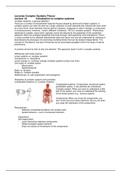
Lectures Complex Systems Theory
Lecture 1A Introduction to complex systems
Complex Systems: a general definition
There are a number of characteristic features that are shared by almost all complex systems. A
complex system can often be seen as a large collection of small elements that interact with each other
at a micro-level. Such elements may be atoms in physics, molecules or cells in biology, or consumers
in socioeconomics. However, ‘more is different’ (Anderson, 1972) in complex systems. Phenomena
observed at a global, macro-level, typically cannot be reduced to the properties of the constituent
elements: there are emergent properties that arise through ‘self-organizing’ local interactions. This is
in sharp contrast to the classical reductionistic idea that nature can only be understood by reducing or
decomposing its processes into elementary building blocks that can be studied independently. The
concept of ‘Complexity’ has been introduced as the associated paradigm shift in the study of natural
phenomena.
In science we tend to look at only one element. This approach doesn’t work in complex systems.
Differences with linear science
Linear systems vs. complex systems:
Components vs. interactions
Linear change vs. nonlinear change (complex systems evolve over time)
One scale vs. multiple scales
- Micro/macro
- Spatial/temporal
Static vs. dynamic
Single vs. multiple causality
Reductionism vs. self-organization and emergence
Properties of complex systems and examples
Complicated Systems vs. Complex Systems
Complicated systems: Components, dynamical system,
predictable system, it can perfectly be understood.
Complex system: When you have to understand a little
part of the system, you have to understand the working
of the whole system (e.g., nervous system).
Components: When you know the components, you
don’t know that much about behavior. But you do when
you study the interaction of the components.
Reductionism:
- Reduces complicated problems into simpler parts.
- System behavior = sum of component behavior.
Interactions:
Self-organization:
- Local interactions between components
- Global emergent system behavior
- Does not reduce to the behavior of the components
, Everything what we are doing is dependent of all
the components doing other things.
There’s not a single cause for a change in
behavior. There is not one component that
doesn’t work in for example dyslectic readers.
Interactions: behavioral, neuro, and genetic
studies at the group level often mask important
findings at the individual level. Months and
years, even decades, days and weeks and
seconds and minutes.
On average you can see a difference between two groups. But if you
look into a brain between two different people, you can see different
brain activity.
What did we learn so far from linear statistics?
What we do often in our field is categorizing people into groups. And we
end up with statements that are general.
Broad statements about groups
- Women are more emotional than men
- Baby’s don’t have a ToM, whereas toddlers do
- Lesbians only have sex with women
- Adolescents are more impulsive than young adults
- People with ADHD have weakly developed EF
- Children with ASD display repetitive behavior
- Teachers are prejudiced against pupils from low-SES backgrounds
Statements are often linear
- The older one gets → the less impulsive the behavior will be
- The weaker EF → the stronger ADHD
- The more repetitive behavior → the clearer the autism
What did we learn so far from linear statistics?
Compare means: Mean EFadhd < Mean EFcontrol. 20(SD=3.4) < 24(SD=4.2). T test is significant, p<.05
Compute correlation: Age * Impulsiveness: r = -0.30, p < .05, 9% variance explained.
Run ANOVA: IV = Gender (Female vs. Male) and Group (Autistic vs. Control) DV = Score on a test of
Theory of Mind (ToM)
Effect of Gender: ToMfemale > ToMmale 3% of variance explained Effect of Group: ToMautistic < ToMcontrol
10% of variance explained
You can explain just a small part about something; 91% is still not explained!
When you work with one individual, you can do not much with these statistics.
Scope of traditional statistics:
- Only concern the group, not the individual.
- Linear relationships (e.g., correlation, t test, ANOVA, regression)
- Components explain behavior (IV + Noise → DV): Autism + noise → ToM
- Independent components added together explain behavior: 3% of the variance caused by
gender + 10 % by the group = 13% in total.
- Observed score = true score + noise; In formula: X1 = T + ε1
Scope of complexity theory:
- Concern group and individual, measured over time. When you measure a lot of induvial, then
you still can say something about groups.
- Nonlinear relationships (e.g., phase transitions, CUSP catastrophe, small cause large effect
and vice versa)
- Interactions explain behavior (local interactions →global pattern, emergence)
- Dependent components not A → B, entire system may matter
- Observed score = dynamical change process; in formula: Xt+1 = f(Xt)
,Linear: A change in X is associated with a proportional change in Y.
Nonlinear: A change in Y is not proportional to X. Far more common than linearity in human behavior:
finger movement, ‘eep’-to-‘pee’, transitions from walking to running and perceptual ambiguity.
Static: Typically, each data point represents one measured value
for one person.
Dynamic: Typically, each data point represents a change process
(many values measured over time) of one individual. Yt+1 = f(Yt) →
Example: Vocabulary development. Nonlinear and dynamic, e.g.
vocabulary spurt.
Individual trajectories
Group level data: aggregated
over individual trajectories →
Causality in complex systems: it
is not A → B. But a dynamic
explanation.
Example: Mood dynamics. Depressive symptoms can fluctuate enormously.
Left is individual data. Aggregated: M
= 4.6 and SD = 2.6. How meaningful
is M?
The mean is the value that occurs the
least →
, Lecture 1B Diversities A
Why care about diversity?
Almost everything you’ve learned so far is based on population statistic. Interventions (clinical,
educational, youth care etc.) are effective on average. But they are not effective for everyone…
Diversity as Error (traditional view)
Mean = Norm(al)
Deviation (i.e., diversity) = error
Average represents most.
Diversity is a kind of error/deviation. We
often use the mean to score people.
Average represent most of the people. When you design something on average, it will help most of the
people. When you are a weirdo, you have bad luck; this intervention won’t work for you.
The average brain is created by individual brain patterns. So not one individual matches with the
average brain
What is happening here?
Dimensionality: Average size includes:
- Length
- Arm length
- Leg length
- Neck circumference
- Thigh circumference
- Wrist circumference
- …
Nobody scores average on multidimensional constructs! Other examples of dimensions: symptoms, IQ
subdomains. Principle of jaggedness: no individual corresponds to average.
Main message 1: The average person does not exist. Nobody scores average when there are many
dimensions involved.
Diversity as rank: the case of correlation.
Individuals are deviations from average with
certain rank. Two variables are positively
correlated when a high rank in X is
associated to a high rank in Y. Misleading
correlations: typing speed.
Main message 2: Group differences do not
generalize to individual processes. Between-
subject and within-subject variation are different. Between-subject results have no reliable implications
for interventions. All research questions concerning change demand within-subject analysis.
Lecture 1A Introduction to complex systems
Complex Systems: a general definition
There are a number of characteristic features that are shared by almost all complex systems. A
complex system can often be seen as a large collection of small elements that interact with each other
at a micro-level. Such elements may be atoms in physics, molecules or cells in biology, or consumers
in socioeconomics. However, ‘more is different’ (Anderson, 1972) in complex systems. Phenomena
observed at a global, macro-level, typically cannot be reduced to the properties of the constituent
elements: there are emergent properties that arise through ‘self-organizing’ local interactions. This is
in sharp contrast to the classical reductionistic idea that nature can only be understood by reducing or
decomposing its processes into elementary building blocks that can be studied independently. The
concept of ‘Complexity’ has been introduced as the associated paradigm shift in the study of natural
phenomena.
In science we tend to look at only one element. This approach doesn’t work in complex systems.
Differences with linear science
Linear systems vs. complex systems:
Components vs. interactions
Linear change vs. nonlinear change (complex systems evolve over time)
One scale vs. multiple scales
- Micro/macro
- Spatial/temporal
Static vs. dynamic
Single vs. multiple causality
Reductionism vs. self-organization and emergence
Properties of complex systems and examples
Complicated Systems vs. Complex Systems
Complicated systems: Components, dynamical system,
predictable system, it can perfectly be understood.
Complex system: When you have to understand a little
part of the system, you have to understand the working
of the whole system (e.g., nervous system).
Components: When you know the components, you
don’t know that much about behavior. But you do when
you study the interaction of the components.
Reductionism:
- Reduces complicated problems into simpler parts.
- System behavior = sum of component behavior.
Interactions:
Self-organization:
- Local interactions between components
- Global emergent system behavior
- Does not reduce to the behavior of the components
, Everything what we are doing is dependent of all
the components doing other things.
There’s not a single cause for a change in
behavior. There is not one component that
doesn’t work in for example dyslectic readers.
Interactions: behavioral, neuro, and genetic
studies at the group level often mask important
findings at the individual level. Months and
years, even decades, days and weeks and
seconds and minutes.
On average you can see a difference between two groups. But if you
look into a brain between two different people, you can see different
brain activity.
What did we learn so far from linear statistics?
What we do often in our field is categorizing people into groups. And we
end up with statements that are general.
Broad statements about groups
- Women are more emotional than men
- Baby’s don’t have a ToM, whereas toddlers do
- Lesbians only have sex with women
- Adolescents are more impulsive than young adults
- People with ADHD have weakly developed EF
- Children with ASD display repetitive behavior
- Teachers are prejudiced against pupils from low-SES backgrounds
Statements are often linear
- The older one gets → the less impulsive the behavior will be
- The weaker EF → the stronger ADHD
- The more repetitive behavior → the clearer the autism
What did we learn so far from linear statistics?
Compare means: Mean EFadhd < Mean EFcontrol. 20(SD=3.4) < 24(SD=4.2). T test is significant, p<.05
Compute correlation: Age * Impulsiveness: r = -0.30, p < .05, 9% variance explained.
Run ANOVA: IV = Gender (Female vs. Male) and Group (Autistic vs. Control) DV = Score on a test of
Theory of Mind (ToM)
Effect of Gender: ToMfemale > ToMmale 3% of variance explained Effect of Group: ToMautistic < ToMcontrol
10% of variance explained
You can explain just a small part about something; 91% is still not explained!
When you work with one individual, you can do not much with these statistics.
Scope of traditional statistics:
- Only concern the group, not the individual.
- Linear relationships (e.g., correlation, t test, ANOVA, regression)
- Components explain behavior (IV + Noise → DV): Autism + noise → ToM
- Independent components added together explain behavior: 3% of the variance caused by
gender + 10 % by the group = 13% in total.
- Observed score = true score + noise; In formula: X1 = T + ε1
Scope of complexity theory:
- Concern group and individual, measured over time. When you measure a lot of induvial, then
you still can say something about groups.
- Nonlinear relationships (e.g., phase transitions, CUSP catastrophe, small cause large effect
and vice versa)
- Interactions explain behavior (local interactions →global pattern, emergence)
- Dependent components not A → B, entire system may matter
- Observed score = dynamical change process; in formula: Xt+1 = f(Xt)
,Linear: A change in X is associated with a proportional change in Y.
Nonlinear: A change in Y is not proportional to X. Far more common than linearity in human behavior:
finger movement, ‘eep’-to-‘pee’, transitions from walking to running and perceptual ambiguity.
Static: Typically, each data point represents one measured value
for one person.
Dynamic: Typically, each data point represents a change process
(many values measured over time) of one individual. Yt+1 = f(Yt) →
Example: Vocabulary development. Nonlinear and dynamic, e.g.
vocabulary spurt.
Individual trajectories
Group level data: aggregated
over individual trajectories →
Causality in complex systems: it
is not A → B. But a dynamic
explanation.
Example: Mood dynamics. Depressive symptoms can fluctuate enormously.
Left is individual data. Aggregated: M
= 4.6 and SD = 2.6. How meaningful
is M?
The mean is the value that occurs the
least →
, Lecture 1B Diversities A
Why care about diversity?
Almost everything you’ve learned so far is based on population statistic. Interventions (clinical,
educational, youth care etc.) are effective on average. But they are not effective for everyone…
Diversity as Error (traditional view)
Mean = Norm(al)
Deviation (i.e., diversity) = error
Average represents most.
Diversity is a kind of error/deviation. We
often use the mean to score people.
Average represent most of the people. When you design something on average, it will help most of the
people. When you are a weirdo, you have bad luck; this intervention won’t work for you.
The average brain is created by individual brain patterns. So not one individual matches with the
average brain
What is happening here?
Dimensionality: Average size includes:
- Length
- Arm length
- Leg length
- Neck circumference
- Thigh circumference
- Wrist circumference
- …
Nobody scores average on multidimensional constructs! Other examples of dimensions: symptoms, IQ
subdomains. Principle of jaggedness: no individual corresponds to average.
Main message 1: The average person does not exist. Nobody scores average when there are many
dimensions involved.
Diversity as rank: the case of correlation.
Individuals are deviations from average with
certain rank. Two variables are positively
correlated when a high rank in X is
associated to a high rank in Y. Misleading
correlations: typing speed.
Main message 2: Group differences do not
generalize to individual processes. Between-
subject and within-subject variation are different. Between-subject results have no reliable implications
for interventions. All research questions concerning change demand within-subject analysis.