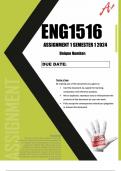
Assignment 1 Semester 2 2024
Unique #:
Due Date: 2024
Detailed solutions, explanations, workings
and references.
+27 81 278 3372

INS3707 Assignment 1 (DETAILED ANSWERS) Semester 2 2024 - DISTINCTION GUARANTEED - DISTINCTION GUARANTEED - DISTINCTION GUARANTEED Answers, guidelines, workings and references ..... QUESTION 1 Choose the correct option from the list provided for each question. Write ONLY the correct letter of the alphabet next to the question number on your answer sheet, Example: 1.1 C. Each question counts 1 mark. 1.1 …. Is a list of words that can be used to retrieve information in an information source. A. natural language B. a thesaurus C. an index D. an abstract 1.2 Terms with the same spelling representing different concepts are known as: A. homonyms B. synonyms C. hierarchical D. non-hierarchical 1.3 In thesaurus construction, which of the following is NOT a narrower term (NT) for “hospitals” A. Public hospitals B. Private hospitals C. Psychiatric hospitals D. Doctors 1.4 In searching databases, keywords can be used A. True B. False 1.5 In a thesaurus, scope notes appear only in the preferred terms. Is this statement True or False? A. True B. False 1.6 All information sources are reliable. Is this statement True or False? A. True B. False 1.7 Which of the following statements regarding indexes is True? A. Indexes provides easy location of information. B. Indexes are also called extracts. C. It is advisable to initiate indexes. D. Indexes can replace abstracts in an information source. 1.8 Which of the following statements regarding indexing is False? A. Exhaustivity of indexing refers to the extent to which the indexing terms reflect the subject contents of a document. B. Specificity is the ability of the index language to describe topics precisely. C. Over-indexing happens when indexing terms are assigned for concepts that do not reflect the aboutness of the article. D. A post-coordinate indexing is based on a controlled vocabulary. 1.9 An indexing language that uses the language of the author is called … . A. controlled vocabulary B. mother tongue C. natural language D. English language 1.10 …. are websites that are developed collaboratively by a community of users, allowing any user to add and edit the content. A. Wikis B. Blogs C. Discussion lists D. Search engines 1.11 The tool used to detect plagiarism is called …. A. Turnit in B. SPSS C. OPAC D. Quillbot 1.12 A paraphrasing tool is called… . A. Turnit in B. SPSS C. OPAC D. Quillbot 1.13 A tool used to present a quantitative data is called…. A. Turnitin B. SPSS C. OPAC D. Quillbot 1.14 The table of contents of journals enable users to scan t h e contents of new and backdated issues. Is this statement True or False? A. True B. False 1.15 Which of the following strategies is NOT used to protect intellectual property on the internet? A. encrypting data B. marking the content with a digital water mark C. posting the information on social media D. persistent online authentication 1.16. Abstracts provide brief summary of an information source. Is the statement True or False A. True B. False 1.17. The Boolean operator NOT is used to exclude certain information. Is this statement True or False? A. True B. False 1.18 What type of a relationship is shown in the following thesaurus example? Fruits NT Apples A. hierarchical relationship B. associative relationship C. equivalence relationship D. family relationship 1.19 Which of the following user interfaces are based on the use of windows, icons, buttons and point-and-click aids, such as a mouse? A. command-driven interfaces B. menu-driven interfaces C. interfaces based on the completion of non-screen forms D. graphical user interface 1.20 You are searching for information on pears, oranges and apples. What terms would you type into a database search to find the relevant sources which include all the terms? A. Pears AND oranges AND apples B. Pears OR oranges OR apples C. Pears NOT oranges NOT apples D. Pears AND oranges NOT apples /20/ QUESTION 2 The purpose of this question is to assess and evaluate your information-searching skills. With this in mind, conduct an information search for sources on the topic: Information access in retrieval in public libraries. In the information searching process, tell us how you searched for the information – tell your story of searching for information. Indicate which databases and/or search engines you used; and explain why you selected the specific sources. Please include screen prints of your searches. Below are some guidelines on what information should be included in your story. These include a number of questions you, as an information searcher, need to consider when conducting an information search – you may think about more questions. Please discuss them as this is about YOUR search strategy, not ours. Since you will be searching the internet, the library catalogue and at least ONE full text database, the same or similar questions require consideration for EACH information search. The information system you are searching will determine the questions you need to consider and answer. NOTE, a simple ‘yes’ or ‘no’ will not be regarded as an answer. The questions that generally require consideration include the following: a. Which keywords did you use to search for information? Why did you use these keywords? b. Which databases and internet search engines did you use? c. Search the Unisa Library for resources, the catalogue; e-resources; e-journals and so forth. d. Which Boolean operators did you use when you conducted your search? e. How many ‘hits’ did you have for each search? How many of these hits were relevant to your assignment topic? f. Was it necessary to refine your search? If yes, how did you refine the search? g. Ensure that your search includes a range of sources (1 book, 2 journal article, 3 database, 1 library catalogue). h. Include screenshots (the search strategies; first result page; etc.) of your searches on the various databases; catalogues and websites you used. i. Please organise screenshots with headings and comments in your discussion. This will support your explanations of how you searched for your information. j. Please do not include full text articles as part of your screenshots. Question 3 Use the sources you have retrieved in Question 2 to write your essay for Question 3. Write an essay of approximately 3 000 words on the topic you searched for Question 2, using the information sources you retrieved from the library catalogue, online databases, the internet and the study guide. Guidelines on writing an academic essay Your essay must include the following: • The topic provided. • An introduction where you provide some background information; highlight the problem you are discussing and indicate how you plan to deal with the problem. • A definition for every keyword appearing in the topic. The definitions should be relevant to the topic and should be your own definitions based on several sources. It should not be longer than a paragraph. • A discussion with numbered headings and subheadings. There must be a logical flow of ideas and you must not deviate from the topic. • A conclusion where you indicate the main points of the discussion and the outcome thereof. • List of sources. The list of sources must include all the sources you cited when writing the essay. Ensure that you list the sources correctly. Refer to Tutorial Letter INKALLE/302/2022 for the correct method to cite your sources. You will also find some guidance in Chapter 9 of the prescribed book. Please note that Unisa uses the Harvard method. When writing this essay, apply the knowledge of essay writing you acquired in the INS1502 module. You will also find guidelines on academic essay writing in the Tutorial letter INKALLE/302/4/2022 and Chapters 10 and 11 of your prescribed book. Also, ensure that you know what plagiarism is and how to avoid it. The Tutorial Letter INKALLE/302/4/2022 and Chapters 8 and 9 in the prescribed book also provide guidance in this regard
Quality you can trust: written by students who passed their exams and reviewed by others who've used these revision notes.
No problem! You can straightaway pick a different document that better suits what you're after.
No subscription, no commitments. Pay the way you're used to via credit card and download your PDF document instantly.
“Bought, downloaded, and smashed it. It really can be that simple.”