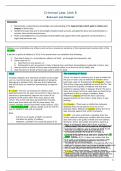
Criminal Law: Unit 6
BURGLARY AND ROBBERY
Outcomes
1. Demonstrate a comprehensive knowledge and understanding of the legal principles which apply to robbery and
burglary in all its forms.
2. Identify the issues that arise in increasingly complex factual scenarios and apply the above law systematically in a
succinct, clear and structured manner
3. Make sound judgements as to potential criminal liability and support these with arguments communicated in a
logical and persuasive way.
Robbery is an indictable only offence and carries a maximum sentence of life imprisonment (section 8(2) of the
TA 1968)
A person is guilty of robbery (s 8(1)) if the prosecution can establish the following:
1. That the D stole (i.e. committed an offence of theft – go through the elements); and
2. Either that the D –
a. Used force on any person, or
b. Put/sought to put any person in fear of being then and there (immediately) subjected to force; and
3. that the force or threat of force was immediately before or at the time of the theft; and
4. that the force or threat of force was used in order to steal
Theft The meaning of ‘force’
Consider whether all 5 elements of theft can be made ‘Force’ is a word in ordinary use. It was a matter for
out (i.e. has there been an appropriation of property the jury in each case to determine whether force
belonging to another (AR), and was the D dishonest had been used (or threatened) (R v Dawson) - Facts:
and did he have an intention permanently to deprive The victim’s bag was grabbed by one of the Ds. The
(MR)?) jury found the D guilty of robbery and that was
upheld on appeal. Note: It appears that in the jury’s
R v Vinall - The D’s convictions for robbery were view, the amount of force used does not need to be
quashed where the Ds were not proven to have had an significant to find a charge of robbery. Note:
intention to permanently deprive the victim of his Reference Dawson where the force used was
property at the point when force was used on the applied directly to the victim’s body (here, it was
victim. The victim had been punched from his bike jostling).
which was then taken but left 50 yards away. The
correct charges should have been under section 12(5) R v Clouden - There was no distinction between
of the Theft Act 1968 - taking a pedal cycle for the D’s applying force to the person or to his or her
own or another’s use and an assault. property. Note: Reference Clouden where the force
was directed against the victim’s property.
Note:
P v DPP - A D who snatched a cigarette from the
- If the D is not guilty of theft, he cannot victim, without making any contact with the victim,
therefore be guilty of robbery was held only to be guilty of theft and not robbery.
- However, consider if he could be guilty of an Similarly, where only slight touching is used (e.g.
assault offence if he used unlawful force where a pickpocket takes items from a victim’s
When
jacket must the
pocket), this force
will notbebeused or threatened?
sufficient to justify a
conviction for robbery, and a charge of theft would
The use or threat of force must be broadly
be the more appropriate charge to bring.
simultaneous with the theft (i.e. it must be
‘immediately
The before
force or threat or at can
of force the time’ of the theft
be in relation (TA
to ‘any
1968, s(section
person’ 8(1)). 8(1)). It does not matter that the
force used or threatened is against someone other
It is necessary to determine when the theft is
than the owner of the property.
complete, as any force used or threatened after the
theft willinnot
However, givewhere
cases rise toforce
a charge of robbery
is threatened (although
rather
the D could be charged with theft and assault).
than actually used, the intended victim of the force
must be aware of the threat. - Scenario: Hamish
R v Hale - The Court of Appeal held that the issue to be
tells Jennifer that he will cut her child’s throat now
determined was whether the appropriation was still
unless she hands over the ring. Note: child must
continuing at the time the force was used. If the
presumably be aware of the threat made in order
1
BURGLARY AND ROBBERY
Outcomes
1. Demonstrate a comprehensive knowledge and understanding of the legal principles which apply to robbery and
burglary in all its forms.
2. Identify the issues that arise in increasingly complex factual scenarios and apply the above law systematically in a
succinct, clear and structured manner
3. Make sound judgements as to potential criminal liability and support these with arguments communicated in a
logical and persuasive way.
Robbery is an indictable only offence and carries a maximum sentence of life imprisonment (section 8(2) of the
TA 1968)
A person is guilty of robbery (s 8(1)) if the prosecution can establish the following:
1. That the D stole (i.e. committed an offence of theft – go through the elements); and
2. Either that the D –
a. Used force on any person, or
b. Put/sought to put any person in fear of being then and there (immediately) subjected to force; and
3. that the force or threat of force was immediately before or at the time of the theft; and
4. that the force or threat of force was used in order to steal
Theft The meaning of ‘force’
Consider whether all 5 elements of theft can be made ‘Force’ is a word in ordinary use. It was a matter for
out (i.e. has there been an appropriation of property the jury in each case to determine whether force
belonging to another (AR), and was the D dishonest had been used (or threatened) (R v Dawson) - Facts:
and did he have an intention permanently to deprive The victim’s bag was grabbed by one of the Ds. The
(MR)?) jury found the D guilty of robbery and that was
upheld on appeal. Note: It appears that in the jury’s
R v Vinall - The D’s convictions for robbery were view, the amount of force used does not need to be
quashed where the Ds were not proven to have had an significant to find a charge of robbery. Note:
intention to permanently deprive the victim of his Reference Dawson where the force used was
property at the point when force was used on the applied directly to the victim’s body (here, it was
victim. The victim had been punched from his bike jostling).
which was then taken but left 50 yards away. The
correct charges should have been under section 12(5) R v Clouden - There was no distinction between
of the Theft Act 1968 - taking a pedal cycle for the D’s applying force to the person or to his or her
own or another’s use and an assault. property. Note: Reference Clouden where the force
was directed against the victim’s property.
Note:
P v DPP - A D who snatched a cigarette from the
- If the D is not guilty of theft, he cannot victim, without making any contact with the victim,
therefore be guilty of robbery was held only to be guilty of theft and not robbery.
- However, consider if he could be guilty of an Similarly, where only slight touching is used (e.g.
assault offence if he used unlawful force where a pickpocket takes items from a victim’s
When
jacket must the
pocket), this force
will notbebeused or threatened?
sufficient to justify a
conviction for robbery, and a charge of theft would
The use or threat of force must be broadly
be the more appropriate charge to bring.
simultaneous with the theft (i.e. it must be
‘immediately
The before
force or threat or at can
of force the time’ of the theft
be in relation (TA
to ‘any
1968, s(section
person’ 8(1)). 8(1)). It does not matter that the
force used or threatened is against someone other
It is necessary to determine when the theft is
than the owner of the property.
complete, as any force used or threatened after the
theft willinnot
However, givewhere
cases rise toforce
a charge of robbery
is threatened (although
rather
the D could be charged with theft and assault).
than actually used, the intended victim of the force
must be aware of the threat. - Scenario: Hamish
R v Hale - The Court of Appeal held that the issue to be
tells Jennifer that he will cut her child’s throat now
determined was whether the appropriation was still
unless she hands over the ring. Note: child must
continuing at the time the force was used. If the
presumably be aware of the threat made in order
1