Plant tissues, organs and systems
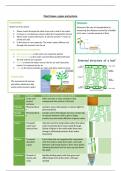
Transpiration: Potometer:
Water loss from leaves Measures the rate of transpiration by
1. Water travels through the plant from root to leaf in the xylem measuring the distance moved by a bubble
2. It moves in a continuous column called the transpiration stream of air over a certain amount of time
3. When water reaches the leaves, it exits by osmosis + moves to
all the leaf cells
4. In the leaves it can evaporate. The water vapour diffuses out
through the stomata, into the air
Factors that increase transpiration:
High temperature so the water can evaporate quicker
Dry/ not humid so the water concentration gradient between
the leaf and the air is greater
Windy so when the water moves into the air and it becomes
humid, it is replaced by dry air
Light so the leaves stomata are open and allow water to leave
Translocation:
The movement of sucrose
and other substances like
amino acids around a plant
Tissue Function How the structure helps its function Picture
Epidermal Cover and Often secretes a waxy substance that
protect waterproofs the surface of the leaf
surfaces
Palisade Photosynthesi Contains many chloroplasts to absorb light for
Mesophyll s photosynthesis
Spongy Photosynthesi Contain some chloroplasts but also contain big
Mesophyll s air spaces between cells to give a larger
surface area and make diffusion of gases easier
Xylem Transport Cells die and form long hollow tubes that allow
water and water and minerals to move easily through.
mineral ions Spirals of lignin in the walls make them very
strong to withstand pressure from water
movement
Phloem Transport Form tubes but are supported by companion
dissolved cells that help to keep them alive. Cell walls
sugars between cells break down to form sieve plates,
allowing dissolved food to move up and down
the plant
Meristem Growth of Rapidly dividing plant cells that grow and
shoots and differentiate into all the other cell types
roots needed
Transpiration: Potometer:
Water loss from leaves Measures the rate of transpiration by
1. Water travels through the plant from root to leaf in the xylem measuring the distance moved by a bubble
2. It moves in a continuous column called the transpiration stream of air over a certain amount of time
3. When water reaches the leaves, it exits by osmosis + moves to
all the leaf cells
4. In the leaves it can evaporate. The water vapour diffuses out
through the stomata, into the air
Factors that increase transpiration:
High temperature so the water can evaporate quicker
Dry/ not humid so the water concentration gradient between
the leaf and the air is greater
Windy so when the water moves into the air and it becomes
humid, it is replaced by dry air
Light so the leaves stomata are open and allow water to leave
Translocation:
The movement of sucrose
and other substances like
amino acids around a plant
Tissue Function How the structure helps its function Picture
Epidermal Cover and Often secretes a waxy substance that
protect waterproofs the surface of the leaf
surfaces
Palisade Photosynthesi Contains many chloroplasts to absorb light for
Mesophyll s photosynthesis
Spongy Photosynthesi Contain some chloroplasts but also contain big
Mesophyll s air spaces between cells to give a larger
surface area and make diffusion of gases easier
Xylem Transport Cells die and form long hollow tubes that allow
water and water and minerals to move easily through.
mineral ions Spirals of lignin in the walls make them very
strong to withstand pressure from water
movement
Phloem Transport Form tubes but are supported by companion
dissolved cells that help to keep them alive. Cell walls
sugars between cells break down to form sieve plates,
allowing dissolved food to move up and down
the plant
Meristem Growth of Rapidly dividing plant cells that grow and
shoots and differentiate into all the other cell types
roots needed