
Laura Latkova
Technetium 99m
Technetium is radioactive substance with half-life of 6 hours. –m in the name means it is
metastable; after its half-life the technetium 99m becomes technetium 99.
It is used for diagnostic imaging as after a day there is only about 6% left of the technetium
in the body.
Because Technetium has short half-life, hospitals need to create their own Technetium 99m.
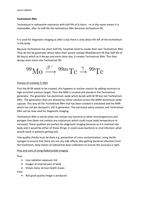
They do this by generator which takes their parent isotope Molybdenum 99 (has half-life of
66 hours) which as it decays and emits beta rays, it creates Technetium 99m. This then
decays even more into Technetium 99.
Process of creating Tc 99m
First the M 99 needs to be created; this happens in nuclear reactor by adding neutrons to
high enriched uranium target. Then the M99 is created and placed in the Technetium
generator. The generator has aluminium oxide which bonds with M 99 but not Technetium
99m. The generators then are drained by saline solution across the M99/ aluminium oxide
capsule. This way all the Technetium 99m that has been created is extracted and the M99
which has not yet decayed is still in generator. The extracted saline solution and Technetium
99m can be now used for diagnostic imaging.
Technetium 99m is sterile (does not contain any bacteria or other microorganisms) and
pyrogen free (does not contain any substances which could cause body temperature to
increase). These qualities are perfect for diagnostic imaging because as it is inserted into
body and it would be either of those things, it could cause bacterial or viral infection; what
would result in patients getting sick.
Few quality checks must be done e.g. prevention of cross-contamination, using sterile
syringes to ensure that there are not any side effects (like getting bacterial infection) from
the treatment; daily checks of radioactive dose calibrators to ensure the accuracy is right.
Pros and cons of using Radionuclide imaging
Pros
Low radiation exposure risk
Images of internal part of body
Shows many serious health issues
Cons
Not good quality image is produced


